
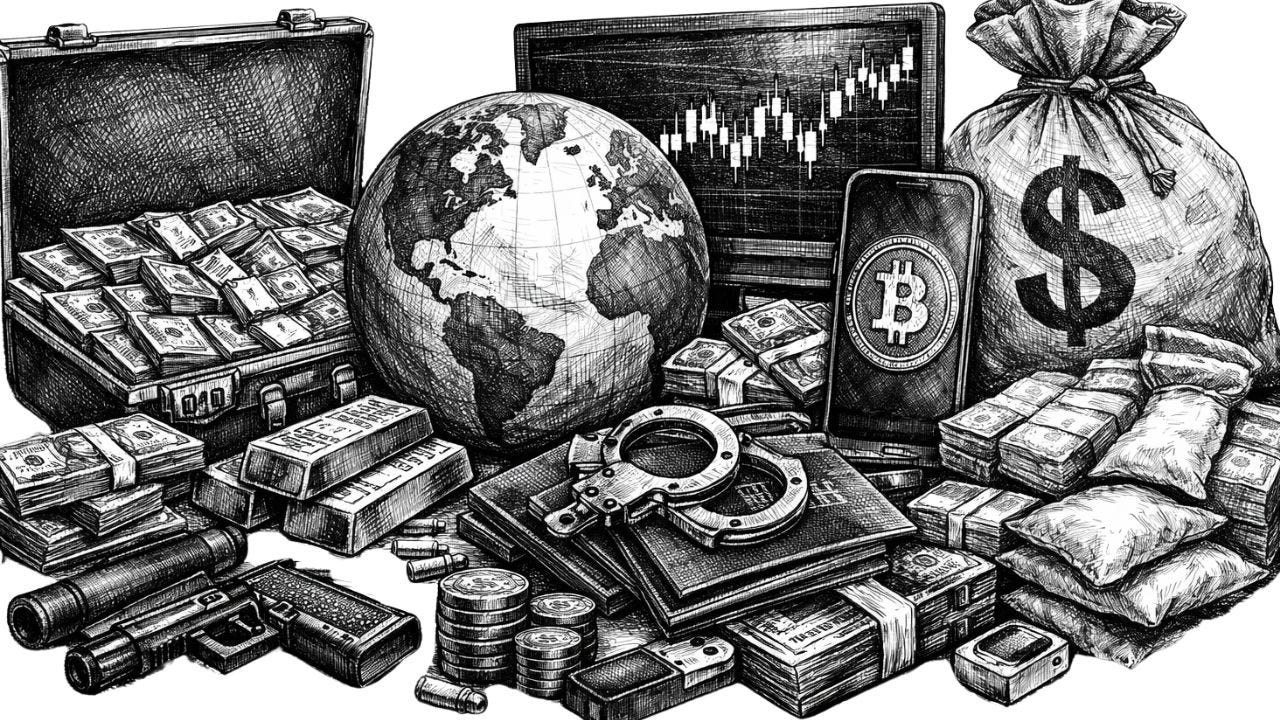
Over the last four decades, the global financial system did not simply modernize. It split. One side remained visible, regulated, and publicly accountable. The other expanded outside the guardrails, faster than laws, oversight, and public understanding could keep up. Today, that parallel system is not marginal or experimental. It is dominant and as a lawyer, this concerns me. It should concern you too.
In the early 1980s, financial activity operating outside traditional banks was measured in the low single digit trillions of dollars. Estimates placed shadow banking and closely related non bank activity at roughly 2 trillion dollars. Today, even conservative measures show tens of trillions of dollars moving through shadow banking channels. Broader regulatory data reveals a far larger reality. Global regulators report that non bank financial institutions held approximately 218 trillion dollars in assets in 2022. By 2024, that number reached roughly 257 trillion dollars. Two hundred fifty seven trillion dollars operating largely beyond traditional banking rules. That single figure exceeds the combined annual GDP of every country on Earth.
As non bank finance grew, illicit financial flows scaled alongside it. In the late twentieth century, global illicit flows were estimated in the hundreds of billions of dollars per year. Today, international institutions consistently estimate that between two and five percent of global GDP is laundered annually. At current scale, that equals roughly 1.6 trillion to as much as 4 trillion dollars moving through criminal, corrupt, or covert channels every year.
This entire topic was put on my radar over the weekend by global systems architect and strategist, Geneviéve Walker. Please make sure to connect with her on LinkedIn.
Human trafficking provides one of the clearest examples. The International Labour Organization estimated that forced labor generates at least 150 billion dollars annually in illegal profits. More recent assessments place that figure closer to 236 billion dollars. This growth reflects industrial scale exploitation sustained by financial systems designed to hide, move, and recycle enormous volumes of money.
Illicit drug markets show the same pattern. Global revenues are routinely estimated in the hundreds of billions of dollars each year, with many analyses placing totals near or above 500 billion dollars annually. Illicit weapons markets, while smaller in absolute terms, have more than tripled over recent decades, amplifying violence and instability far beyond their monetary size.
Criminal networks do not operate outside finance. They operate through it. They depend on shell companies, trade based money laundering, lightly supervised intermediaries, offshore secrecy jurisdictions, and increasingly, private credit and digital payment systems. The same opacity that allows legitimate actors to move capital efficiently allows criminals to move invisibly.
Crypto did not create financial crime. But it reshaped the operating environment. From essentially zero in 2010, the global crypto market grew to a peak market capitalization of roughly 3 trillion dollars in 2021. Even after repeated crashes, bankruptcies, and enforcement actions, crypto markets continue to fluctuate in the trillions.
Illicit crypto activity represents a minority of total transactions, but the base is so large that even a small percentage translates into enormous sums. Law enforcement agencies and blockchain analysis firms consistently document tens of billions of dollars per year tied to ransomware payments, darknet drug markets, pig butchering fraud schemes (sophisticated, long-con financial scam designed to extract large sums of money from victims over time, not in a single hit), sanctions evasion, and cross border laundering.
The design features matter. Pseudonymity reduces identity friction. Rapid cross border settlement collapses jurisdictional barriers. Irreversible transactions limit recovery. Self custody removes intermediaries that would otherwise impose compliance checks. Each feature has legitimate uses. At scale, together, they weaken preventive enforcement.
Stablecoins add another layer. Dollar pegged tokens now move billions of dollars daily across borders, often outside the banking system and under inconsistent oversight. Functionally, they act as private money substitutes. When private money circulates at scale without uniform regulation, the line between payments, shadow banking, and monetary policy begins to blur.
My go to expert on cryptocurrency related business and legal news is Molly White. Connect with Molly here.
Financial regulators, central banks, law enforcement agencies, and security institutions are issuing increasingly blunt warnings. They are not focused solely on volatility. They are warning about systemic fragility, criminal capture, and democratic erosion. When hundreds of trillions of dollars operate beyond effective oversight, enforcement becomes selective, policy becomes vulnerable, and accountability becomes negotiable.
Weakening regulatory capacity, underfunding enforcement, attacking independent oversight, or framing transparency as anti innovation does not create freedom. In a system already saturated with opaque capital, those choices accelerate risk. They reward the most aggressive actors. They magnify the size and speed of future crises.
The uncomfortable truth is that this system benefited powerful interests for a long time. Complexity protected profits. Distance concealed human cost. Victims remained invisible while money flowed freely.
But complexity does not eliminate consequences. It delays them.
And delay is exactly what this parallel financial system, now reinforced by non bank finance and digital assets, has learned to exploit.
Be aware. Be careful.
Mitch Jackson, Esq.
Thanks for reading Uncensored Objection. This work exists because you deserve substance, not spin. If you value straight talk, accountability, and a community that does not flinch, upgrading to premium keeps this conversation sharp, independent, and moving forward.