

I often refer to photography as a blend of art and science. However, our cameras’ lack of adherence to scientific principles can lead to confusion. Both our photographer ancestors and the camera manufacturers are to blame.
If you work with more than one brand of camera or want to move from one make of camera to another, you enter a mess of contradictory and sometimes misleading jargon. There is no standardization. Here are some of the anomalous terminologies and inconsistencies you will encounter, along with thoughts on how the various brands could improve.
I Tried to Tackle This, But a Pandemic Got in the Way
Just before the COVID-19 pandemic hit, I was in conversation with the British Standards Institute (BSI). That is the body in the UK responsible for applying standards to industry. In the US, the equivalent body is the American National Standards Institute (ANSI). That oversees the creation, promulgation, and use of thousands of norms and guidelines in the U.S. Both bodies are members of the International Organization for Standardization (ISO).
That’s the same ISO that your camera refers to when setting its sensitivity to light. In theory, if your camera is set to ISO 100, then if the lighting and aperture settings are equal, as well as the T-stop for the lens, the shutter speed should be the same for every other camera. (The T-stop is the term used to describe the actual amount of light transmitted through a lens to the camera sensor or film. Not all lens elements let through the same amount of light. It’s more critical in cinematography than photography because minor inconsistencies between lenses become very evident when performing a camera switch in a scene.)
All sciences rely on standardisation. That is why they use consistent, universally accepted naming systems to describe scientific concepts, organisms, chemicals, and other entities. It ensures clear communication across languages, disciplines, and countries.
For example, biology uses the binomial nomenclature first developed by Carl Linnaeus; humans are Homo sapiens, the gorillas are Gorilla gorilla, and blue jays are Cyanocitta cristata. Chemistry uses the International Union of Pure and Applied Chemistry (IUPAC) nomenclature, astronomy that of the International Astronomical Union (IAU), and physics and engineering the International System of Units (SI).

As a result, we, as consumers, can be assured that when we buy a meter of cloth, a liter of milk, or a kilogram of flour anywhere in the world, we will receive that precise measurement. But that is where photography fails. Beyond the ISO, there is little standardization. That makes it especially difficult for students learning photography, as well as photographers working in studios where they may use multiple brands of camera.
Autofocus and Its Abnormal Aliases
Take, for example, continuous autofocus. With most cameras, that is instantly recognisable as a function. Some abbreviate it to C-AF, while others use AF-C. Although my cameras use the former, having initially trained in an engineering environment, starting with the function (autofocus) and then its sub-function (continuous), makes more sense to me. But the name is descriptive of its function and easily understandable. When you half-press the shutter release button continuous autofocus refocuses as the subject moves. Measnwhile, single autofocus locks the focusing distance.
However, Canon went off-piste completely and used AI-Servo. They didn’t attempt to match their naming with other brands or try to call it something that is straightforwardly descriptive. Instead, it is confusing to a novice. One could even argue it is misleading because it doesn’t utilize what we think of as “AI”, such as machine learning or neural networks, it’s just a basic algorithm.
Likewise, most manufacturers refer to single autofocus as just that, often abbreviated to AF-S or S-AF. However, Canon calls it “One Shot,” which sounds more like a name for single-frame shooting. It’s not just Canon that does this. Other manufacturers confuse photographers by using the term “single” to refer to both single autofocus and single frame shooting.

The Stupid Average Metering Mode Names
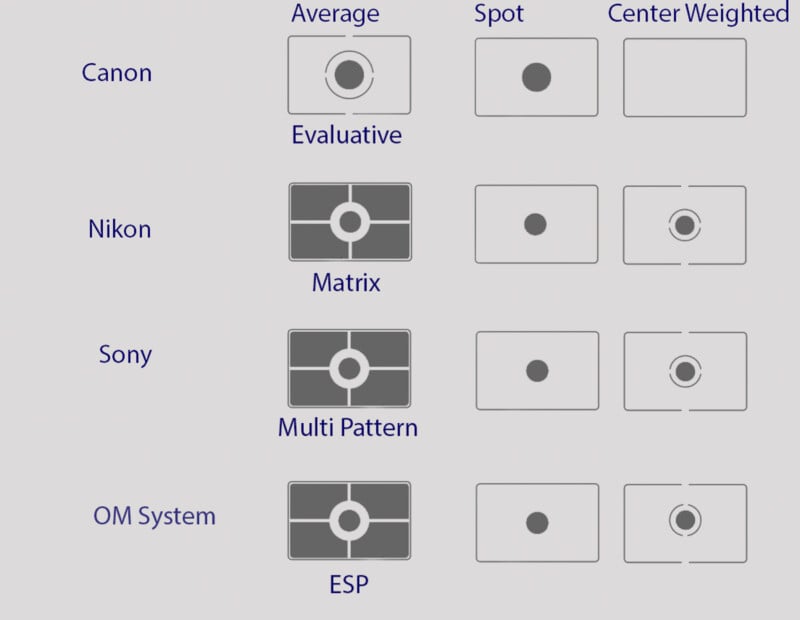
It doesn’t stop there. The standard metering mode on cameras takes an average reading of the scene’s light levels. Although the reading may be modified slightly to yield better results, “average” is an understandable and therefore reasonable description of that function.
However, Nikon calls it Matrix. Sony and Pentax refer to it as Multi-Segment Metering – Multi for short, a term also used by Fujifilm and Hasselblad. Panasonic comes close to that with Multiple Metering, and Leica refers to it as Multi-Field Metering. Meanwhile, OM System chose Electro Selective Pattern (ESP), and Canon calls it evaluative. They all do a very similar job, so why not standardize the names and make it easier for photographers by using plain English?
It doesn’t stop with those names. The icons different brands use for various functions also vary. However, the most ridiculous are again Canon’s, as you can see in this diagram I created for a workshop I ran years ago.
What’s Written on the Mode Dial?
Canon also went awry with their mode dial. While everyone else uses A for aperture priority, Canon chose Av for Aperture Value. That’s a bit daft because the value is set with the adjustment dial, not the mode dial. The mode dial just sets the way you choose to make the adjustments.
Similarly, what everyone else calls shutter priority, which they label with an S, Canon uses Tv, which stands for time value.
Furthermore, the word “value” is superfluous. When you stand on the scales, you measure your weight, not your “weight value.” Similarly, we don’t add “value” to the measurement of distance, speed, or time.
There is some consistency. All brands use the term “shutter speed” in their literature. However, that is a misnomer we inherited. Regardless of the exposure length, the mechanical shutter opens and closes at the same speed. It’s the gap between one curtain opening and the other closing that changes. So, Canon was closest with the term “time.” It’s just a shame they added the name to the incorrect dial and included the unnecessary word “value.”
Is that an Engyphoto Lens?
There are more naming inconsistencies.
It is strange that we refer to long lenses as telephoto. Why not narrow-angle lenses? After all, we call short lenses wide-angle. Or, perhaps we should name wide-angle lenses engyphoto, as the Greek-derived prefix “engy”, meaning close, is the antonym of “tele”, meaning far.
Then, there are the other camera dials. Various manufacturers refer to them as either command or adjustment dials. Meanwhile, others simply call them front and rear dials, which seems sensible.
Why Do They Do It?
While using highfalutin terminology might seem like a good way for marketing departments to impress their customers, it is often perceived as unnecessary gobbledegook by those of us who prefer straightforward language. However, it’s entirely understandable why camera companies want to be insular; it makes it difficult for their clients to swap brands. That’s why Nikon lenses don’t fit Canon, which in turn don’t fit Sony, and so on.
Nevertheless, in hospitals where cameras are used, non-standardisation between models can be problematic for medical staff who work between multiple specialist departments using different cameras. Furthermore, the big studio owners and colleges want their staff, apprentices, and students to transition easily between medium format, 35mm, APS-C, and Micro Four Thirds formats. Weird nomenclature is not going to facilitate that.
Attempts to standardize in other ways have been resisted in the past. Swapping to Adobe’s DNG raw format would have been an excellent move for camera manufacturers to make from a photographer’s perspective. Furthermore, it might have led to better consistency when developing the raw files in Adobe Camera Raw and Lightroom, as those programs handle some raw files more effectively than others. It didn’t happen.
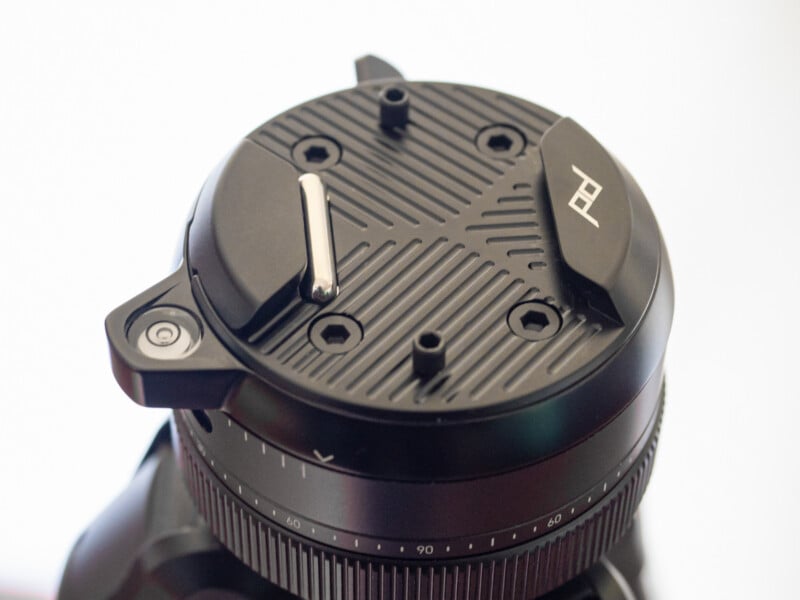
It isn’t just the camera brands that have been resistant to standardization. For a long time, Manfrotto resisted fitting Arca-compatible heads to their tripods, a feature widely used by other brands. However, they have a couple of models now that do.
Printing companies also complicate the issue; many display paper sizes in either metric or imperial units, but rarely show both. One company I found here in the UK advertises its prints in inches and its frames in centimeters.
On the other hand, one of the joys for photographers is the need for constant learning. Swapping brands, creating challenges for us to overcome, and learning new terminologies are great ways to exercise our brains.
In Conclusion
Without standardisation in some critical areas, photography will never be adequately integrated into the areas of science. It would not detract from the functionality or individuality of the cameras, but it would undoubtedly help the photographers on the ground.
Sadly, the pandemic and subsequent bereavements got in the way of me pursuing this with the BSI. I intend to try again. However, the BSI informed me that they would need at least one major camera brand on board to establish a standard. Is that likely to happen? Probably not. After all, for most photographers who traditionally shoot with a single brand, it doesn’t matter. If your brand calls single autofocus “fiddleygub”, nobody else cares so long as you know what it is called.
If you were to standardize the names of camera functions, what would you choose? Are there others that I haven’t mentioned here that would benefit from being aligned with other brands? It would be fascinating to hear your thoughts in the comments.