
According to a newly released study, scientists have discovered a free-floating planet and, for the first time, measured its mass and distance from Earth.
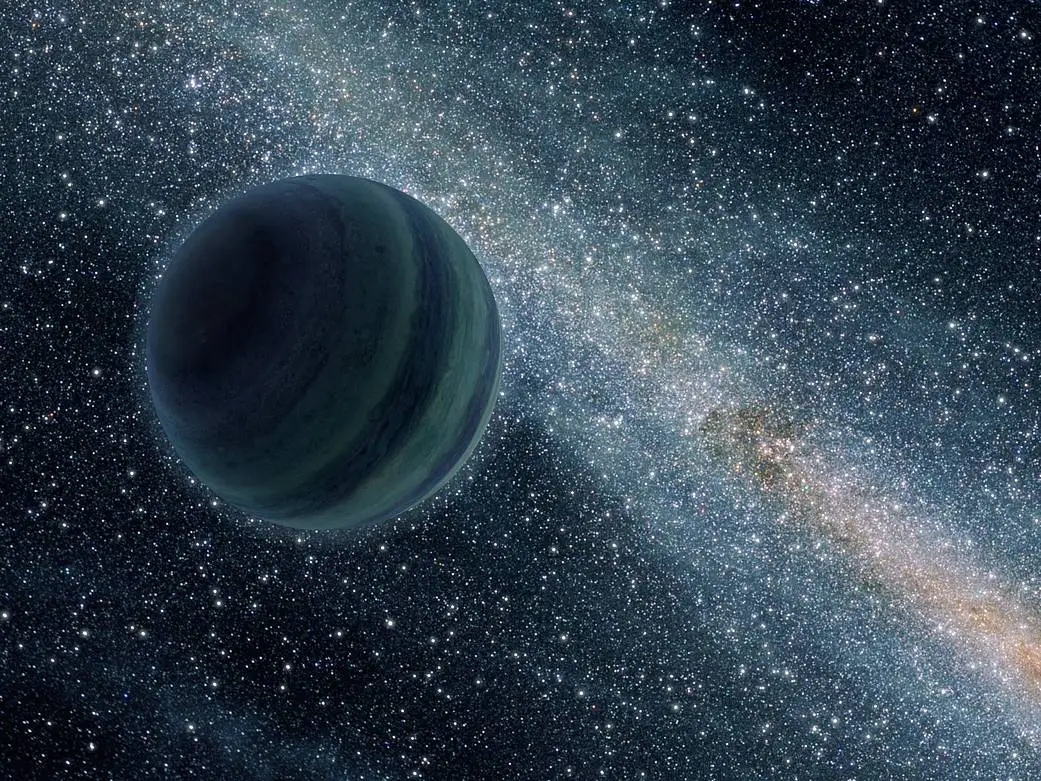
An imagined Jupiter-like rogue planet floats alone in the void of space in this artist’s illustration. Astronomers measured the mass and distance of a similar free-floating planet in a recently released study. Credit: NASA
- Rogue planets, which are free-floating and lack a host star, are detected through gravitational microlensing, where their gravity momentarily magnifies the light of a background star.
- A significant challenge in microlensing observations has been the “mass-distance degeneracy,” preventing the simultaneous determination of a rogue planet’s mass and distance from a single light curve.
- A study published in Science on January 1, 2026, reported the first successful measurement of both the mass and distance of a rogue planet (KMT-2024-BLG-0792).
- This breakthrough was achieved by observing a microlensing event concurrently from ground-based telescopes and the Gaia space telescope, enabling the calculation of microlens parallax to break the mass-distance degeneracy and determine the object’s distance (9,785 light-years) and mass (approximately 22% of Jupiter).
Most planets spend their lives orbiting a star, but some are destined for exile. According to a study published in Science on Jan. 1, 2026, astronomers have successfully measured the mass and distance of such a wanderer for the first time. Known as free-floating or rogue planets, these rogue worlds are thought to have been violently ejected from the planetary systems where they were born, causing them to drift through the galaxy.
Spotting a rogue planet
Because rogue planets don’t orbit a host star, they can’t be found using astronomers’ typical go-to methods: radial velocity or transits. (Radial velocity measures the way a star wobbles as an unseen planet orbits it, while the transit method watches for periodic dimming of a star as its planets pass in front of it.) Instead, scientists hunt down free-floating planets using gravitational microlensing. Gravitational lensing occurs when a massive foreground object bends and magnifies the light of a more distant object behind it. While strong gravitational lensing — such as that caused by massive galaxy clusters that lie between us and more distant objects — can produce dramatic, visible distortions, microlensing is far more subtle. This occurs when a smaller object, such as a planet, is the intervening object responsible for the lensing. Because the mass of a planet is relatively small, it doesn’t create a visible image of warped space that a telescope can resolve.
When a free-floating planet passes in front of a distant background star, its gravity acts like a natural magnifying glass that briefly intensifies the star’s light. The only detectable signal is a temporary spike in the star’s brightness, which lasts anywhere from a few hours to a few days. The star’s light curve (a graph of brightness over time) can thus reveal when a hidden object has temporarily bent the path of its light.
Historically, this method has had a significant limitation: Observers have been unable to measure how far away the lensing planets were. The reason is a so-called mass-distance degeneracy: Essentially, the same microlensing light curve could result from different combinations of mass and distance, leaving astronomers unsure which was correct. A given light curve could be due to a nearby small planet or a faraway large planet. And without knowing the planet’s distance, the planet’s mass also remained a mystery.
A different point of view
This barrier was broken on May 3, 2024. An event designated KMT-2024-BLG-0792 (also called OGLE-2024-BLG-0516) was captured by a global network of telescopes on Earth. The Korea Microlensing Telescope Network (KMTNet) and the Optical Gravitational Lensing Experiment (OGLE) watched from ground stations in Chile, South Africa, and Australia. Simultaneously, the Gaia space telescope caught the same flash from its orbit a at the Earth-Sun Lagrange point L2, nearly a million miles away.
By comparing the two vantage points, researchers could use a technique called parallax to constrain the planet’s distance from Earth, thus breaking the mass-distance degeneracy to determine the correct combination of mass and distance. Researchers measured the microlens parallax: the tiny shift in the timing of the microlensing event caused by the differing perspective of the two observations, taken a million miles apart. This allowed them to calculate that the object sits roughly 9,785 light-years away and has approximately 22 percent the mass of Jupiter, putting it on par with Saturn’s mass.
According to the team, the rogue planet’s mass suggests it didn’t form in isolation like a star or a brown dwarf. Instead, it was likely born in a protoplanetary disk before being cast out by violent processes. In the paper, the authors write: “We conclude that violent dynamical processes shape the demographics of planetary-mass objects, both those that remain bound to their host stars and those that are expelled to become free-floating.”
This discovery is a prelude to a new era. With the scheduled 2027 launch of the Nancy Grace Roman Space Telescope, astronomers expect to uncover even more of these lonely giants.