
Not all planets are lucky enough to live in a neighborhood like our Solar System – some are doomed to roam the cosmos alone. Astronomers have now, for the first time, measured the mass of, and distance to, one of these lonely worlds.
The planet packs about a fifth of the mass of Jupiter, and is located a little under 10,000 light-years away from Earth, towards the center of our galaxy. That size suggests it most likely formed as part of a planetary system, before being exiled by a game of gravitational billiards.
Related: Record-Smashing Rogue Planet Caught Growing at 6 Billion Tons Per Second
Being small and dim, these rogue planets can’t be directly seen. Instead, astronomers usually spot them due to their effects on distant light. As they pass between us and a bright background object, such as a star, the gravitational influence of the planet acts like a lens and briefly magnifies or warps the light.
To figure out the mass of a lensing object, you generally need to know how far away it is – and a planet flying solo provides few context clues, so it’s hard to calculate its distance.
But in this case, astronomers got lucky. The initial lensing event was spotted independently by multiple ground-based telescopes in Chile, South Africa, and Australia on 3 May 2024. It was also observed by the now-retired Gaia Space Telescope six times over a 16-hour period.
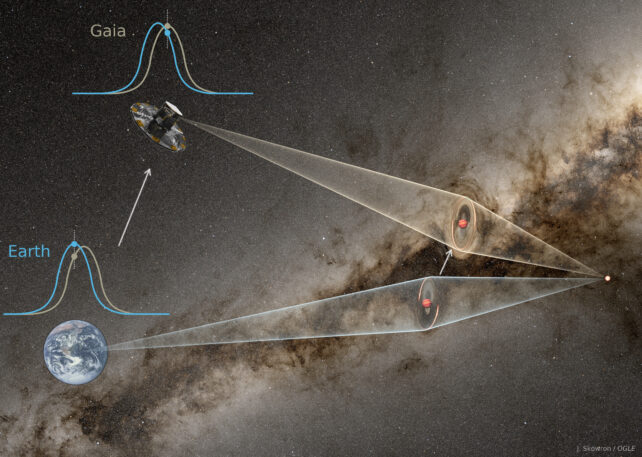
And here’s the kicker: At the time of the microlensing event, Gaia was located 1.5 million kilometers from Earth, giving it a slightly different view of the sky from the telescopes on the ground. The light from the star reaches each observer at different times.
That allowed the astronomers to estimate the distance to the lensing object – kind of like how our brains perceive distance from the slightly offset inputs we receive through two eyes – and by extension, its mass.
Related: Gaia’s Farewell Gift Is The Best Milky Way Map We’ve Ever Seen
The team calculated that the planet is located about 9,785 light-years from Earth, and has a mass of around 22 percent that of Jupiter.

In a related perspective article, astrophysicist Gavin Coleman of Queen Mary University of London suggests that the technique could prove especially useful for studying rogue planets after the Nancy Grace Roman Space Telescope launches in 2027.
“This finding demonstrates how coordinated observations can overcome difficulties in determining both the position and mass of a rogue planet and improve the understanding of how these planets form,” Coleman says.
The powerful new telescope will survey vast swaths of the sky 1,000 times faster than the Hubble Telescope, upping our chances of catching another gravitational lensing event like this one.
The research was published in the journal Science.