
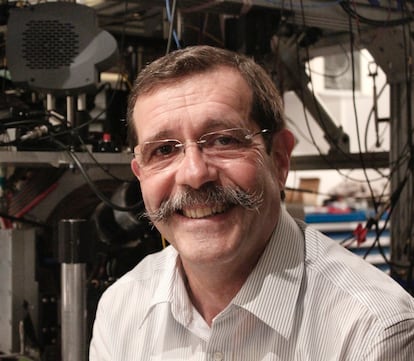
Alain Aspect, 78, learned “the real” quantum physics in Cameroon. Not at the École Normale Supérieure in Paris, but during his civil service in Africa, reading a book by Claude Cohen-Tannoudji while teaching physics. That work — which “revolutionized the teaching of quantum physics,” he explains — changed his life. Decades later, Aspect experimentally demonstrated something that most physicists considered science fiction: quantum entanglement, the phenomenon Albert Einstein called “spooky action” and that few believed in.
It is so counterintuitive that even today it is hard to grasp: two particles are connected in a way that classical physics cannot explain, and what happens to one instantaneously affects the other, even when they are separated by miles. Aspect’s experiments in 1982 settled a half-century-long debate between two of the most important physicists in history, Albert Einstein and Niels Bohr, and opened the door to the second quantum revolution — computers, cryptography, and technologies that today generate billions of dollars.
On October 4, 2022, the Royal Swedish Academy of Sciences awarded Aspect the Nobel Prize in Physics alongside John Clauser and Anton Zeilinger for “pioneering quantum information science.” Aspect, born in Agen, France, has just published Si Einstein avait su (If Einstein Had Known), a historical journey through the fascinating debate in quantum physics from Max Planck to the 2022 Nobel Prize for Physics, including the disputes between Einstein and Bohr and the “important” work of John Stewart Bell in the 1960s.
In this conversation with EL PAÍS via videoconference, which takes place a few days after Aspect returned from Stockholm following the Nobel celebrations, he talks about physics and physicists, the genius of Albert Einstein, the limits of quantum technology — and his new hobby: magic. “It’s like physics,” he explains. “I do something that is really unbelievable, but there is an explanation for it.”
Question. The title of your book is provocative: If Einstein Had Known. What would have changed in 20th-century physics if Einstein had lived to see your 1982 experiments?
Answer. Nothing would have changed in the world. But it would have been interesting to know Einstein’s reaction; he was so smart that he would have had to acknowledge the results and react. So I try to imagine how he would have reacted.
Q. And how would he have reacted?
A. I think he would have realized that he had to abandon [one of his positions]: realism or locality [either particles have no defined properties until we observe them, or there are instantaneous connections between them regardless of distance]. And I think he was so committed to realism that he would have kept realism and abandoned locality.
Q. You say that Bohr wins from a certain point of view, but Einstein detected “something extraordinary.” Can you explain in what sense they were both right?
A. It’s interesting from the historical point of view that there were two debates. Einstein was wrong in 1927, at the Solvay meeting. But in 1935, as you say, Bohr’s point of view can be defended. It all depends on your epistemological position regarding what is physical reality. If you take Bohr’s view that the physical reality of an object cannot be defined without saying how you observe that reality, then you are convinced by Bohr. But if you agree with Einstein’s point of view, that physical reality is intrinsic to the object, you don’t need to define how you observe it. Thirty years later, John Bell showed that if you take Einstein’s viewpoint seriously, you have a contradiction with quantum physics.
Q. In 1982 you experimentally demonstrated quantum entanglement, but you say that many physicists weren’t interested in it. Why?
A. Physicists had heard that there had been a debate between Einstein and Bohr and thought it had been settled with Bohr being right. Even someone like Richard Feynman, one of the greatest physicists of the second half of the 20th century, ended up acknowledging: “Oops, maybe I underestimated entanglement.” And then they began with the first ideas about quantum computing.
Q. You spent eight years working on your experiments. What was it like when you finally got the results?
A. We had prepared for this for a long time. Every detail and every little point had to be solved before we did the final experiment. And once everything was in place, it worked, and I got a result, I thought, “Wow, I did it.”
Q. Did you realize then that your discovery would be recognized with a Nobel Prize?
A. No, no, absolutely not. When I stopped thinking about it and stopped accepting invitations on the subject, I switched to something else. When I started, in 1974, everyone told me that what I was doing was of no interest whatsoever. Then I did my experiment, and they were saying, “Oh, that’s very interesting; you finally settled the Bohr-Einstein debate.” Well, I settled the Bohr-Einstein debate, period. I had no idea that it could be useful for something. The first hint that it could be came around 1990, when Arthur Ekert, a young student, came to me and said, “Did you know that you can do quantum cryptography with entangled photons?” I said, “Wow.” But up until that point, for me, it was finished. I had settled the Bohr-Einstein debate, and that was it. I absolutely never envisioned that it could lead me to the Nobel Prize.
Q. You mention Richard Feynman. Did you ever meet him?
A. Yes. In 1984, I gave a talk at Caltech, and Feynman was sitting in the front row. There were people in the room expecting Feynman to attack me [laughs]. And no, not at all. He was extremely friendly. Because at that time, he had understood that entanglement was interesting. He made extremely positive comments. He took me to his office, we talked for an hour, and then he sent me a letter. I still have it.
Q. Spanish physicist Juan Ignacio Cirac, who wrote the foreword to the Spanish edition of your book, spoke with EL PAÍS a few days ago and argued there is a bubble in quantum computing. Do you agree?
A. Yes, there’s too much hype. That doesn’t mean it’s not interesting. But the problem is the press releases from companies and universities. Scientists are usually reasonable. But the communications teams exaggerate.
Q. What will a quantum computer be able to do that a classical computer will never be able to do?
A. It’s very difficult to say. I’m sure there are some applications that will be used. For example, quantum cryptography. We also have quantum computers that are producing some interesting initial results, but we’re not yet at a stage where we can say, “It’s a totally new world.” Will they change society? I have no idea. But I’m deeply convinced that we’ll have an answer in the coming years. I hope so, because I’m not such a young man, and I’d like to see it.
Q. Cirac mentions in the prologue of your book that you are also a magician…
A. Oh, well, this is just for fun. But in a sense, it is like physics. I do something that is really unbelievable, but there is an explanation for it. It’s the same in physics. There’s something in nature that’s incredible, but there’s an explanation. And I can push the comparison a little further. In natural physics, the people who have access to the explanation are experts, people who already know the theory and everything. The general public doesn’t really have access to the explanation. It’s the same with magicians. That’s why I like it. It’s fun.
Q. What is your opinion on the problem in some countries, such as the United States, that are facing major attacks on science from different pressure groups and politicians?
A. It’s terrible. But my point of view when I give talks is that if some people think the Earth is flat, that’s fine, they’re allowed to have that opinion. But they’re not the ones I’m interested in; I can’t convince them. And then there are the people who love science and are happy to come to my talk because it reinforces their pleasure. And in between are all the people who sometimes may hesitate. They are the ones I try to keep on the right side. They’re the ones I make the effort for.
Q. After settling one of the biggest debates in physics, and winning a Nobel Prize, are there still unanswered questions that keep you up at night?
A. Yes, yes, of course. My biggest question is how big an object can be and still be quantum. There are quantum computers with thousands of qubits now. But can we have millions? Can we have billions and still control for errors? I joke about this. If at some point we discover that we can’t have a quantum computer that size, I’ll be very happy because I’m a physicist and we’ll have learned something. And if there’s no limit, if we can build a quantum computer, I’ll be happy too because I’m a co-founder of a quantum computing startup [Pascal]. So in both options I win. I’m an optimist.
Sign up for our weekly newsletter to get more English-language news coverage from EL PAÍS USA Edition