
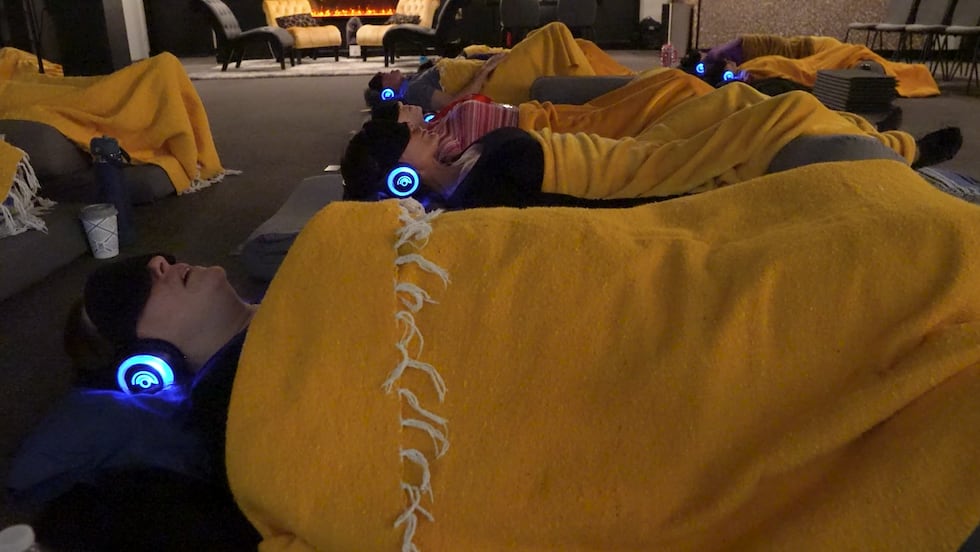
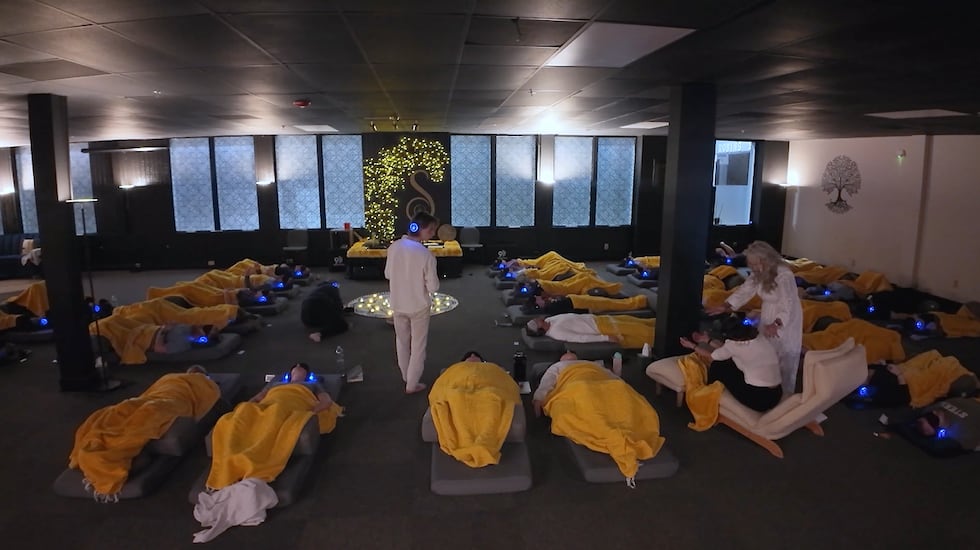
LENEXA, Kan (KCTV) – On a Saturday night in Lenexa, about 50 people lie on the floor, eyes closed, breathing in a sustained, conscious rhythm. There are no drugs or alcohol. The release they are chasing comes from their own breath. The experience is called 9D Breathwork.
What is 9D breathwork?
Colette Wilson is one of roughly 90 certified 9D facilitators in the world and just the third to be certified globally when the practice launched.
“I knew even before 9D was a true entity that I was going to be involved with it,” Wilson said. “So I was there from the very, very inception.”
Wilson describes 9D Breathwork as a layered experience that goes beyond traditional breathing exercises.
“It’s bringing science and modern technology with the ancient wisdom of the breath and bringing them together for these amazing experiences,” she said.
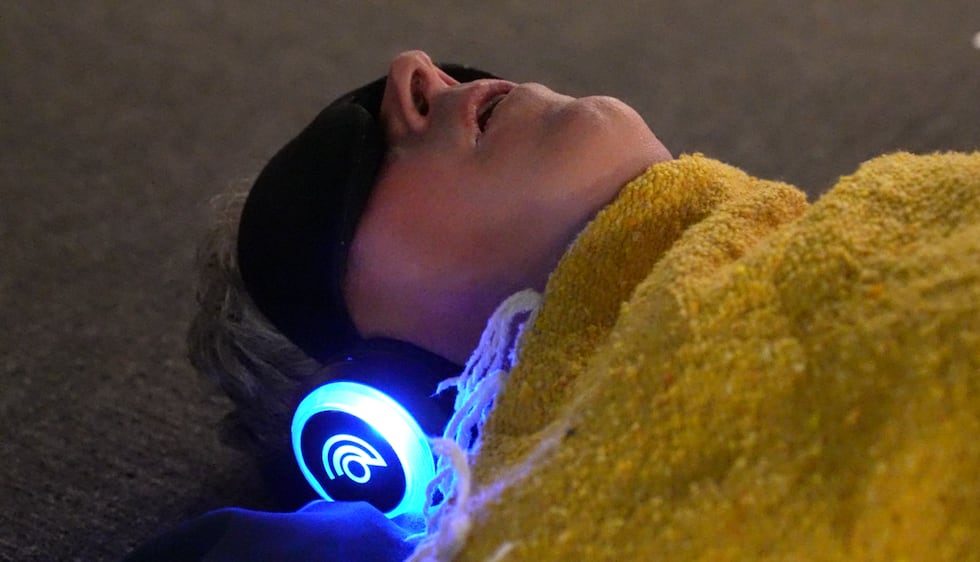
The “9D” refers to nine distinct layers of engineered audio — including binaural beats, solfeggio frequencies, isochronic tones, multi-directional sound, neuro-linguistic programming, and subliminal messaging — combined with sustained conscious breathing for 45 minutes to an hour.
“When we consciously start to breathe, we change the physiology of our blood, we actually start to create new neural pathways in the brain,” Wilson said. “We have so much neuroscience behind what’s going on with breathwork that it’s no longer woo-woo — it’s actually woo-true.”
The goal, Wilson said, is to shift the nervous system into a state where the body can release stored trauma.
“And what begins to shift is the nervous system,” she said. “The nervous system finally begins to feel safe.”
What the science says
UCLA neuroscientist Dr. Jack Feldman has studied the relationship between breathing and the brain for decades. He said the effects of breathwork on emotional state are well-documented.
“It’s being used to treat people with clinically diagnosed anxiety, depression, panic disorder,” Feldman said. “So, it goes beyond sort of the woo-woo aspects.”
Feldman used an analogy to explain how breathwork can interrupt patterns associated with depression and anxiety.
“Imagine you’re walking on dirt and you’re walking around in a circle,” he said. “If you keep walking enough, you’re going to start to create a little bit of a ditch. And the ditch will get deeper and deeper and deeper. That you might say is analogous to what happens to people who have severe cases of depression, anxiety — that have this set of neurons that are strongly connected to each other. And the activity keeps reverberating around that circuit.”
Feldman said those circuits can be disrupted just by changing your breathing pattern.
He said different types of breathwork pull different levers in the brain and body. Slow breathing, such as box breathing — used by Navy SEALs — reduces breathing from a typical 12 to 15 breaths per minute down to around four to six, which Feldman said can measurably affect emotional state over time.
Rapid breathing techniques, such as holotropic or Wim Hof-style breathing, work differently — shifting the balance of oxygen and carbon dioxide in the blood, which affects the acid-base balance of every cell in the body, including the brain.
“When you slow breathe, your carbon dioxide levels may go up a little bit. When you fast breathe, your carbon dioxide levels may go down,” Feldman said. “And that in and of itself can have effects besides any other mechanical aspects.”
He said a recent meta-analysis found that as little as five minutes a day of slow breathing — reducing from 15 breaths per minute to six — produced measurable changes in physiological and mental variables related to emotional state after one month.
On whether adding sound to breathwork, as 9D does, can amplify results, Feldman said the science of brain oscillations supports the concept.
“If you have more involved forms of breathwork, and in fact you begin to incorporate other aspects into it, like sound, that can have all sorts of amplifying effects,” he said.
He added that the right auditory frequency can influence how widespread parts of the brain process information, potentially producing positive effects on emotional and cognitive function. However, Feldman said the data on 9D Breathwork specifically is still limited.
“So, you know, scientists have to be skeptical. Not cynical, but skeptical. Let’s see the data,” he said. “And in this case, I think individuals can say, okay, I’m going to do the experiment on myself. Give it a shot.”
A former law enforcement officer’s story
Jason Prayson came to breathwork carrying decades of unprocessed trauma — the early loss of his father, a career in law enforcement marked by multiple shootings, a surgery that left him in a coma, and 13 years on PTSD medication.
“My father passed away at three, so I had some abandonment wounds and things I needed to deal with,” Prayson said.
During his law enforcement career, an FBI agent he was paired with during hurricane relief work in Louisiana told him he needed help.
“And of course, manchismo won. I didn’t do anything with it,” Prayson said. “Ended up getting divorced a year later, and spent the next 13 years on PTSD meds. And just living life, drinking a lot.”
Prayson said the emotional weight of police work does not leave the body when a shift ends.
“Cops aren’t shaking when they’re going through that. They’re bottling that stuff up,” he said. “And it doesn’t release when you sign off at the end of the shift. It doesn’t come out of your body.”
Breathwork, Prayson said, gave him a way to navigate his emotions rather than numb them.
“Breathwork turned into my drug,” he said.
Prayson is now completing his 9D facilitator certification, with a focus on serving first responders. He said the practice has also helped repair his relationship with his daughters.
“I was a cop. I came home unregulated. I brought that trauma from the field to my family,” he said. “And they had to reap the repercussions of it. And being able to talk to them and have conscious communications now and apologize and hear them say, it’s okay, dad — there’s something powerful here.”
A personal mission
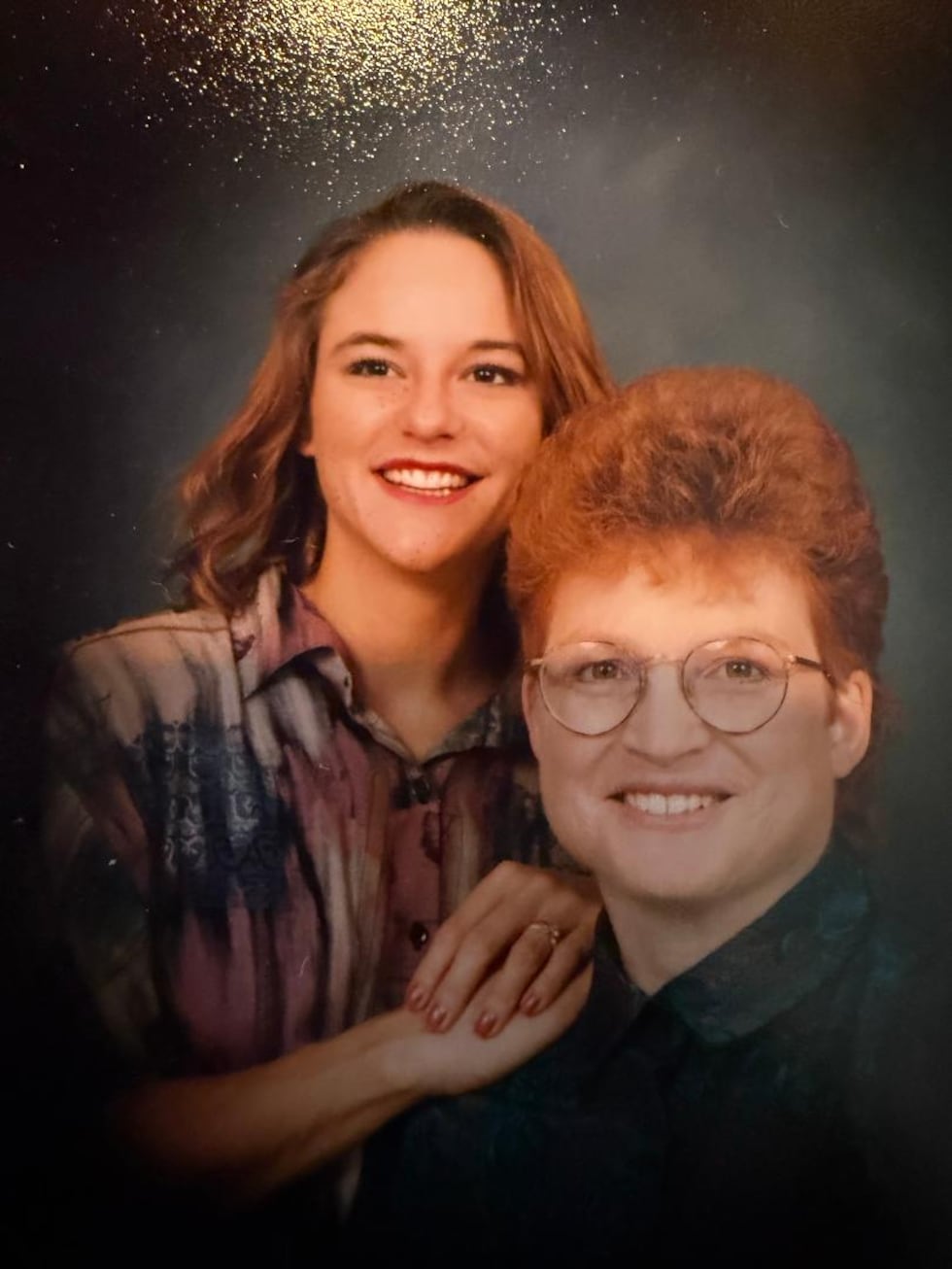
Wilson’s path to breathwork is rooted in her mother’s struggle with mental illness.
“She tried all sorts of medications, always with a counselor, therapist, inpatient treatment,” Wilson said. “And eventually it turned into chronic pain, chronic fibromyalgia, you name it. She still was constantly looking for safety and peace. And she died at 55, not finding any of that.”
Wilson turned 55 this year. She said opening StillPoint Studios in Lenexa is her gift.
“It’s my gift to Kansas City because I know this would have saved my mom’s life.”
Two months in, she said every session has sold out.
“I have this vision and this mission of Kansas City — we’re already known as the Heartland — but Kansas City actually being known as a regulated community,” Wilson said. “The ripple effect of one person having a regulated nervous system is exponential.”
For more KCTV5 Special Reports, click here.
Copyright 2026 KCTV. All rights reserved.