Growing up, I never really thought of myself as a science person. And my high school science teachers who gave me C’s in chemistry and physics probably didn’t either. For me, and undoubtedly many, to excel in science meant memorizing equations, reciting theorems, and acing tests. Yet, these modes of learning weren’t intuitive and quite frankly never reflected the way I digest, internalize, and interact with new information.

This contrast has been top of mind this year as a PhD fellow with the Bren Environmental Leadership (BEL) Program as I lead high school field trips at the Jack and Laura Dangermond Preserve (JDLP). JDLP is also where I conduct much of my own dissertation research on how coast live oak trees respond to drought stress across different environments. A year of studying the same two hillslopes has shown me that science is established less by memorized facts and more on the intuition built by repeated observation, pattern recognition, and critical reasoning.
Themes from my research feel especially prominent during BEL program field trips where coast live oak serve an entry point to ecology. Many of the high school students I meet remind me of my younger self: curious, capable, yet unsure whether they belong in science. And then I hand them an acorn.
Through an activity endearingly titled, “A Nutty Solution,” I ask students to identify living and non-living challenges that a newly planted acorn could encounter during its germination, as well as develop land-management strategies to ensure their oak acorns mature into oak seedlings.
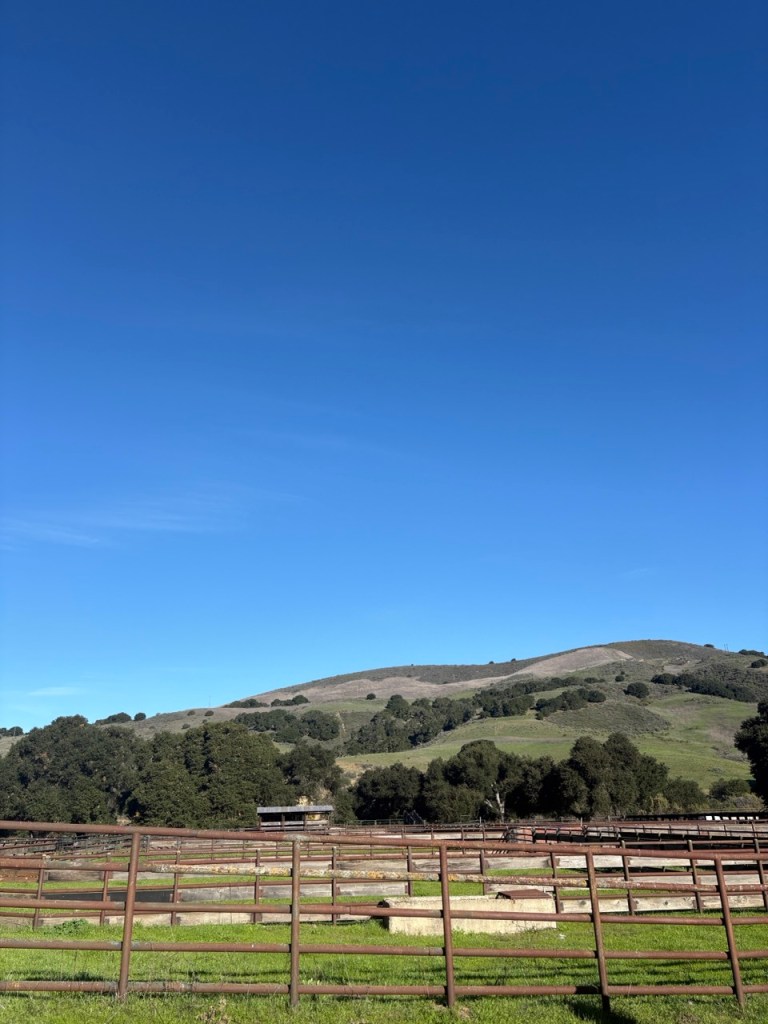
Among the many, two obstacles and their accompanying strategies stand out in particular. The first was made by a 10th grader named Oscar. While students spent a few minutes exploring their surroundings to craft strategies, Oscar was immediately drawn to the distant hills. His observation that coast live oaks generally organize themselves at the bottom of hillslopes, prompted a keen insight; “We should plant our acorn at the bottom of a hill,” he suggested. “Water flows downhill, so trees at the bottom of a slope will have more access to water than trees at the top.”
Through exploring his surroundings, Oscar moved from noticing a pattern, analyzing the spatial relationships behind it, and ultimately to interpreting what those relationships meant in context. The result was a sharp observation that built intuition on the topographic controls on water availability which is an ecohydrological principle that underpins much of my own dissertation research, and an observation that I think might not have been possible in a classroom setting.
What field-based education reveals about how students learn
Activities like A Nutty Solution, and Oscar’s subsequent insight, demonstrate how field-based education anchors science concepts to phenomena students can see, touch, and ultimately interact with. This lowers the barrier for entry by making ecological principles intuitive rather than abstract. While traditional education often hinges upon linear and text-based learning1, environmental education situates students within the system they’re trying to understand, and ultimately at the center of their own inquiry. This allows for students to gather evidence, reason, and interpret insights within a landscape, which, in my experience, mirrors the scientific process and hypothesis generation far more than any classroom exercise could.
Field context changes the kinds of questions students ask
Along the trail, I’m often excited to show students evidence of wild boar. One major sign is the muddy troughs they carve under oaks while foraging for freshly shed acorns. It’s both emblematic of oaks as a keystone species, while also providing a great reference point for A Nutty Solution.
In another round of the activity, a group of students quickly flagged wild boar herbivory as an additional barrier to oak seedling maturation. What struck me most wasn’t the idea itself, but rather the variety of follow-up questions that followed:
“How does a boar know where an acorn is planted?”
“If boars eat too many acorns, how do oak forests survive?”
“How would removing boars change the ecosystem?”
These kinds of questions were qualitatively different from the kinds I’ve heard in classroom visits, shifting away from focusing on the what, toward a deeper interest in the how. It appeared that, when students were standing in front of real rooting pits, surrounded by oaks and with acorns underfoot, their questions embodied a different mode of thinking. The experience of being in the field allowed students to formulate more open-ended and nuanced questions that expanded past recall and into ecological reasoning.
Environmental education as a tool for accessible science
Taken together, these moments reveal how students think differently in the field and how environmental education can expand how science is processed and learned. When students work with real phenomena and within the system they are trying to understand, their cognitive process shifts, relying more on direct observations, and interpretation1. This serves as a valuable tool for making science more accessible to students who might not see themselves as “science people,” because it enables different modes of thinking (spatial, visual, tactile) that can supplement traditional classroom learning1.
At JDLP, this might look like hiking down a hillslope to compare trees located in riparian zones, identifying boar tracks among rooting pits beneath oaks, or counting how many acorns woodpeckers store in their granaries. What I love most about these experiences is that students get to have fun while also being pushed to parse through surrounding evidence and come up with explanations. What’s more, they get to engage with the very same ideas that researchers at the preserve study.
For me, this has been a useful reminder of what counts as learning and how it can occur. Additionally, it has reinforced the idea that science doesn’t hinge upon reproducing or correctness, but rather on the ability to observe surroundings, reason, and make sense of patterns in the world.
References:
- “How Can Environmental Education Be More Accessible?” Lifestyle | Sustainability Directory, 13 Sept. 2025, lifestyle.sustainability-directory.com/question/how-can-environmental-education-be-more-accessible/