
Greetings, my name is Ollie Barder. I’m from the UK and work in the game industry as both a game designer and a journalist in Tokyo. My area of expertise is mecha games, having played them for over 30 years.
This is my second column for AUTOMATON, so I thought I would cover Gundam: One Year War on the PS2 and how I think it’s one of the best Gundam games ever made.
Why the One Year War is hard to adapt into a game
Back in 2005, before Bandai and Namco merged, Namco made a Gundam game for the PS2. Under the banner of Project Pegasus, the team behind the game managed to make something genuinely special.
Obviously, over the years, there have been numerous Gundam games, some great, some good, and some truly awful. The main issue is that, unlike other mecha anime, the rules that govern mobile suit combat in the original Universal Century timeline were somewhat flexible.
This was entirely intentional, as when I interviewed Yoshiyuki Tomino about making Gundam, the creation of Minovsky Particles was purely so that mobile suits would have to fight each other in close quarters. This, he explained, was to make the combat look more dramatic. So the emphasis from the start was on drama, rather than any kind of functional coherence.
As a result, this has put various Gundam games in a difficult bind; how do you recreate something functionally that already isn’t internally coherent? The answer, in the better Gundam games at least, is to create your own ruleset that mimics part of the anime but not all of it.
There have been various implementations of this approach, from the excellent cockpit-viewed Blue Destiny games on the Saturn and Rise from the Ashes on the Dreamcast, to the more modern arena multiplayer games such as Gundam Extreme Versus.
However, trying to tackle the One Year War period specifically has birthed a broad selection of games that only really worked in one environment, and normally, that was ground combat.
Mobile Suit combat, perfected by Namco
Journey to Jaburo and the much-improved Lost War Chronicles on the PS2 managed to implement that approach well. When things moved into space, we got Encounters in Space, which split its gameplay between on-rails shooting sections and then spherical combat areas similar to Omega Boost.
In short, tackling each environment in a Gundam game during the PS2 era tended to result in a specific game for each one. This was until Namco got involved.
While there are some strange on-rails shooter sections and other oddities in this Namco-developed game, the main game itself is remarkably well implemented.
Broadly speaking, the controls adopted what we would now understand as a modern third-person shooter control scheme. With the left analogue stick handling movement, and the right analogue stick controlling where you looked.
You also had a lovely boost setup with some deft use of momentum to give the mobile suits some nice heft to them.
However, the real master stroke was the lock-on system.
The targeting had you manage two main types of threats: missiles and other enemies. The missiles were auto-tracked by your head vulcans, which was an excellent use of them, and then the manual control of the enemy targeting was given to the player.
The clever addition here was that each enemy had a gentle snap-to lock-on that would allow you to orbit them when you started boosting.
This implementation smartly hid the fact that, up until you locked onto an enemy, it felt like you were in full manual control of your mobile suit.
The other major crowning glory of this control scheme was that, unlike many other Gundam games before it, the setup worked just as well on the ground as it did in space.
Set over 28 missions and two difficulties, you also had “Memorial Actions” where the player would see special cutscenes, such as if they managed to finish Ramba Ral’s Gouf with a close combat move, replicating what happened in the anime.
Over the course of the game, you would eventually unlock mobile suits like the RX-78NT-1 from Gundam 0080, which was hugely powerful in relation to the rest of the game.
A “top-tier” experience that was only playable in Japan
All of this clever and fluid functionality aside, this game was also a very visually polished one. With beautiful graphics and visual effects, it really pushed the PS2 hardware.
For instance, fighting Lalah Sun in her Elmeth and then undergoing a Newtype vision was and still is a special moment, doubly so when the game slowed down for you to manually shoot down the Elmeth’s bits.
Back then, I remember thinking that finally someone had managed to nail mobile suit combat in a way that would work with overseas fans, but sadly, the game was only ever given a Japanese release.
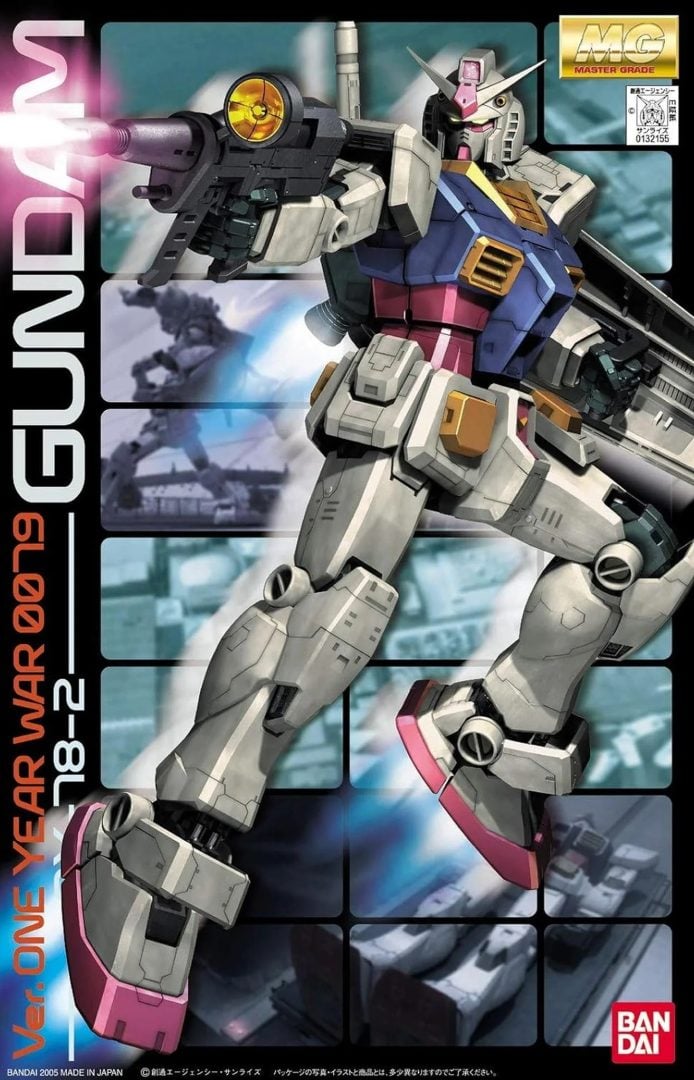
At the time, I do remember this game being somewhat of a big deal in terms of its Japanese promotion, as it received its own custom Master Grade model kit and got a fair amount of publicity for the fact that Namco was finally tackling Gundam.
A year after this game was released, Namco merged with Bandai, becoming Bandai Namco, and all of the gains that this game had made were seemingly lost to time.
Looking back, even though I imported and finished the game in its entirety, I wish I had reviewed the game and pushed it harder with my editors at the various UK game magazines I wrote for back then. However, I hope even though I am now two decades late, this review will at least remind people just how good Gundam games could be when given to a uniquely talented team of game developers.
Score: 9/10
If you are at all curious about my thoughts on the various Gundam games, then feel free to check out my reviews over on my site, Mecha Damashii, as well as the feature I did to convince people that not all Gundam games are terrible. As for more recent Gundam games, you can check out my reviews of games such as Gundam Extreme Versus Maxiboost ON for the PS4, which I still think is thoroughly superb and desperately needs a PC release.