
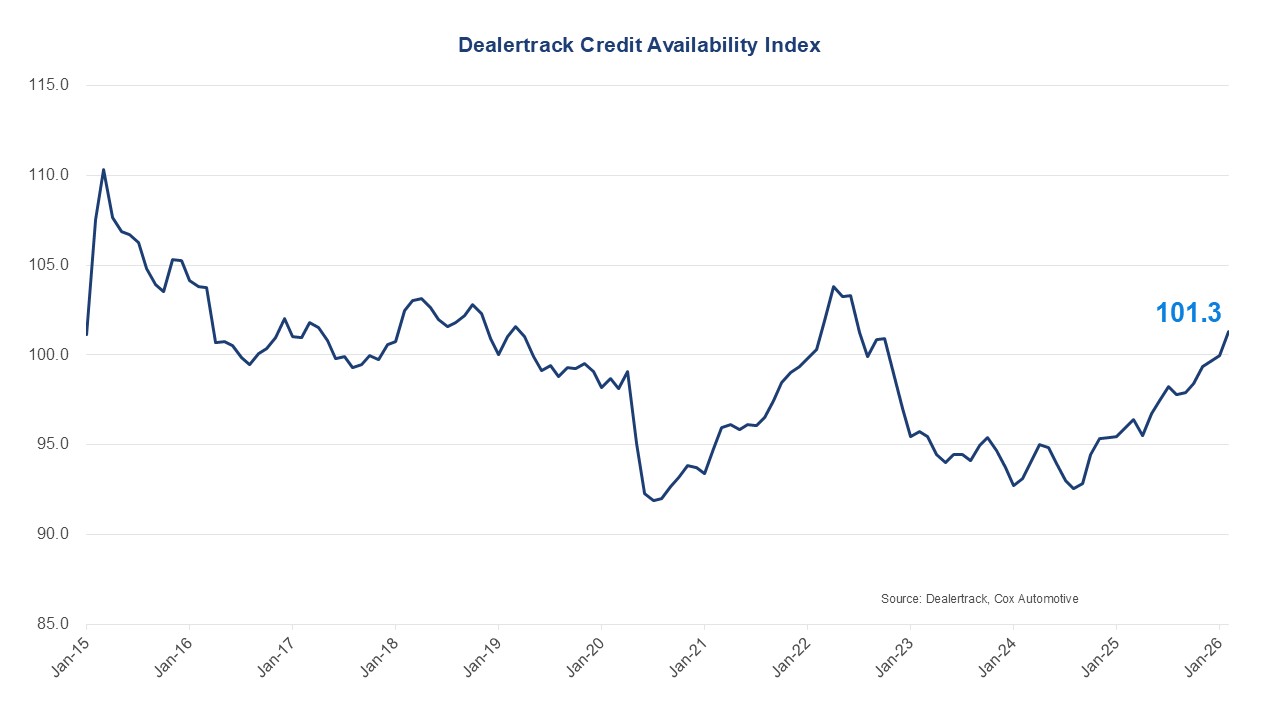
In February 2026, the Dealertrack Credit Availability Index rose to 101.3, its best reading since June 2022. The All-Loans Index increased 1.5% from January’s 99.8 and is up nearly 6% from February 2025. Even as approval rates declined and yield spreads widened, the month’s improvement was driven primarily by a surge in subprime lending.
Dealertrack Credit Availability Index
Key Metrics
- Approval Rates: The approval rate for auto loans fell to 70.9% in February, down 60 basis points (bps) from January, and down 40 bps from February 2025 (71.3%). Approval rates have now declined for two consecutive months, even as most lenders continued to expand access broadly.
- Subprime Share: The share of loans to subprime borrowers increased by 180 bps month over month (from 15.7% to 17.5%) and is up 320 bps year over year. While a January-to-February rise in subprime share is a consistent seasonal pattern, February’s reading of 17.5% came in above recent seasonal norms and reached its highest level since March 2025. This sustained expansion suggests lenders are increasingly comfortable extending credit to higher-risk borrowers.
- Yield Spread: The yield spread rose by 39 bps (from 7.14 to 7.53), while the average contract rate rose 29 bps (from 10.9% to 11.2%). The 5-year Treasury yield decreased by 10 bps (from 3.78% to 3.68%). This widening spread represents less favorable pricing for consumers and may reflect lenders charging a premium to offset the increased risk from higher subprime lending and elevated negative equity.
- Loan Term Length: The share of loans with terms greater than 72 months increased by 130 bps (from 28.0% to 29.3%) and is up 480 bps year over year, continuing a three-month increase. This may reflect ongoing affordability pressures as consumers opt for longer terms to manage monthly payments, with lenders appearing willing to accommodate these requests. This is the highest share of extended-term loans recorded in the dataset, surpassing the previous record set in July 2022.
- Negative Equity Share: The proportion of borrowers with negative equity increased by 170 bps month over month (from 56.3% to 58.0%) and is up 540 bps year over year. This significant monthly increase follows January’s surge, pushing the share to an all-time high for the second consecutive month and signaling increased risk as more borrowers carry loan balances that exceed their vehicle’s value.
- Down Payment Percentage: For the second consecutive month, the average down payment percentage increased, moving higher by 20 bps (from 13.4% to 13.6%). Despite the increase, the average down payment is down 70 bps year over year.
Channel and Lender Trends
- Channels: Credit access improved across all sales channels in February. The largest gains were in the Franchise Used segment, followed by All Used and All New. Independent Used, Non-Captive New, and CPO also saw improvement.
- Lender Types: Lender performance was mostly positive in February. Captives led the improvement again, with credit availability rising 3.9%, reflecting a strong appetite for growth and a greater willingness to extend credit. Banks and Finance Companies also showed loosening, up 0.8% and 1.4% respectively, while credit unions were down 0.3%. Overall, lenders are showing more willingness to extend credit, with captives driving the month-over-month improvement.
Year-Over-Year Comparison
Compared to February 2025, credit access was looser across all channels and lender types:
- Channels: The most notable year-over-year improvements were in franchised used and all new, indicating stronger credit availability in both the new- and used-vehicle segments. Non-Captive New saw solid improvement as well, followed by All Used, Independent Used, and CPO.
- Lender Types: Captives and Banks led the year-over-year loosening, while Finance Companies also improved. Credit unions showed a more cautious yet still positive stance on credit access compared with a year ago.
Implications for Consumers and Lenders
- Consumers: Credit access continued to broaden in February, with improvement across all channels and lender types offering financing opportunities in both new and used markets. However, the underlying picture carries increasing caution. Record negative equity, a sharply rising subprime share, widening yield spreads, and loan terms at their highest level on record all point to elevated borrowing costs and greater long-term financial risk. Consumers should carefully consider the full terms of any financing offer, particularly total loan length and overall cost.
- Lenders: Captives continued to lead the market in February, posting their strongest monthly gain in several years and pushing their index to its highest level since April 2022, reflecting an aggressive and sustained appetite to grow auto lending volume. Banks and finance companies also expanded access, while credit unions pulled back modestly. With negative equity reaching an all-time high, lenders increasing exposure in this environment face growing collateral risk, and balancing volume growth with disciplined underwriting will be increasingly important as these risk indicators continue to build.
Overall, the February Dealertrack Credit Availability Index reflected continued improvement in auto credit access, with the headline index climbing to 101.3, its best level since June 2022. Individual metrics told a more complex story, however. Subprime lending and longer loan terms signal broader access for some borrowers, and captives drove strong gains across lender types. Yet the continued decline in approval rates and a surge in negative equity to its highest level in the entire dataset point to growing risk beneath the surface. With two consecutive all-time highs in negative equity and yield spreads moving higher alongside subprime share, lenders appear willing to extend credit, but the data increasingly reflects a market where access and risk are rising together.
View historical Dealertrack Credit Availability Index reports.
The Dealertrack Credit Availability Index tracks six factors that affect auto credit access: loan approval rates, subprime share, yield spreads, loan term length, negative equity and down payments. Reported monthly, the index indicates whether access to auto credit is improving or declining. This typically means that it is cheaper and easier for consumers to obtain a loan or more expensive and harder. The index is published around the tenth of each month.