
South Korea has one of the most robust and advanced financial systems in Asia. It ranks second among ASEAN+3 economies (comprising the Association of Southeast Asian Nations [ASEAN], China, South Korea, and Japan) for traditional financial development indicators, trailing only Japan and outperforming China, Singapore, and other regional peers.
However, when assessed by its ability to mobilize financial resources toward climate goals, South Korea drops to fourth position, behind China, Japan, and Singapore. Despite its significant capital resources, South Korea has an average climate finance performance, comparable to emerging economies such as Indonesia and Thailand. This gap highlights a fundamental structural issue — the misalignment between South Korea’s institutional financial strength and the urgent regional and global imperatives of climate action.
Institutional financial strength but limited climate leadership
This gap between South Korea’s traditional financial strength and its climate finance performance is clearly illustrated by comparing two complementary indices across ASEAN+3 economies — the International Monetary Fund’s (IMF) Financial Development Index (FDI) and the Global Green Finance Development Index (GGFDI). The FDI scores countries on a 0–1 scale based on the depth, access, and efficiency of their financial institutions and markets. Meanwhile, the GGFDI grades countries on a scale of 0 to 100 for how efficiently their institutional financial systems channel capital toward climate-aligned objectives, covering 53 indicators across policy frameworks, financial products, and international cooperation.
While South Korea is a leader in traditional financial development, with well-developed capital markets, a robust banking sector, and strong financial regulation, its capacity in climate finance stands in stark contrast. The country lags behind its regional neighbors in green finance, suggesting that its well-established financial system has not translated into leadership in climate-aligned allocation. In fact, South Korea is the only advanced economy within ASEAN+3 where climate finance performance does not match with its overall level of financial development. Whereas Japan ranks highly on both indices, and China performs strongly through strategic prioritization of green finance, South Korea remains positioned in the middle of the regional rankings alongside considerably smaller economies.
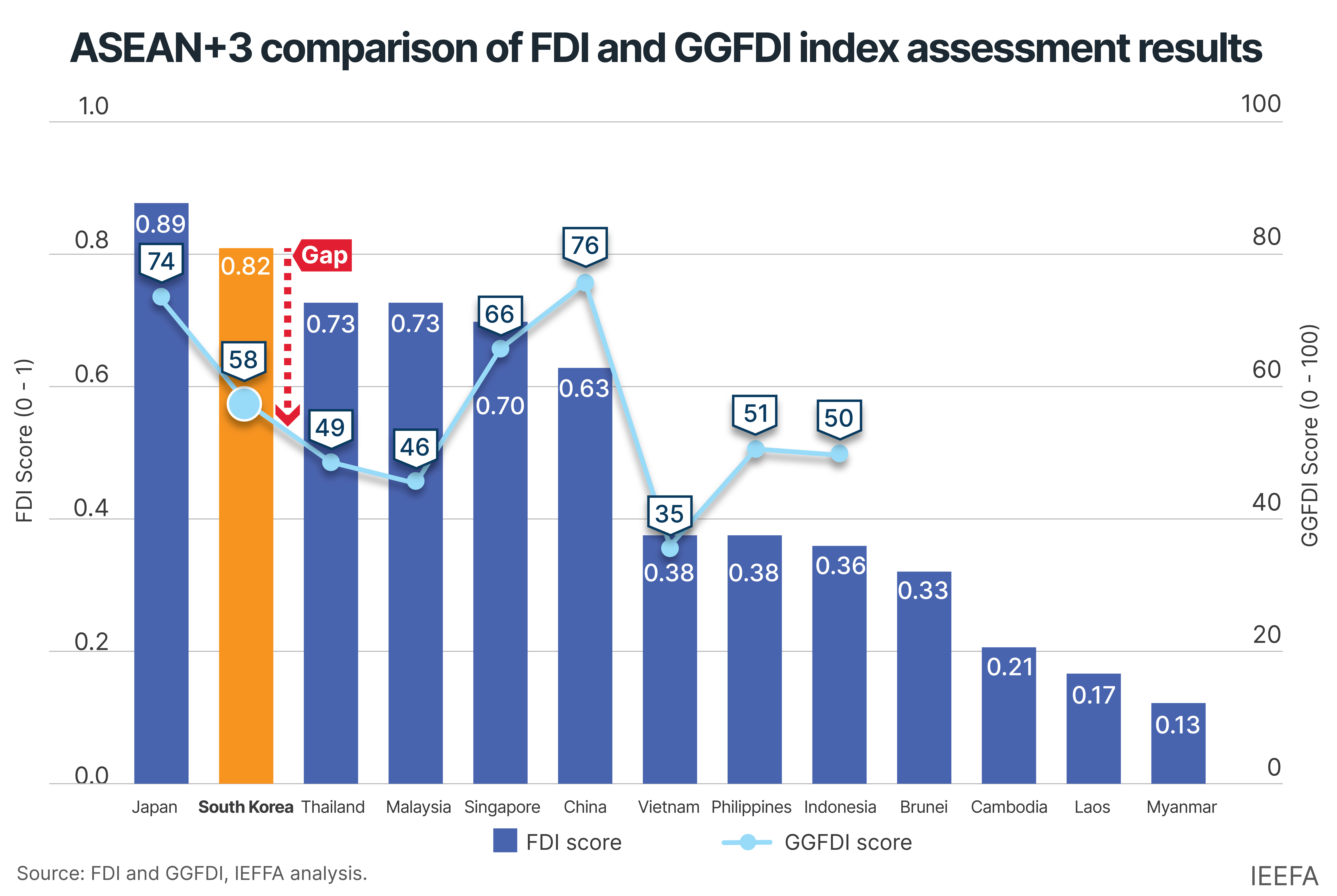
Among the developed ASEAN+3 economies, South Korea has the largest gap between its FDI ranking and its GGFDI performance.
According to the Asia Capital Markets Report 2025, cumulative sustainable bond issuance reached USD779 billion in China, USD314 billion in Japan, USD136 billion in South Korea, and USD33 billion in Singapore between 2016 and 2024. In aggregate terms, South Korea’s climate finance issuance is eclipsed by that of its regional neighbors. While China and Japan led the market by committing financial resources on a vast scale, South Korea’s cumulative volume fell short in comparison. Even Singapore, despite its considerably smaller economy, has achieved comparatively higher sustainable finance issuance.
These differences reflect contrasting institutional strategies. Japan has achieved its scale through a robust, government-led policy framework, while Singapore has leveraged its status as a financial hub to achieve strong performance relative to its economic size. By comparison, the volume of sustainable finance issued in South Korea remains modest relative to the scale and sophistication of its financial system. Its climate finance activity therefore falls short of what is expected from the region’s second-most developed financial system, suggesting it is not yet mobilizing sufficient capital to support the green transition.
Institutional evidence from green central banking performance
Additional evidence reinforces this conclusion. The 2025 East and Southeast Asia Green Central Banking Scorecard assesses how central banks integrate climate considerations into monetary policy, supervisory frameworks, and financial instruments. The assessment ranked the South Korean central bank (Bank of Korea) 8th out of 13 ASEAN+3 central banks, despite South Korea being one of the wealthiest economies in terms of per capita income. This ranking suggests that strong conventional financial infrastructure, including deep capital markets, efficient payment systems, and sophisticated banking regulations, has not generated commensurate green finance governance capacity in South Korea.
The Scorecard identifies three specific shortfalls in South Korea’s green central banking practices. First, climate risk integration in monetary and supervisory frameworks remains incomplete, with climate considerations treated as peripheral to the Bank of Korea’s core mandate. Second, climate-related guidance to financial institutions has been limited in scope and specificity, creating market uncertainty and inconsistent implementation. Third, active green finance instruments — such as preferential refinancing facilities, differentiated collateral frameworks, and macroprudential measures addressing climate-related systemic risk — remain significantly underutilized compared to regional leaders.

Despite four years of global acceleration in climate finance — including the widespread adoption of ISSB (International Sustainability Standards Board) disclosure standards, rapid growth in labeled bond markets, and the mainstreaming of climate risk into prudential supervision — South Korea’s relative position has not substantially improved. The country has made incremental progress but has not matched the pace of regional leaders who have moved more decisively to integrate these developments into core central banking functions.
Translating financial leadership into climate objectives
South Korea has a robust financial system that can lead the region’s climate transition. It has demonstrated the ability to mobilize capital rapidly when strategic priorities are clearly defined, particularly in areas such as infrastructure development, industrial policy, and crisis response. Climate finance requires the same level of institutional commitment. The central challenge is therefore not a lack of financial capacity, but the absence of clear strategic direction.
A Bank of Korea stress test published in March 2025 illustrates the economic consequences of climate change on the nation’s financial stability. It showed that even under optimistic transition scenarios, South Korea’s financial sector could face significant structural strain. Climate-related risks are projected to reduce annual Gross Domestic Product (GDP) growth by approximately 0.30%, amounting to tens of billions of dollars in potential losses. Under scenarios involving delayed policy action or insufficient mitigation efforts, these pressures are expected to intensify, threatening the stability of capital flows and asset valuations.
These findings represent quantifiable exposures that the financial system is currently under-equipped to manage or mitigate. Yet the results of the stress test have not been fully leveraged to accelerate financial flows toward climate risk mitigation and green investment.
To strengthen South Korea’s climate finance capacity, four structural policy measures should be considered:
1. Public financial institutions should pivot from passive lending toward a proactive, market-shaping role.
The Bank of Korea and other South Korean policy banks have the capacity to de-risk climate investments, establish robust market standards, and demonstrate that transition projects are viable at scale, thereby “crowding in” private capital. As research by the Institute for Energy Economics and Financial Analysis (IEEFA) on Asian sustainable bond markets indicates, limited public sector involvement has historically constrained market depth across the region. In advanced markets, by contrast, sovereign and government-related issuances have played a decisive catalytic role in establishing market credibility and depth.
2. Climate finance definitions should be strengthened and consistently enforced.
Compared with more robust international frameworks, South Korea’s green taxonomy (K-Taxonomy) still contains ambiguous criteria that risk classifying fossil-fuel-dependent projects as green. The taxonomy currently functions as a voluntary guideline rather than as a binding market-shaping instrument. Strengthening these definitions and enforcement mechanisms is essential to prevent greenwashing and to ensure that capital is directed toward genuine decarbonization rather than prolonging the lifespan of carbon-intensive assets.
3. The focus should shift from measuring commitments to tracking climate outcomes.
Current reporting frameworks frequently stop at the point of financial issuance, leaving a significant data vacuum regarding actual emission reductions or adaptation impact. Robust data systems, regular reporting requirements, and accountability mechanisms are needed to ensure that green-labeled finance is used for its intended purposes. An IEEFA report on adaptation finance in Southeast Asia found that the persistent gap between stated commitments and actual capital flows stems largely from the absence of practical, interoperable outcome indicators.
4. The Bank of Korea should integrate transition climate risk assessments into routine banking supervision and macroprudential policy oversight.
Although the Bank of Korea has recently begun conducting climate stress tests, these exercises should evolve into a permanent component of banking supervision and macroprudential policy. Aligning supervisory practices with international frameworks, such as the Network for Greening the Financial System (NGFS) and the Task Force on Climate-related Financial Disclosures (TCFD), will ensure that climate-related financial stability is monitored with the same rigor as inflation and liquidity risks.
When policy signals remain uncertain, financial institutions hesitate to commit capital at scale. Addressing this hesitation requires more than financial capital alone; it requires clear regulatory direction and strong institutional leadership. By implementing these structural reforms, South Korea can close the gap between its financial capability and climate finance delivery and position itself as a regional leader in financing the energy transition.