
Geologist Michael Jordan is a double alumnus of NC State. He earned his bachelor’s degree in geology in 2000, then continued on with the Wolfpack through 2003, when he earned his master’s degree in hydrogeology.
Now, Jordan serves as the senior vice president of operations for the Southeast division of Terracon. Terracon is an employee-owned environmental consulting firm that works with clients to mitigate their risk and ensure compliance with environmental regulations.
In his role, Jordan is responsible for the safety and growth of 19 offices and more than 1,000 people. He leads and executes business operations, meeting with both employees and clients to ensure all needs are being met.
Jordan’s day-to-day responsibilities vary widely — an aspect of his job Jordan said he enjoys. He often travels to meet with Terracon employees both in the office and out in the field. He works to build relationships with them, address ongoing challenges and find ways for different offices in his division to work together. Working with people and seeing them grow in their careers is his favorite part of his job, Jordan said.
Jordan also contributes to corporate discussions focused on finances and vision strategy to grow the business. When Jordan’s not meeting with Terracon’s internal team, he meets with the clients who the business serves, such as regulators with the North Carolina Department of Environmental Quality. Jordan works to understand a client’s needs and goals, plus what kind of solutions may fit a given budget.
While Jordan has been in his senior-level role for three years, he’s worked at Terracon since 2013. Over the past decade, he has contributed to numerous projects, several of which have been aimed at remediating contaminated soil or groundwater.
One particularly rewarding project, Jordan said, involved taking a polluted site in Illinois and restoring it for better use for the local community. The site was a former foundry whose soil was contaminated with polycyclic aromatic hydrocarbons — a group of chemicals that can, in some cases, contribute to diseases like cancer and asthma. With funding from the Environmental Protection Agency’s Brownfields program, Jordan and his team planted buckwheat that removed the contaminants from the soil. Now safe, the site has been transformed into a public park.
In the Q&A below, read more about Jordan and his time in the NC State Department of Marine, Earth and Atmospheric Sciences, as well as his advice for current students:
How did MEAS help you in your career path?
MEAS really provided the foundation for me for everything that I do, from problem solving to data analysis, to developing my critical thinking skills and improving my writing skills, and learning how to work with people and teams. It provided me with what I needed to grow and be successful. I made a number of tremendous relationships with other people here, both on the faculty side and on the student side, and they have become lifelong friendships.
I was very fortunate to take a number of multidisciplinary classes. I took classes in the civil engineering department, with the soil science department and in GIS. That provided a really well-rounded foundation for the idea that different classes and disciplines really complement one another.
I worked in between undergrad and grad school for two years, so when I came back to grad school, I had a really strong focus on what it was that I wanted to study and learn about. It was a tremendous opportunity to work with Professor Dave Genereux on some long-term ongoing research that they had down in Costa Rica, which is an absolutely phenomenal field site. I collected surface water samples from some of the streams in the jungle. There were two adjacent river basins, and so we were looking at how much groundwater flowed into the one basin in comparison to the other basin.


That work applies to what I do now. It was really focused on understanding the groundwater flow dynamics. Not just groundwater flows, but everything that is dissolved in the groundwater flows along with it. That work was very foundational in understanding how groundwater movement informs how contaminants migrate, and then also how we clean them up.
What is a favorite class or memory from your time in MEAS?
I changed majors to geology after taking a class with Skip Stoddard, and he was very influential. I have fond memories of the annual taco party that he hosted at his house every year. I’d also like to shout out Dave Genereux – he was a great mentor throughout grad school.
As an undergrad, the opportunity to take field trips and be in the field really allowed you to take what you learned in the classroom and put everything together and see the big picture. I really enjoyed those opportunities and have a lot of really good memories of field trips, camping and being out in the field.
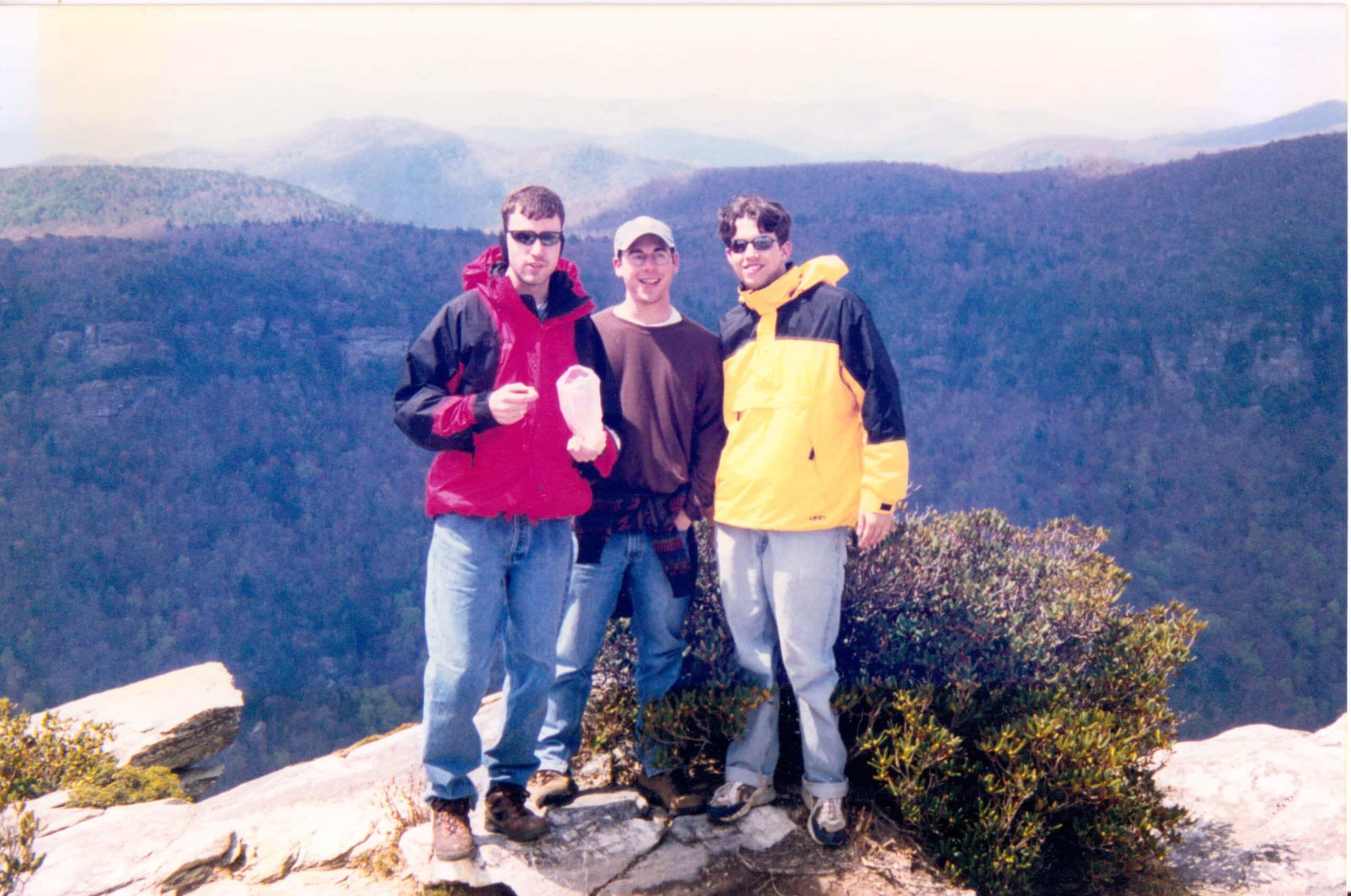
Field camp was a very impactful capstone — that culmination of all those different things coming together was a really great experience for me. The field camp I went to was in Western Ireland, so it was a fascinating opportunity. To be able to combine work with travel with geology and put all those together was pretty fun.
One of the things I was super interested in as an undergraduate, which is not where my career went, was marine geology and coastal geology, and I got to do a multi-week field camp out at the Outer Banks. We started at the Virginia Institute of Marine Science at William & Mary — it was a combination of universities, but it was offered through NC State, and we worked all the way down through the Outer Banks. It was a really neat program.
What advice do you have for students?
Be curious, ask questions and have a desire to learn. Put the work in; you’ll get back out of your career what you put into it. Pick a career that’s rewarding and brings you happiness. You spend a lot of time at work, so you should enjoy what you’re doing and who you work with, and you should feel like it brings you satisfaction.
What’s a fun fact about yourself?
I was in a TikTok that went viral with over 50 million views. A former student of my wife who is also an NC State graduate has turned social media into a full-time profession, and a TikTok she did at our house during Christmas blew up.