
Key takeaways:
- The share of Republicans and Republican-leaning independents who say the country should prioritize oil, coal and natural gas over wind and solar power has doubled to 71% over the last six years.
- Majorities of Republicans see wind and solar power as less reliable than other energy sources, and decreasing shares of Republicans say wind and solar energy is better for the environment.
- An overwhelming majority of Democrats continue to prioritize wind and solar power and say the federal government should encourage their development.
A year into the second Trump administration, Republicans continue to sour on wind and solar energy: A majority says the United States should prioritize fossil fuels like oil, coal and natural gas, a reversal of Republican views in 2020. Meanwhile, Democratic support for wind and solar power remains very high, but support is slightly lower than earlier this decade.
These findings come from a new Pew Research Center survey of 3,524 U.S. adults conducted in March 2026, a few weeks into the U.S. military conflict with Iran that has led to tumult in the energy market internationally and higher gasoline prices in the U.S. This research builds on our long-standing interest in Americans’ views on energy sources and energy policy.
Which is the bigger priority: Increasing renewable energy or fossil fuels?
With rising energy costs and increased demand, Americans are still more likely to say that renewable energy should be prioritized over fossil fuels. But that share continues to drop: 57% say this today, down from 79% in 2020.
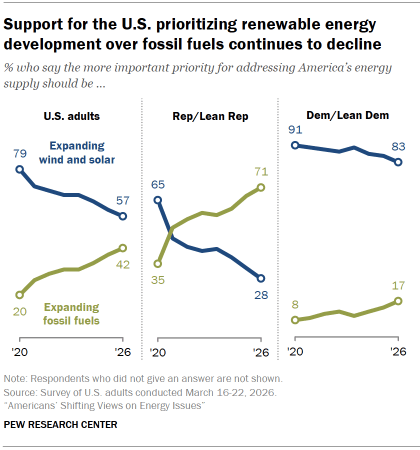
This decline has been driven mostly by Republicans sharply shifting their views on fossil fuels and renewable energy in the last six years. In 2020, a majority of Republicans and those who lean to the Republican Party said the focus should be on renewables (65%). Now, just 28% of Republicans say this, while 71% say the priority should be on fossil fuels.
About eight-in-ten Democrats and Democratic leaners (83%) say the country should give priority to developing wind and solar production, but this share has also ticked downward in the last few years.
What should be the federal government’s role on energy issues?
The Trump administration has reduced or eliminated many of the subsidies for renewable energy that started during the Biden administration. Instead, they have encouraged increased production of fossil fuels like oil, coal and natural gas. But what do Americans think the federal government should emphasize?
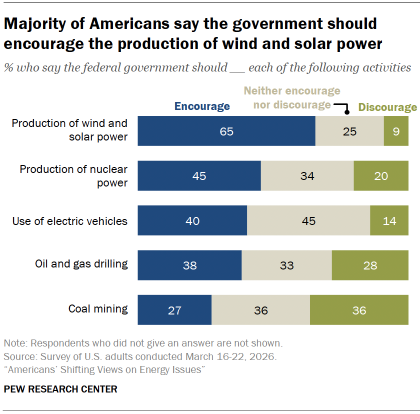
Wind and solar attract the most support, with about two-thirds (65%) calling for policies to expand production from these sources. And coal mining attracts the least support, with more saying the government should discourage (36%) this activity than encourage it (27%). Americans have more mixed views of other sources, with none attracting majority support, but also none facing large opposition.
How views have changed
For most sources, these reflect small increases in public support over the last few years.
But there has been a slight turn away from federal intervention in wind and solar. In 2022, 72% said the government should encourage this production, 7 percentage points higher than today.
In contrast, support has gone up slightly during that time for encouraging coal mining (7 percentage point increase since 2022) and oil and gas drilling (5-point increase). There has also been a small increase in support for more nuclear power.
How Republicans and Democrats differ on the federal government’s role on energy issues
As is the case with which energy source should be prioritized, Republicans and Democrats increasingly differ in views of the federal government’s role in the production of wind and solar and fossil fuel energy production. This is largely driven by shifting views among Republicans, while Democrats’ views have remained relatively stable.
Wind and solar production
Republicans have long been less supportive of wind and solar production than Democrats.
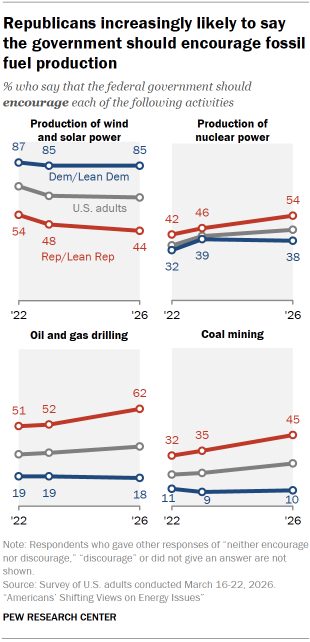
In 2022, a slim majority (54%) of Republicans supported government policies to encourage production of these renewable sources. In four years, that has dropped 10 percentage points to 44%.
This is consistent with past Center surveys, which found that the shares of Republicans who say they support more wind power and solar power both dropped by more than 20 points from 2020 to 2025.
An overwhelming majority of Democrats (85%) continue to say the federal government should encourage the production of wind and solar power.
Fossil fuel sources
The opposite pattern emerges with fossil fuel sources: Republicans have been more supportive than Democrats of federal programs to encourage these sources, and the share in favor of such programs has grown.
- Oil and gas drilling: 62% of Republicans now say the federal government should encourage oil and gas drilling, up 11 percentage points since January 2022.
- Coal mining: 45% of Republicans say the federal government should encourage coal mining, up 13 points in four years.
Much smaller shares of Republicans say the federal government should discourage oil and gas drilling (8%) or coal mining (14%).
Just as in the Biden years, Democrats are far more likely to say the federal government should discourage rather than encourage oil and gas drilling and coal mining.
Nuclear power
Slightly more than half of Republicans (54%) and 38% of Democrats now say the federal government should encourage production of nuclear power.
These shares are larger than they were in 2022, when 42% of Republicans and 32% of Democrats said that the federal government should encourage nuclear power production (though the increase among Democrats took place between 2022 and 2023).
This is consistent with past Center surveys, which found that support for more nuclear power plants has increased among both Democrats and Republicans since 2020.
The partisan divide is smaller on nuclear power than on other energy issues.
Why are views changing on wind and solar energy?
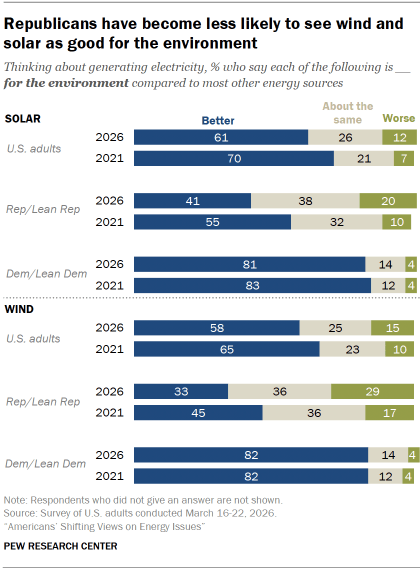
While majorities view these sources as better for the environment than most others, the share who hold this view has dropped since 2021. And compared with views of these sources’ environmental impact, views of their cost and reliability are far less positive.
Impact on the environment
As with other attitudes around renewable energy, Republicans are less likely than they were five years ago to say solar and wind power are better for the environment.
- Solar: Republicans are 14 percentage points less likely now to say that solar power is better for the environment than most other energy sources. The share of Republicans who say solar power is worse for the environment has increased.
- Wind: Similarly, there has been a 12-point drop in the share of Republicans who say that wind power is better for the environment than most other energy sources. About three-in-ten Republicans (29%) now say wind power is worse for the environment, up 12 points from five years ago.
Cost to consumers
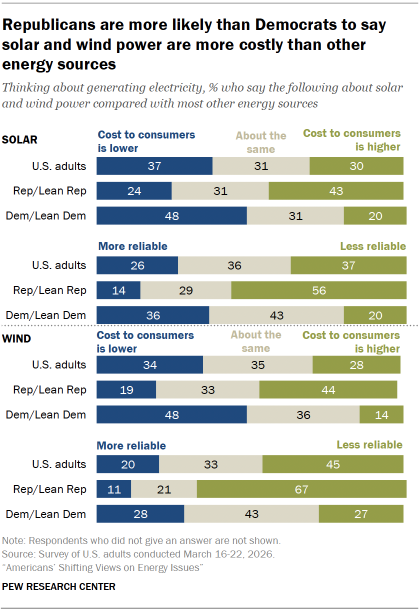
Americans are slightly more likely to say that solar and wind power are cheaper compared with other energy sources than to say it is more expensive. Again, though, Republicans are more likely than Democrats to view these sources as more costly.
More Republicans say wind (44%) and solar (43%) cost consumers more than other energy sources than say these cost less than other sources (19% and 24%, respectively).
A 2023 Center survey found that most Republicans said a transition from fossil fuel to renewable energy sources would make their home energy prices worse.
Democrats follow the opposite pattern: More say that wind and solar cost less than other energy sources (48% each) than say they cost more (20% for solar and 14% for wind).
Reliability
Americans view both solar and wind power as less reliable than other energy sources (though more Americans say wind is less reliable than say the same about solar). Republicans are especially negative about these sources’ reliability.
In a 2023 Center survey, most Republicans said they expected that a transition from fossil fuels to renewable energy would lead to a less reliable energy grid.
This year, Republicans are far more likely to say solar and wind power are less reliable rather than more reliable compared with other energy sources, while Democrats are more mixed. Democrats are split on the reliability of wind power, and they’re more likely to think solar power is more reliable than less reliable.