
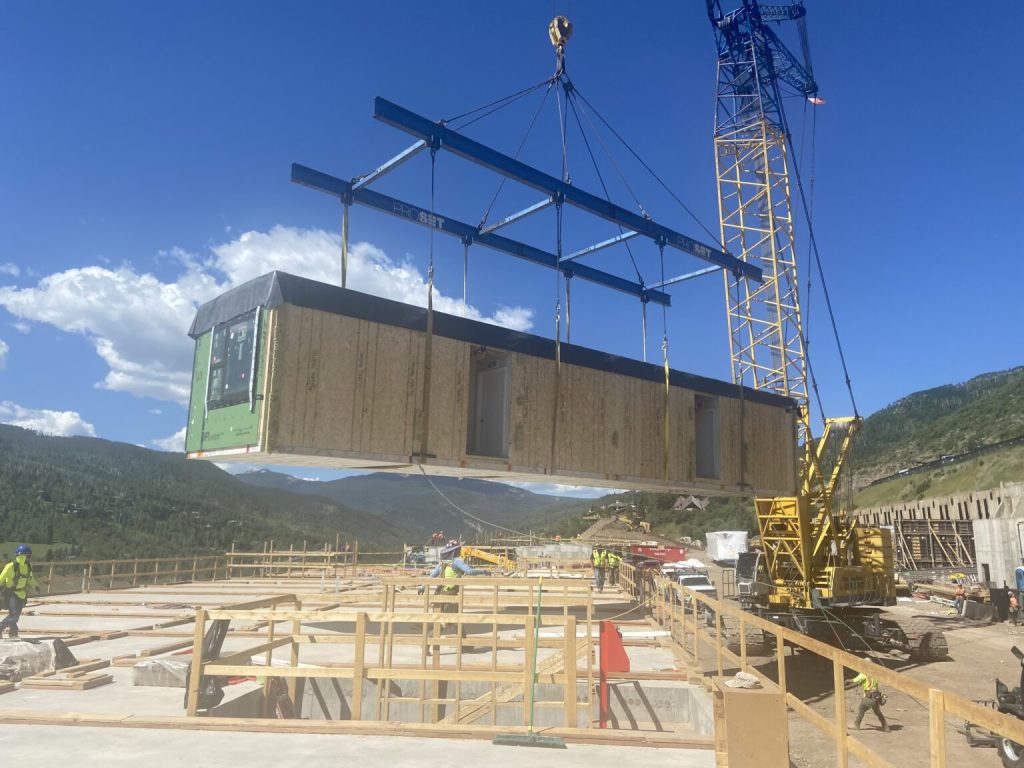
David O. Williams/Vail Daily
As Eagle County and the town of Avon forge ahead with planning for a possible taxpayer-funded regional housing authority, some officials in Vail are feeling nervous about the ski town’s current financial commitment to affordable housing.
“In the last two years, we’ve kind of exposed the town significantly. There’s a significant financial exposure which comes from this affordable (housing) thing, to the point where it’s made quite a few people nervous,” Vail Mayor Pro Tem Reid Phillips said at a joint meeting with the advisory Vail Local Housing Authority on Feb. 17.

Avon Town Manager Eric Heil called Vail the “moose in the kitchen” at a Feb. 3 meeting by acknowledging that Vail accounts for about 40% of all the revenue in the county in terms of sales, property and lodging taxes and that it would be a “real big game changer” for Vail to be part of the proposed regional housing authority.
Phillips was not specifically addressing the concept of a taxpayer-funded regional housing authority, which will be the subject of a community survey sometime next month and would have to be approved by voters, but he did say he thought Vail was doing more than its fair share at this point.
“Sometimes it is disappointing to look at Dowd (Junction to the west of Vail) and around the corner and see what we have spent here and the amount of money that’s been spent in our little end of the valley and how much we’ve contributed to that deficit,” Phillips said of a county housing needs study that found an existing deficit of 2,638 housing units.

Support Local Journalism
“Then you look at the rest of the county and that number of 2,600, I mean, we’ve taken on almost 45% of that,” Phillips said. “We should be accountable for about 25% of that. So, it is concerning, and hopefully our down-valley partners are taking a little bit of a lesson from us and committing, but all I see is free-market projects being built en masse down there.”
Eagle County Housing Director Kim Bell Williams, at the Feb. 3 regional housing authority meeting, said the Eagle County Housing and Development Authority is out of money after spending more than $70 million on more than 1,000 units over the last five years.
Last summer, the county cited its unprecedented $64.9 million taxpayer investment in housing over the last four years that produced 747 units of “new homes, preserved housing and support for renters, homebuyers and homeowners.” Of those 747, 213 were newly constructed units, county officials have said.
The town of Vail, by comparison, is trying to build and deed restrict 1,000 new affordable housing units by 2027, although it was 150 units below that target last August. Since 2020, Vail had spent or committed $254 million to new housing and $12.8 million to deed restricting 177 existing units through its Vail InDeed program that started in 2017.
Vail Resorts, the largest employer in the region, leases and owns employee units throughout Eagle County, but the only new workforce units the company ever built in the town of Vail were the 124 beds of First Chair back in 2011, which was a town-mandated obligation for the company’s Arrabelle Hotel near the Eagle Bahn Gondola in Lionshead.
Overall, last year’s Eagle County Regional Housing Needs Analysis found a deficit of 6,375 total units of housing (the existing shortage of 2,638 and future projection of 3,736 units). The Vail Local Housing Authority says approximately 95% of locally owned and occupied, non-deed-restricted homes convert to second homes or investment properties upon sale.
In all, Vail is in the process of bringing nearly 1,000 new residents back into the town of Vail following a steady westward exodus since the 1990s. But Phillips said those new residents will need services that the town will have to provide above and beyond building so much housing, from public transportation to schools to child care to mental health services.
“There’s this other whole price tag that comes with bringing all these people back to the town of Vail,” Phillips said. “But I don’t know how we task some of that money, the tax dollars or whatever, to come back this way and support our projects more, because I feel like the county sometimes looks at it as the rich Uncle Vail that just does their own stuff and we don’t need any of the county money.”