
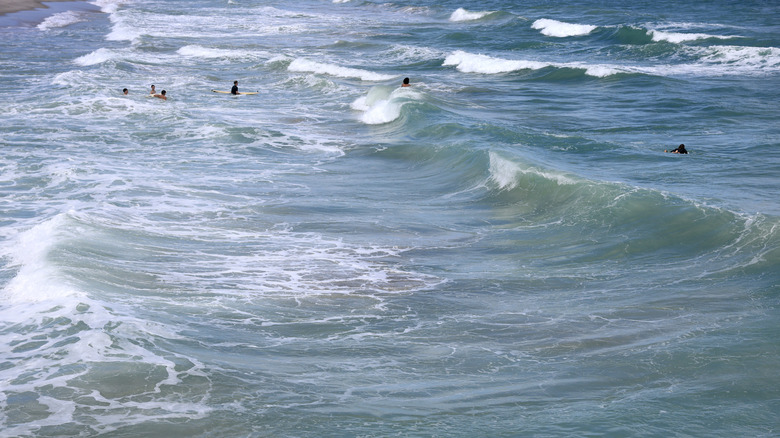
Many of us have a way of taking the oceans for granted. A place to surf, perhaps, or to enjoy other water sports, or simply admire while sitting on the beach. Those who make their livings in far harsher ocean conditions would feel rather differently, however, and so do climate scientists, who warn that the Atlantic Ocean could reach a critical point from which it’s going to be impossibly difficult to recover. Though we often think of the ocean as separate and distinct from life on land, the thing to remember is that about 71% of the planet is covered in water, the vast majority of which is ocean water. The Atlantic Ocean, the second largest on Earth, covers 41.1 million square miles, about one-fifth of the surface of the planet. This is why it takes so long for an aircraft carrier to cross the Atlantic, and it also makes it a critical barometer and provider of life on Earth.
Tragically, its role in safeguarding that life is in increasing jeopardy because of climate change. A study from René M. van Westen et al., published in Hydrology and Earth System Sciences in November 2025, sounds the alarm: “The Atlantic Meridional Overturning Circulation (AMOC) is expected to weaken or even collapse under anthropogenic climate change.” Humanity, according to the report, is causing the AMOC, a system of currents that the Met Office likens to “a conveyor belt” regulating the temperature of ocean water, to deteriorate. The study created several potential scenarios to detail what might happen if this system was lost, and the possible impact on life on Earth in a broad sense is chilling to think about. Let’s take a closer look at the AMOC and what the impact of climate change on it potentially means for the Earth.
The nature and critical role of the AMOC
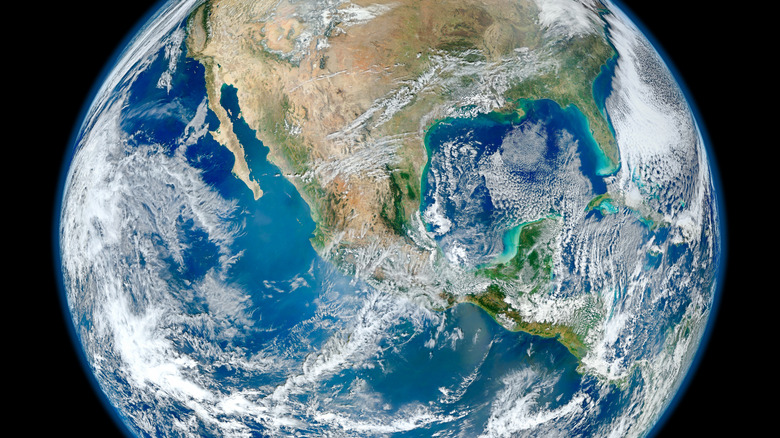
There’s no understating the role that the ocean and marine creatures play in reducing the impact of global temperature changes. In fact, the United Nations notes that “the ocean generates 50 percent of the oxygen we need, absorbs 30 percent of all carbon dioxide emissions and captures 90 percent of the excess heat generated by these emissions.” The AMOC is a system of water currents that regulates the temperature of the oceans by ensuring that warmer water, which is saltier and less dense, and cooler water, which is lower beneath the surface and more dense, flow as expected.
Upwelling, which is the process whereby coastal winds blow the warmer water near the surface out of the way for the colder waters to replace them and bring their nutrients to the surface, occurs so that the waters rise to the surface and sink to the bottom in cycles. This keeps a healthy filtration of nutrients like phosphates while also allowing the tiny creatures that live in these waters, like phytoplankton, to continue to thrive in the area and so serve as a vital part of the food chain. It’s a delicate balance we sometimes don’t spare a thought for, but which is very important in keeping the oceans and the wider planet healthy. The changing climate, unsurprisingly, is having an effect on this process too. The temperature changes mean that the ocean waters remain hotter, and this may impact the AMOC process, which revolves around the interplay between warmer and cooler waters. With several aspects of climate change, it is impossible to put a definite timeline to events, but it seems inevitable that the AMOC will be negatively impacted by the effects of a heating world.
The critical point for the AMOC, according to the study
Tipping points are potential temperature thresholds or other levels of specific change, beyond which problems are seemingly accelerating beyond potential mitigation. The Met Office notes, for instance, that the reduction of the Amazon rainforest could reach a point where it’s no longer able to regrow (because the forest’s trees add moisture to the atmosphere that encourages rainfall), and this is exactly the kind of warning being issued about the AMOC by the researchers. The researchers of the Royal Netherlands Meteorological Institute investigated the potential repercussions if the AMOC’s effect were to drastically reduce, or if it even disappeared entirely. In the first instance, the study states, “precipitation rates over Europe are expected to decrease under an AMOC collapse, potentially affecting the European hydroclimate.”
A decrease in rainfall would be another step towards a more dangerous and uncertain future, surely making for hotter summers and a greater risk of drought and food shortages. As would be expected of one of the world’s largest oceans, too, this effect would not be a localized European issue. The study adds that the AMOC “effectively cools the Southern Hemisphere and warms the Northern Hemisphere,” and so if it were to be significantly diminished or even disappear, this would have global repercussions. The loss of one means of temperature regulation naturally means more pressure on existing ones, exacerbating the global problem. The researchers note that the process would unfold differently under different scenarios modeled and that the degradation and its potential associated impact would not unfold quickly. The scientists suggest that it would not be this century, but after 2100 that the impact would be felt. There is potential to reverse some climate change damage, but we don’t yet know what the future holds for the AMOC.