
The sector has broadly performed well in recent months.
Banks have been on a good run in recent months, surging as investors took chips off the table in the red-hot tech and artificial intelligence (AI) sector and rotated into other unloved sectors like financials.
However, there has been a divergence this year. Small- and mid-cap bank stocks have outperformed large bank stocks, which had previously been outperforming the sector. That can be seen in the iShares U.S. Financials ETF (IYF +0.77%), an exchange-traded fund that holds stock in many of the largest banks in the country and is trading down 3% this year, despite the broader banking sector performing well.
Is the financials sector still the best value play in 2026?

Image source: Getty Images.
A long history of underperformance
Banks have arguably been viewed as a value play since the Great Recession. The sector has also underperformed the broader market widely over the past decade. Since the Silicon Valley Bank crisis in 2023, larger banks have had the edge, as the reputational fallout from several failed banks pushed more money into large banks deemed “too big to fail.”
Banks have also benefited from rotation, a steeper yield curve, and actions by the Trump administration, which has approved mergers and acquisitions and also promised deregulation. The largest names by weighting in the IYF are Berkshire Hathaway, JPMorgan Chase, Bank of America, Goldman Sachs, and Wells Fargo, which together account for about 35% of the ETF.
Here are their recent valuations on a price-to-tangible-book-value basis, which compares a company’s market value to its net worth. It’s a frequent way that investors in the financials space value stocks.
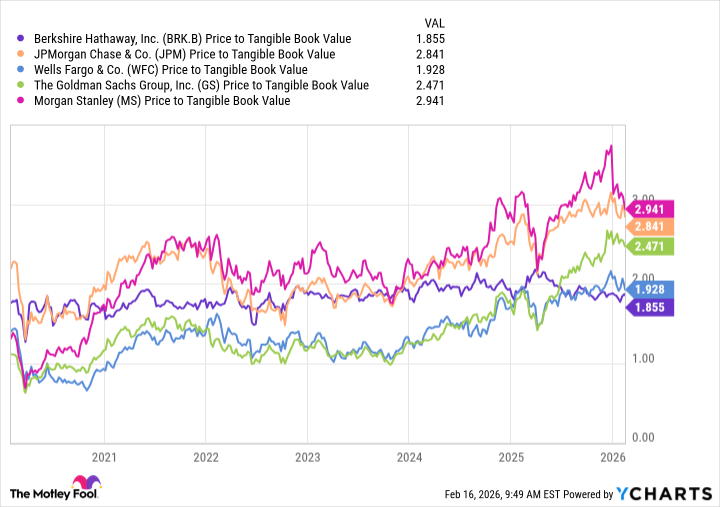
Data by YCharts.
As you can see, there has been a recent pullback, but valuations certainly aren’t low. The large investment banks, Goldman Sachs and Morgan Stanley, have benefited as more companies have gone public, due to better market conditions and lower interest rates.
Banks are also benefiting from lower interest rates, which investors believe will further steepen the yield curve, making longer-dated U.S. Treasury bills yield more than shorter-dated ones. This tends to be a tailwind for banks because they typically borrow short-term and lend long-term.
Credit quality in the banking system has also held up remarkably well over the years. Some investors believe the good times can continue to roll, while others are a bit nervous that a credit event is due.

iShares Trust – iShares U.s. Financials ETF
Today’s Change
(0.77%) $0.96
Current Price
$125.80
Key Data Points
Day’s Range
$125.19 – $126.32
52wk Range
$95.34 – $133.54
Volume
263K
In terms of whether banks are still the best value play in 2026, it depends on whom you ask. Some investors would say this could be the beginning of a new cycle for banks, which are due for a rerating, while others would say it’s time to take profits.
For the large banks in the IYF, I do not think they are currently a value play based on valuations and performance. That doesn’t mean they can’t keep moving higher, but they aren’t a screaming buy. However, investors will find more opportunity in the small- to mid-cap banking space. This area, by and large, has done well recently, too, but I still think there are pockets for stock pickers to find opportunities.