
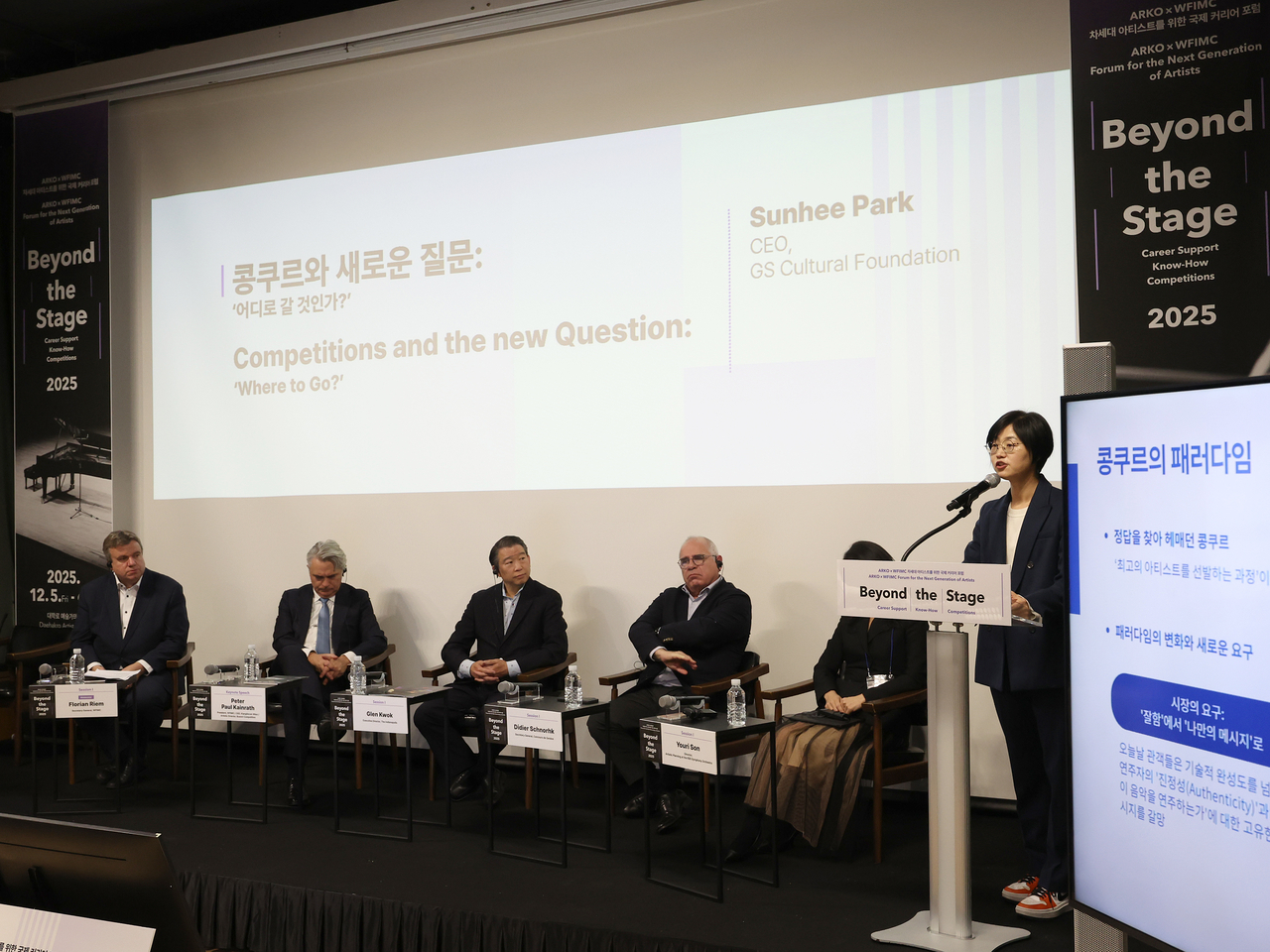
International music competitions have long been familiar to Korea and its musicians, thanks to the large number of Korean participants and prizewinners who have made their mark on the global stage. On Friday and Saturday, executives from some of the world’s leading competitions convened in Seoul to explore how young musicians can build sustainable careers beyond the competition circuit.
Organized by Arts Council Korea (ARKO), the forum focused on what happens after a victory — an often overlooked phase in a young artist’s professional journey.
ARKO Chairman Choung Byoung-gug said, “Korea may be a powerhouse in music competitions, but that is not the whole story. We created this forum to examine whether the way we have supported artists until now has truly been the right one.”
Organizers emphasized that competitions are not the culmination but rather the very starting point of a career, one that requires musicians to transition from students who spend countless hours practicing to public figures navigating global exposure in an era of unprecedented attention to classical music.
The two-day forum set out practical guidance for building a sustainable career in classical music, addressing everything from programming and working with management to self-promotion. But it opened with a more fundamental question: Why has cultivating a distinctive artistic identity become more critical than technical excellence alone?
Peter Paul Kainrath, president of the World Federation of International Music Competitions and artistic director of the Busoni Competition, said that while classical music has never enjoyed a larger global audience, more concert halls, or easier access through streaming platforms, these advantages have not translated into greater artistic risk-taking.
“The moment of a concert — a life experience and a highly subjective, individual artistic statement — becomes more important than ever before. A new and wide repertoire, with a lot of discoveries, a new style of interpretation in the spirit of freedom, and a new freshness in the act of playing on stage, is strongly needed,” he said.
His words echoed those of many at the forum who emphasized that while the technical level of young finalists is already exceptional, what is now required is a distinctive artistic identity.
Park Sun-hee, CEO of GS Arts Center, noted, “Participants study the history of each competition and analyze the tendencies of its jury members. Rather than expressing their individuality, many have tried to force themselves into a standardized, mechanized framework.” She continued, “By now, we all know that technical excellence alone is no longer enough to satisfy the public or the industry. The market demands that we go further and present a message that is uniquely our own.”
The forum in the Daehangno theater district in Jongno-gu, Seoul, brought together 16 key leaders from the world’s top music competitions and festivals. The lineup included Florian Riem, secretary general of WFIMC, who served as CEO and artistic director of the Tongyeong International Music Festival from 2013 to 2020; Jacques Marquis, CEO of the Van Cliburn International Piano Competition; Glen Kwok, executive director of the International Violin Competition of Indianapolis; Didier Schnorhk, secretary general of the Concours de Geneve; Arthur van der Drift of the Rotterdam Philharmonic Orchestra; Michael Haefliger, executive and artistic director of the Lucerne Festival; Sisi Ye, director of the Schoenfeld International String Competition; and Kim Jinyoung, Korea project manager for the Berlin Philharmonic, among others.
gypark@heraldcorp.com