
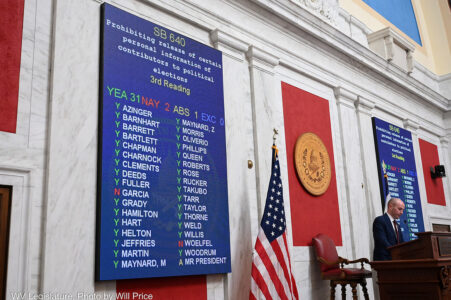
The Senate voted Monday afternoon on SB 640, changing what is publicly available on state campaign finance reports.(Photo Courtesy/WV Legislative Photography)
CHARLESTON – The two lone Democratic members of the 34-member West Virginia Senate voted against an effort by the Republican supermajority to shield certain campaign donor information from public scrutiny.
Senate Bill 640, prohibiting release of certain personal information of contributors to political elections, passed in a 31-2 vote Monday afternoon with one member absent or not voting. The bill now heads to the House, where the Judiciary Committee was considering a similar bill.
SB 640 clarifies that the street number and employer of a campaign donor would be redacted from publicly posted campaign finance reports and not subject to the Freedom of Information Act beginning Jan. 1, 2027. The bill does not apply to past campaign finance reports still publicly available.
“The committee substitute for Senate Bill 640 is designed to protect the campaign contributor’s privacy and prevent potential harassment based on political participation,” said Senate Finance Committee Chairman Tom Willis, R-Berkeley. “I think the intent here … is to protect employers from harassing calls from those who may disagree politically with the employee’s political contribution.”
Publicly available campaign finance data would include a donor’s name, city, state, occupation, and how much they donated. The bill requires financial statements in local elections to be filed with the secretary of state. It permits the secretary of state to disclose restricted information in limited instances.
If a government agency publishes protected information, the bill gives the agency 10 business days to cure the offending notice before imposing a $1,000 penalty.
Both Senate Minority Leader Mike Woelfel, D-Cabell, and Senate Assistant Minority Leader Joey Garcia, D-Marion, opposed the bill. Garcia said he had no issues with street addresses for donors being excluded from public-facing campaign finance reports. However, he said the bill would shield candidates from public scrutiny as to whether multiple employees from one company were donating to the same candidate.
“The old phrase goes, democracy dies in darkness. I cannot support a bill that’s going to darken and shadow where people are getting their money from,” Garcia said. “It’s done on a federal level. This is important information that can help us decide or at least see why people might be leaning one way or the other.”
Sen. Mike Azinger, R-Wood, is the lead sponsor of SB 640. He said he understood some of Garcia’s concerns but the goal was to protect donors from being harassed or endangered at their home or business.
“(Garcia’s) concerns, actually, they’re not illegitimate,” Azinger said. “I just think that … we’re trying to protect employers from harassment that happens in horrible ways often that 30 years ago wasn’t even contemplated.”
“You should be able to donate to somebody you believe in or to a cause you believe in in this state and in this country without having to be concerned about this kind of unjust retribution,” Azinger continued. “This is a great bill. It’s a bill that protects people that want to give to controversial candidates like me sometimes.”