Black Friday live: I’ve already found hundreds of early Black Friday PC gaming deals as the sales kick off today
Refresh
Sage advice time…
I hate to be ‘that guy’ but this Black Friday sales period could well be our last chance for a while to get some PC gaming hardware for a decent price. We’ve only just recovered from the GPU pricing madness and now AI data centers have come for our memory.
So yes, RAM prices have shot up in recent weeks, to the extent that the doubling of the price of a pretty standard memory kit is not at all uncommon. And soon won’t be as bad as it gets. But that’s having a knock on effect on other kinds of memory, too, with SSDs soon to get that bit more expensive, and also we’re hearing reports that graphics cards are only set to get more expensive once the current stock on the shelves sells through.
They are, after all, filled with VRAM. That’s not the same as the system memory sought by AI data centers, but manufacturers are always going to prioritise capacity for the most in-demand kind of memory.
So yeah, if you’re in the market to pick up some new hardware, Black Friday might just be your best bet until well into next year at the least.
Sorry.
Well, well, well, a genuine, modern OLED gaming monitor for a shade less than $390. Who woulda thought we’d hit that point so early in these Black Friday shenanigans? Not I, and yet here we are with a lovely MSI panel delivering on that promise for just $390 at Newegg.
There are few compromises, either. It’s a 27-inch panel, so the pixel pitch isn’t too loose, it’s got a still-pretty-high refresh rate of 240 Hz, and you’re only missing out on some USB-C connectivity. Feels like a bit of a bargain to me.
🚨Cheap 4K alert🚨
One of the best things about the rise of OLED panels as peak gaming monitor in 2025 is the fact that it’s driven the price of normal VA and IPS displays right down. To the point where we’re getting high-refresh rate 4K monitors for under $290 right now. My only issue with the Asus TUF below is the fact that its peak luminance rating is just 300 cd/m2, which feels a little dim.
Though it will likely be fine for you unless you game regularly in a super brightly lit room.
If you want something a bit brighter, but not a lot more expensive, then this Gigabyte 4K monitor still has a 160 Hz refresh rate, still comes in under $300, but comes with a rated 350 cd/m2 level of brightness.
If that’s going to matter to you, then it’s not a lot more to get the brighter IPS panel.
People sure are excited about the Steam Machine, but it was Valve’s handheld that made it all possible. Well, that and SteamOS with its Proton layer meaning Windows games now run well (sometimes even better) on Linux.
And now SteamOS is not restricted to the Steam Deck, either, because Lenovo has got in there early with its Legion Go S which now has top place in our overall best handheld gaming PC guide. It’s a great device, and now at a far more reasonable price.
(Image credit: Future)
The OLED which launched a thousand ships. Sorry, it’s too early in Black Friday month to go off on a Greek myth tangent. This Alienware ultrawide OLED was the first to really prove that the pricey panel technology did have a place in proper PC gaming monitors, and it still stands up today.
Yes, there are many other similar screens available, but few at this price right now. Possibly none, in fact.
The same reasons we fell in love with it in our Alienware AW3423DWF review remain, namely that glossy panel making the contrast and true black levels really pop. You can get 240 Hz versions now, and the updated Alienware AW3425DW is only $100 more, but will you really notice the difference between 165 Hz and 240 Hz?
And how about if I paid you $100, could you still see the difference?
(Image credit: Future)
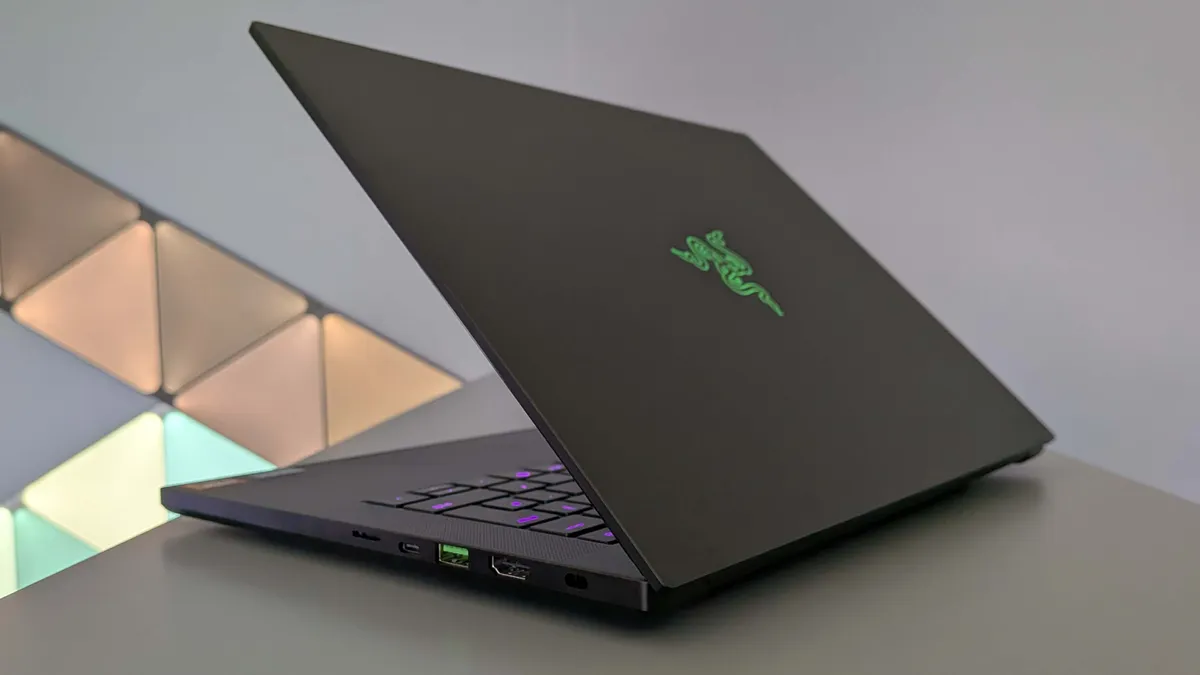
This little guy is still my daily driver, and has been every since I reviewed the Blade 14 back in June. It’s a beautiful, beautifully svelte gaming laptop, with a gorgeous screen, decent battery life, and plenty of gaming performance on offer, too.
I use it with both the Radeon 880M integrated graphics for lightweight gaming on the go, and for more power-hungry graphics there’s always the Nvidia RTX 5070 GPU when you need higher FPS.
And it’s been dropping in price since I reviewed it, to the point where it is now $1,000 cheaper than at launch. For $1,700 at Amazon, this is getting on for standard RTX 5070 laptop pricing and not the Razer premium we’ve come to expect.
PCIe 5.0 SSD performance for PCIe 4.0 SSD pricing. That’s what we’re getting already this Black Friday, with Crucial’s impressively quick, impressively affordable drives out-doing a lot of last-gen SSDs in terms of both pace and price.