
At Aria CFO Services, we’ve had the opportunity to work with 400+ NGOs—ranging from large to small, with geography spanning urban to rural, with focus on national to grassroots level. If there’s one thing we’ve consistently seen, it’s that finance is often the most under-invested function, especially in the early years of an NGO’s lifecycle.
It’s completely understandable. When you’re focused on impact and outcomes, field operations, managing programs, raising funds, and building your team, finance often becomes something you “figure out as you go”.
But here’s what we’ve learnt. The way you set up your finance function can directly impact your ability to fundraise and build trust with donors, grow, and stay compliant. In that sense, it’s a mission critical function.
How it usually starts: One person, many hats
In the early stages of most NGOs, one person—usually an accountant—is expected to manage everything. And while it might be manageable for a while, as the organization grows—more programs, more donors, more reporting requirements—this setup starts to crack.

You may start seeing:
- Delays in compliance filings
- Inaccurate and/or late reports to donors
- Struggles with resolving audits queries
- Difficulty creating budgets or forecasts
- Frustration among program teams
This not only creates stress internally, but it can also hurt your credibility with donors, and limit your ability to take on new opportunities.
Is this starting to sound familiar?
What if we reimagined the finance function early on?
Instead of waiting for things to break, what if NGOs were supported from the beginning with a clear understanding of what a full finance function looks like? Even if you don’t have the resources to hire for every role upfront, just knowing what roles should eventually exist can help you plan better and avoid common pitfalls.

Here’s what an effective finance team looks like (eventually):
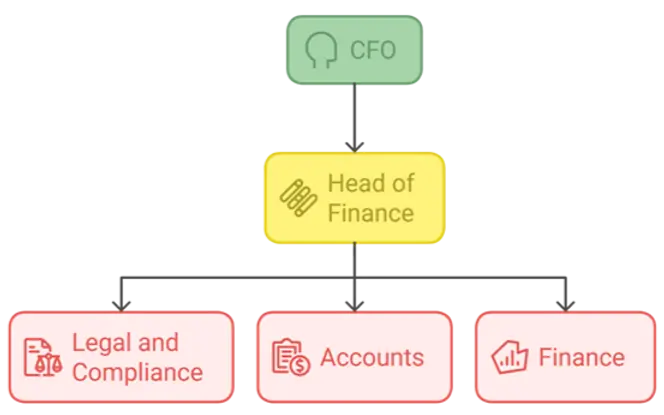
1. Chief Financial Officer (CFO): The Financial Navigator
This person leads the finance function and ensures it’s aligned with your vision and growth. The CFO works closely with leadership on:
- Financial planning and risk management
- Strategic decision-making support
- Donor relations and board-level reporting
- Building financial sustainability
Whether in-house or outsourced, full-time or factional, having strategic finance guidance will be a game-changer. To learn more about this role and when you should consider hiring one, read this article.
2. Head of Finance: The Process Champion
Reporting to the CFO, this person ensures that day-to-day operations are compliant and running smoothly. They oversee:
- Legal & Compliance
- Accounts
- Finance Operations
They’re the go-to person for audits, donor reports, and financial processes. Think of them as the person who makes sure that audits are smooth rather than crisis-driven, donor reporting is organized rather than chaotic, processes are consistently followed rather than improvised, and compliance is managed proactively rather than reactively. In essence, they keep the system running predictably and without surprises. Read this article to learn more about this role.
3. Legal & Compliance Team
Responsible for staying on top of all the regulatory and donor-related requirements:
- FCRA, Income Tax, GST filings
- Statutory audits
- Legal paperwork and contracts
- Board meeting minutes
- Organizational policies
For NGOs, credibility isn’t built on programs alone. It rests on governance and compliance. Donors and regulators look beyond impact narratives to see whether the house is in order. Yet in many organizations, the legal & compliance function is managed reactively, often by overstretched teams. Pragmatic compliance keeps funds flowing, programs running, and reputation intact—by demonstrating control and continuous improvement. To learn more about how to build towards this, read this article.
4. Accounts Team
Handles the core accounting tasks:
- Day-to-day bookkeeping
- Bank reconciliations
- Expense entries and verifications
- Maintaining vouchers and records
- Payroll processing
- Project-wise accounting
When a donor looks at your financial reports, do they see clarity and consistency—or just numbers without context? The answer often depends on the strength of your accounting systems. Without clear structures, reports can become fragmented and difficult to compare across projects and years. Learn about how you can strengthen your organisation’s accounting system here.
5. Finance Operations Team
Supports internal teams and ensures that financial systems support your impact:
- Preparing budgets and tracking actuals
- Donor-wise reporting and utilization certificates
- MIS reports for internal decision-making
- Budget support during proposal submissions
For NGOs, operational efficiency is just as important as program impact. Donors and leadership look beyond program results to see whether funds are tracked accurately, reports are timely, and budgets are adhered to. Reactive, last-minute financial management often leads to errors, audit queries, and lost opportunities to make data-driven decisions. Pragmatic finance operations ensures that money flows where it is intended, reporting is reliable, and decision-makers have the insights they need—turning finance from a task into a strategic enabler. Read this article to learn how you can streamline your organisation’s finance operations.
How many people do you need?
There’s no magic number. The size and shape of your finance team depends on:
- Core competencies within the team
- Size and number of programs you run, locations and field office requirements
- Number of donors and frequency of reporting
- Overall volume of transactions
- Future growth plans
The key is to plan roles, not just people. That way, you know which hats are being worn today, and when it’s time to add new heads!
Solutions can take many forms—building an in-house team, outsourcing parts or all of the function, engaging committed advisors or board members, or a mix of these. There’s no single path, but a structured approach is critical: clearly define roles and responsibilities early, even if one person or an external partner covers multiple roles at first.
Initially, many NGOs benefit from a lean model—for example, combining outsourced CFO support with an internal accountant. As the organization grows, adding finance operations staff, strengthening compliance capacity, investing in simple finance tech, and eventually hiring a Head of Finance becomes essential.
Phased hiring—starting with critical roles and scaling up as complexity increases—ensures the finance function grows in step with the organization’s needs. A well-structured finance team builds donor trust, improves decision-making, and frees leadership to focus on mission and impact.
Build for tomorrow, today
Your finance function isn’t just about numbers. It’s about trust, transparency, and readiness for growth.
At Aria, we believe that every NGO—regardless of size—deserves to have a finance function that supports its mission. With the right strategic and operational guidance, you can move from a reactive state of doing things, to being a more proactive organisation.
This is an edited version of an article that was originally published on Aria Advisory’s website.