
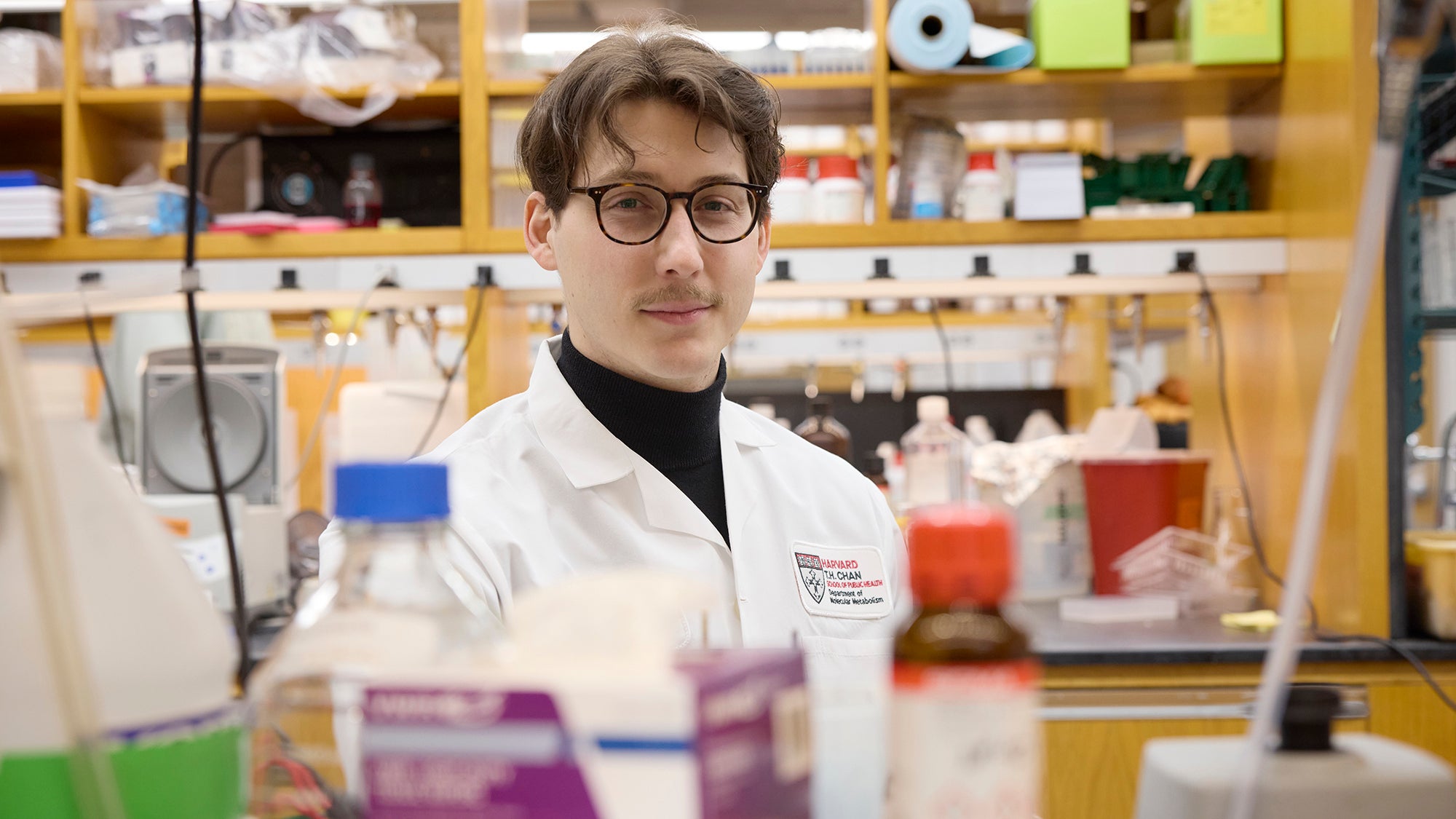
Sam Lapp, PhD ’26, delves deep into the biology of how muscles work
Even from a young age, Sam Lapp always liked figuring out how things worked. As a PhD candidate in the Harvard Griffin Graduate School of Arts and Sciences Biological Sciences in Public Health program, conducting research in Brendan Manning’s lab at Harvard T.H. Chan School of Public Health, he deciphers the biology of skeletal muscle in order to find ways to restore, preserve, and improve muscle function.
I was always interested in science as a kid. In Chicago, where I grew up, I would do experiments, like feeding ducks to see which types of food they prefer. I threw different kinds of scraps—bread, seeds, even Cheetos—to the ducks in a pond that was in the middle of the city, surrounded by skyscrapers. I would count how many ducks would eat each thing and write it down in a little notebook. Cheetos were their favorite.
I didn’t think about it as science at all. I was just curious, and I liked figuring out how things worked and telling people things I thought were cool.
In college at Tulane, I originally was interested in architecture and design, but wound up switching my major to cell and molecular biology. I liked science projects for a number of reasons: If I was wrong there was a reason why, then I could learn from it; if I was right, I would have evidence to support why; or if no one knew the answer, then we’d all be on the same team trying to figure it out.
I had an internship in a cerebral palsy lab at a research hospital in Chicago—the Rehabilitation Institute of Chicago, now called the Shirley Ryan AbilityLab. It was a space where they would bring patients, physicians, physical therapists, and researchers together to solve problems. My experience there pushed me toward wanting to go into research.
There was something exciting about figuring out how muscles worked. You’re always using your muscles, you’re always moving around, and I find it fun trying to understand everything that goes into all of those movements. During college, I found exercise to be the best way to moderate my mental and physical health, and I wanted others to experience the same benefits. At the cerebral palsy lab, we tried to find ways to improve the ability to move for people who either struggled to or were unable to do so.
After college I earned a master’s in kinesiology and community health at the University of Illinois Urbana-Champaign. I joined Marni Boppart’s lab, which was studying how contraction can lead to muscle growth and how the non-muscle cells in muscle play a part in that. The goal was to develop therapies for restoring and recovering muscle mass following periods of immobilization—situations such as someone being in a cast or on extended bed rest, where they lose a lot of muscle mass really quickly. Marni’s lab was looking for ways to stop, slow, or reverse that loss.
I came to Harvard Chan School for a PhD in order to delve deeper into the basic biology that I love. I’ve been studying how skeletal muscle responds to different stimuli. Specifically, I focus on how muscle responds to eating and exercise, to try to determine the individual contributions of each type of stimulus.
We study mice in which we created a mutation in a specific protein in skeletal muscle—a mutation that prevents insulin from performing some, but not all of its duties. Insulin is involved in activating protein synthesis and in turning off protein degradation—both processes that are key to muscle-building. This mutation helps us investigate which aspects of insulin signaling affect protein synthesis or degradation, muscle size, and how muscles respond to other signals, like contraction. We can then put all this together to see the impact on muscle function.
So far, my work has shown that when we eliminate insulin’s activation of protein synthesis, it doesn’t actually affect muscle size. This suggests that we should focus on other stimuli—like muscle contraction—if we want to leverage a pathway against muscle loss. Prompting contraction, through activities such as weight lifting, helps to strengthen muscles. For those who can exercise, contraction is the best way to maintain, gain, or recover muscle mass. For those who can’t exercise or those with serve muscle atrophy—due to immobilization, or age-related muscle loss, known as sarcopenia, or cancer-related muscle loss, known as cachexia—developing drugs that target the same exercise-responsive pathways might be our best bet for restoring muscle mass.
One exciting moment for me in science was when I was waiting to see if a particular finding would be reproduced in a second experiment. We have a machine that reads out something called a Western blot—this little white paper showing black dashes of different intensities, which tells us which proteins are in a sample and what they might be doing—and the machine can read it very slowly. Sometimes, it can take even 15 minutes to go through the whole thing. I remember starting the scan and then just pacing around the lab. I was freaking out because if this finding didn’t repeat, it would be like, “I have no idea what’s true in science anymore.” And then it repeated—and I’m running through the lab, catching everyone that I can see, and saying “It repeated, it’s reproducible!” Everyone was very happy for me, because they know what that feeling is. It’s exhilarating. You have goosebumps. It’s like scoring a game-winning goal at the World Cup.
At the start of my second year of my PhD, I was diagnosed with multiple sclerosis (MS). There are periods of time when I lose mobility, but I’m lucky enough to have the relapsing-remitting type of MS, so when it remits I can move again. But I’ve had a month here and there where I could barely walk and I lose muscle mass rapidly. Eventually I could lose a lot more of my mobility. It feels very personal now, and kind of serendipitous, that I’ve already spent so much time studying the biology of muscle function. Going forward, I plan to focus on the connection between nerves and muscles—called neuromuscular junction—that enables consistent movement. This is a focal point of muscle loss in neuromuscular disorders, spinal cord injury, and aging, and it might be important for MS. Most serendipitous of all is that the specific pathway that I study—that responds to insulin in skeletal muscle—is a really crucial pathway for maintaining the neuromuscular junction.
My overall goal is to keep studying muscle however I can, in a way that is exciting and fun and can benefit people down the line.