
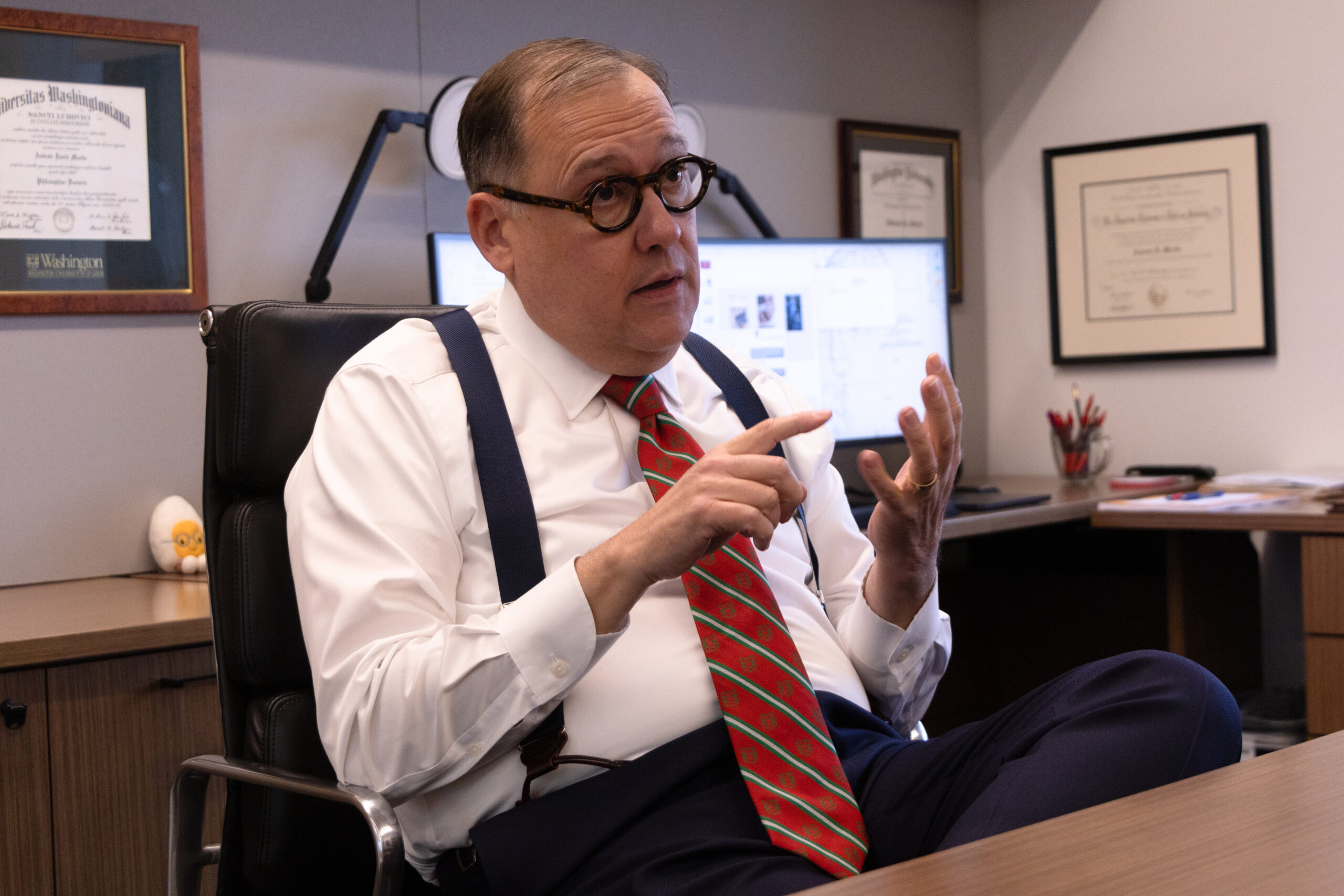
Chancellor Andrew D. Martin spoke with Student Life during a Q&A on Wednesday, April 1. (Isabella Diaz-Mira | Managing Photo Editor)
WashU Chancellor Andrew D. Martin defended the decision to meet with the Trump administration in the fall, discussed the impact of AI on higher education, and talked about emergency preparedness in a Q&A with Student Life on Wednesday, April 1. Martin also shared updates on WashU’s financial situation, including the reasons behind the transition to Workday, the University’s construction planning, and the decision to purchase the University of Health Sciences and Pharmacy (UHSP).
This is a recap of the Q&A with Martin. You can read a full transcript here.
Martin said that the University has meaningfully engaged with politicians in Washington, D.C., on issues such as the endowment excise tax and scientific research funding. One of those engagements included meeting with the Trump administration this fall, a move that some students and faculty criticized. Though the meeting took place in the days after the White House proposed the Compact for Academic Excellence in Higher Education, Martin said the meeting was not explicitly about the compact.
“There’s kind of a saying in Washington that ‘if you’re not at the table, you’re on the menu,’” he said. “When we have policymakers that have an enormous amount of power over what we do, it’s important to be at the table advocating for the institution.”
Martin also said the University’s financials are in a better position than last year, pointing to a slowdown in capital project spending and additional revenue generated by clinical faculty at the School of Medicine. However, Martin said that due to uncertainty surrounding issues like federal research funding, WashU isn’t planning significant investments in construction in the near future, such as the new Arts & Sciences building that began construction last year but was put “on pause” in April. Nevertheless, he said the University will continue to invest in new dormitories and clinical spaces that can generate revenue for the University.
Despite these financial constraints, WashU recently purchased UHSP as part of the University’s plans to create a new pharmacy school based around UHSP’s Doctor of Pharmacy program. Martin said this acquisition, like the purchase of Fontbonne University’s campus, was a “once-in-a-century opportunity.”
“Over the course of history, St. Louis College of Pharmacy and WashU had discussions about coming together, and the timing never worked for either institution,” Martin said. “Even though we are in a moment of looking at budgets and being very rigorous in terms of how we’re stewarding resources, this was an opportunity that we couldn’t pass up.”
Martin said that WashU is beginning a capital planning process to consider options for the “greater Danforth Campus,” which includes the Danforth Campus, the South 40, and the former Fontbonne campus. He mentioned that all options are under consideration, including student residential buildings, activity space, academic buildings, recreation facilities, and administrative offices.
Amidst the University’s financial circumstances, some community members have criticized the over $250 million spent on transitioning from WebSTAC to Workday. Martin said that, while the project has been going “okay,” the move was necessary due to the risk associated with maintaining the outdated WebSTAC system.
“There’s an enormous amount of risk for the University to continue to operate with these legacy systems. In fact, there have been other universities whose student information system just shut down and went away for months, which is extraordinarily costly and quite disruptive,” Martin said. “We decided at that time that we needed to move to a modern platform.”
Martin also shared his perspective on artificial intelligence, which he described as “the most important issue facing American higher education today.” He said WashU needs to engage in discussion about how to prepare students to “be leaders in a world where AI is ubiquitous.”
He also addressed the armed person alert in February, saying that he was “terrified” in the moment. While Martin praised the response of the Washington University Police Department and local law enforcement, he said the situation revealed some gaps in emergency preparedness among students, faculty, and staff.
“We’ve learned that there are some real gaps, and one of the things we’re hearing from students is they’re interested in more training. We’re hearing the same from faculty and staff, and we’re working right now to roll that all out so that hopefully we don’t have to deal with this ever again, but if so, we can do so even more effectively,” Martin said.
At the end of the interview, Martin discussed the possibility of introducing a name for the WashU mascot, saying that he has had conversations with Vice Chancellor of Student Affairs Anna “Dr. G” Gonzalez about naming the WashU Bear. He said, however, that he wants to put the decision in the hands of the students.
“I don’t want to name, I want you guys to name it,” he said.