
Winter ticks continue to pose a significant threat to moose in northeastern Minnesota, and a newly launched citizen science project is now using trail camera photos to document their impact.
On April 2, the Northern Moose Alliance, a collaborative initiative of tribal and state agencies to study moose, particularly juvenile moose, launched a website, and with it, a way for citizens to participate in the research project.
“It’s really an idea about trying to document winter tick loads and looking at the impacts of winter ticks on winter survival of moose in this area,” said Michelle Carstensen, the Minnesota DNR wildlife health program supervisor.
Researchers typically study the amount of winter ticks on a moose during capture and collaring efforts each winter, but Carstensen said that with the help of trail camera photos, researchers will be able to gain a better understanding across the entire region.
“Looking at where tick loads might be more of a problem for moose, versus where animals seem to not have as much hair loss and damage, helps us understand how this parasite might be impacting moose across the range where it might not be uniform,” Carstensen said.
Throughout the summer and fall, ticks attach to moose and, throughout their life cycle, feed on the animal’s blood. As ticks grow and more attach to the moose over time, sometimes in large clumps, this can create a greater disturbance to the animal’s skin.
A moose will try to rub itchy or disturbed areas of its body along a tree, which in turn rubs off areas of its hair, a protective coat needed during the cold winter months.
Carstensen said a moose may have thousands of ticks on its body at once, sometimes as many as 70,000. “And that’s sort of mind-blowing for us.”
Carstensen is one of several researchers involved in the Northern Moose Alliance and has been in the field this winter collaring moose for the research project. While in the field this winter, researchers observed a high amount of ticks on moose.
“I think this is going to be a bad tick year for moose,” said Seth Moore, the director of natural resources for the Grand Portage Band of Lake Superior Chippewa.
Moore said researchers observed pretty significant tick damage fairly early in the season and on a “very high proportion” of the moose.
With the submitted citizen-science trail camera photos, researchers will be able to better understand where forest management may reduce this burden, according to the Northern Moose Alliance website.
Researchers are seeking trail camera photos across the entire northeast moose range. Photos that contain a side profile or a quartering-to-or-away angle of a moose are preferred to allow researchers to assess the amount of hair loss on a moose. Researchers are also requesting that a date stamp be included on the photo or video. Researchers are seeking to collect trail camera photos of moose between Feb. 1 and April 30 of any year to help assess potential hair loss associated with winter ticks.
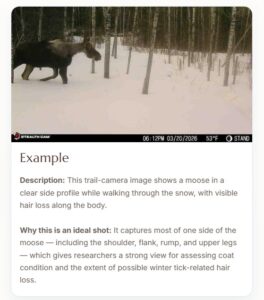
Example of a side-profile trail camera photo of a moose | Contributed Northern Moose Alliance
To learn more about the citizen science trail camera project and to sign up, visit the Northern Moose Alliance website here.
Listen to a special 30-minute program about the newly formed tribal-state collaborative research project under the umbrella of the Northern Moose Alliance below.
WTIP’s Kalli Hawkins spoke with four individuals involved in the Northern Moose Alliance. The audio includes a discussion of field observations this winter, moose populations in northern Minnesota, factors influencing moose mortality, calf recruitment, the geographic scope of the research, and much more.