
A well-designed theater requires far more than simply installing a stage and seating inside of a cavernous room. The best venues are carefully constructed using a mix of materials that address spatial considerations while maximizing the overall sound. But as a study published today in The Journal of the Acoustical Society of America indicates, there is another element that often affects how much you enjoy a show: color.
“Room acoustics perception is multidimensional,” Stefan Weinzierl, a study co-author and acoustics researcher at Germany’s Technical University of Berlin, said in a statement.
The key here is the perception of a theater, and not necessarily its measurable sonic qualities. In addition to reverberation and timbre (a sound’s quality or tone that makes it distinct from another sound), a venue’s appearance influences our interpretation of incoming audio.
“A hall can appear warm, [or] it can appear bright or metallic in sound,” Weinzierl continued.
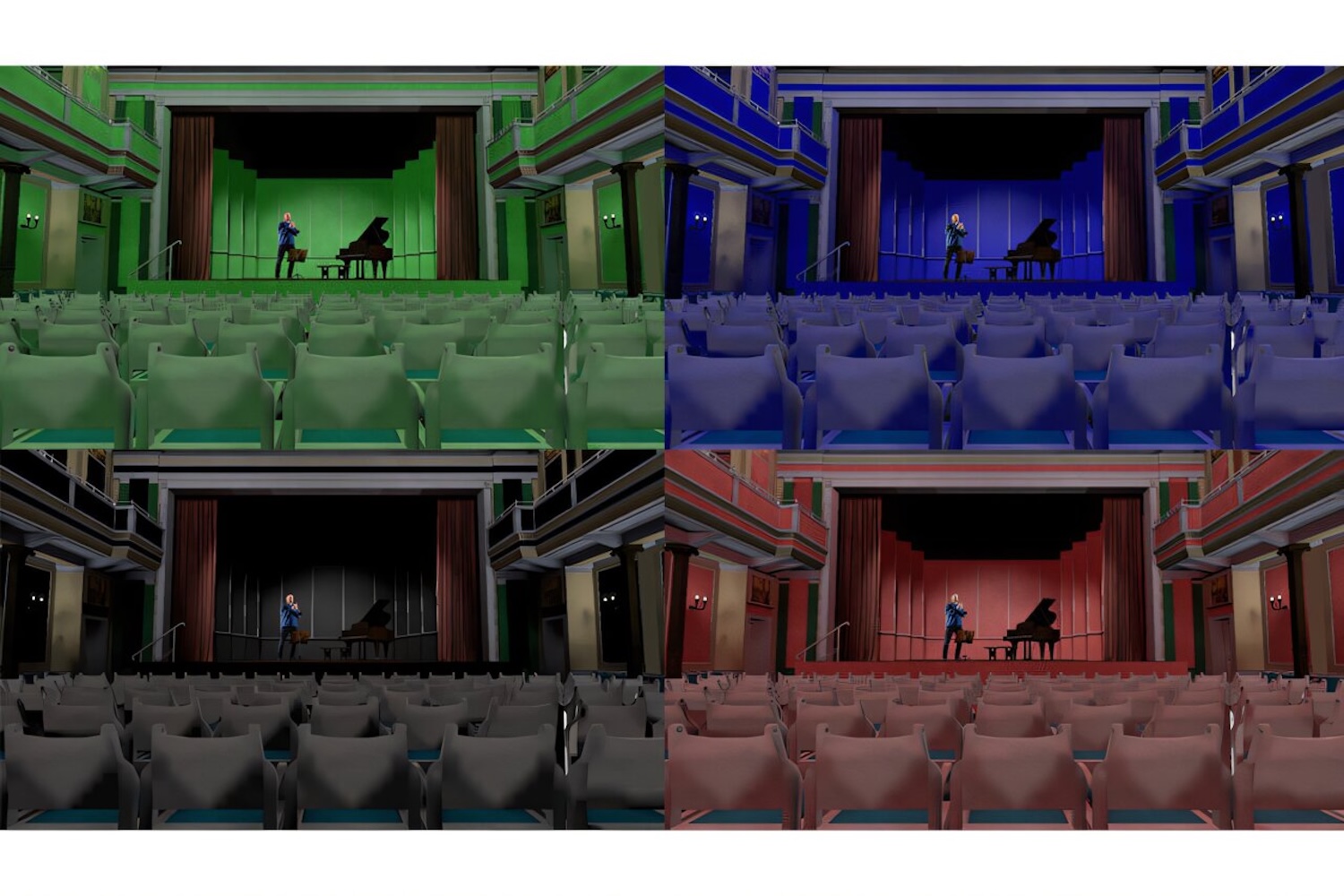
To illustrate this phenomenon, Weinzierl’s team asked a group of volunteers to experience concerts in various theaters—but with a catch. Given the logistical challenge of ferrying participants around multiple locations, the team broadcast the performances to the volunteers on virtual reality headsets. Each person then watched four shows (two violin and two clarinet recitals) in 12 different venues featuring various combinations of color, brightness, hue, and saturation. To boost the realism, the VR headsets also automatically adjusted the sound depending on where a person moved their head.
Following each concert, volunteers rated them based on enjoyment, timbre, reverberance, and strength. The results were clear. There was a distinct correlation between a music hall’s visuals and the perceived timbre of songs. More saturated or cooler hues like blue and green seemed “colder” sounding than the other options. Darker theaters also often increased how much a participant liked the music they heard. At the same time, there was no change in perceived volume depending on coloration—a finding reinforced by past studies.
The study’s authors said that while theater designers should remain focused on maximizing the acoustical capabilities of any given space, these visual cues warrant important considerations.
“All the money that is spent for making a concert hall sound well—I think it should not be overlooked that the visual appearance makes its contribution [to] the sound of the hall,” added Weinzierl.

2025 PopSci Best of What’s New