
Ever since I began playing Crimson Desert on launch day, it has never failed to impress me. Its open world is the most lifelike and immersive I’ve ever experienced; its combat sandbox is incredibly complex and satisfying to experiment within; its narrative, while certainly flawed, has its moments of unparalleled hype, and its moments of quiet exploration are endlessly rewarding and eternally beautiful. Crimson Desert may just be one of the greatest games I’ve ever played, and I am extremely thankful that it exists at all.
However, beyond the impressive open world and stunning visuals, Crimson Desert does something so novel within the world of gaming that it impressed me in a way I didn’t know was possible. Of course, this was only revealed to me once I had managed to slog through Crimson Desert’s awful introduction, but after I had experienced it, I began wondering why no other game has ever really implemented this. Crimson Desert’s incredibly naturalistic dialogue and incredible writing are legitimately mind-bogglingly unique and one of the most interesting and impressive features in the entire experience.
Crimson Desert’s Naturalistic Dialogue Is A Rare Wonder
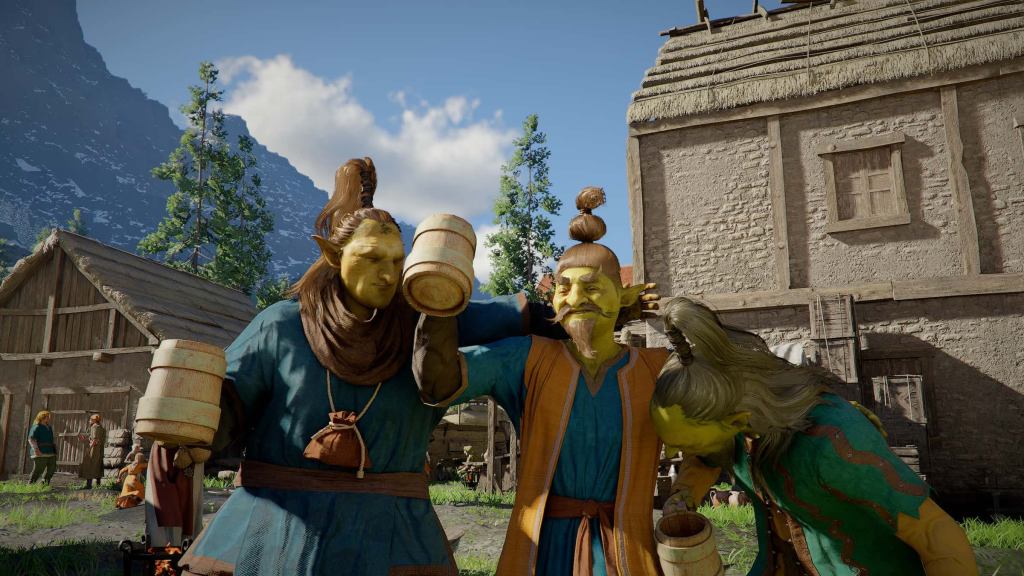
Fairly early on in Crimson Desert’s narrative, you are required to scan a memory of bandits bickering over stolen goods. This is, in the grand scheme of things, a tiny part in an otherwise enormously sprawling storyline. Indeed, within its own questline, this interaction is likely rather forgettable to most. However, it has stuck with me, even after having sunk nearly 100 hours into the game, for one simple reason: the way characters talk over one another. It may seem like a small, insignificant detail to some, but to me, it struck me as both incredibly impressive and exceptionally naturalistic.
It wasn’t a fault with the dialogue or a bug; it is one of Crimson Desert’s best features, and an important one at that. These bandits were bickering, so talking over each other as they determine what to do now that they’ve messed up and interrupting each other as they fearfully concern themselves with their boss’s inevitable negative reaction is both natural and fun to watch. This style of dialogue, which is so immensely rare in video games, gives the entire conversation a whole new dynamic, one that adds a needed sense of urgency and fear to the scene while also making these utterly minor characters feel more real.
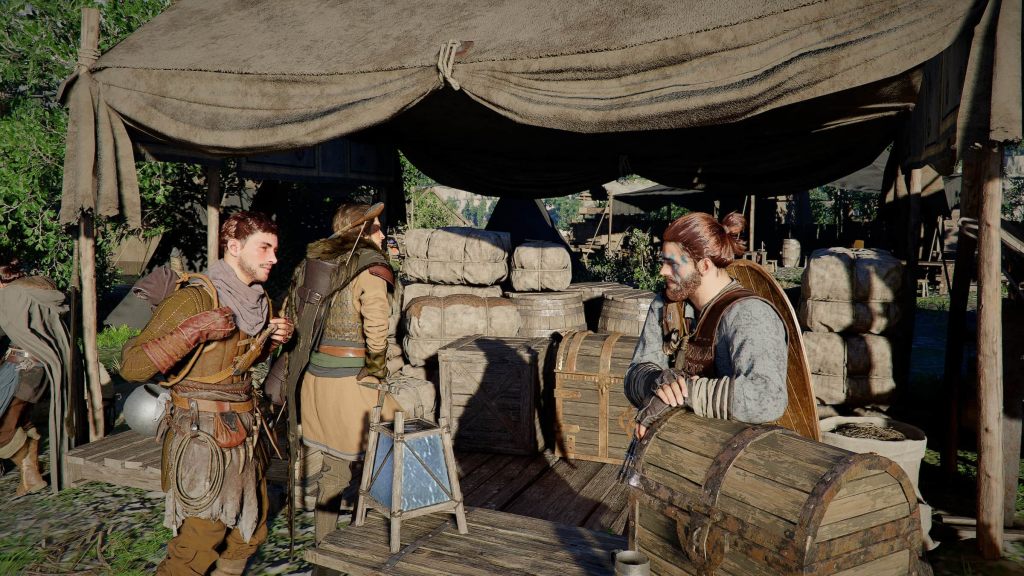
This isn’t the only time that this happens. Within this very same quest chain, there is a sequence in which Shakatu, the leader of the Goldleaf Merchant Guild, asks for your help, and his companions complain in the background about how ill-suited you are for the job. Again, it feels natural, adds to the scene, and allows background characters to both be a part of the conversation and have their feelings revealed in an ironically non-intrusive way. Of course, this happens time and time again throughout the entirety of Crimson Desert and eventually becomes the norm. However, these experiences in particular specifically stuck out to me as it was genuinely the first time I had experienced it in a video game.
More Games Need Dialogue That Feels Real
While this style of naturalistic dialogue is common in movies (watch any Steven Soderbergh for prime examples), in video games, it is barely featured. Typically, conversations happen one line after another, with words only ever being spoken over one another as a result of glitches or Skyrim NPCs inexplicably wandering into your conversation. That has worked for some time, especially in lore-heavy experiences in which lots of information needs to be relayed to the player succinctly and clearly.
One would assume that Crimson Desert would fall into that latter category, and it absolutely does. Not every conversation features characters shouting over one another, and many do take on the traditional cadence of one speaker after another. However, when it feels right and unobtrusive to both the conversation at hand and the information being relayed, or, indeed, it adds to either, Crimson Desert weaves it in perfectly. I really wish more games did this, as it not only makes Crimson Desert one of the most immersive open-world games as a result (in addition to all the other immersive aspects it features, of course), but it also manages to elevate even the most banal and badly written scenes.
As aforementioned, it wouldn’t benefit every game, but especially in those with plenty of motion-capped or lively dialogue sequences, it feels like a necessity. So many RPGs developed in the West have fallen prey to the boring and stale conversations of yesteryear, the kind that dominate experiences like Horizon Zero Dawn and Assassin’s Creed. Sure, over time, they’ve begun to feel a little more lifelike, but even in the most recent iteration of either of those aforementioned series and many others, dialogue often feels so artificial. Don’t get me wrong, Kliff’s occasional interjections that are so ill-suited to the conversation at hand, one wonders if he’s even paying attention, are just as artificial. However, at least in the majority of scenes in which it matters, Pearl Abyss put in the effort to not just record background dialogue, but perfectly integrate it into the mix in such a way that it feels natural.
That attention to detail is what makes Crimson Desert feel so believable, even in its most fantastical moments. Conversations that sound as if they’re happening between real people can ground a scene in the same way that the sounds of birds chirping nearby or the leaves rustling in trees help make the world around you feel more alive. Small audio tricks like this make all the difference, and I believe they are the future of next-gen gaming. We’ve had nice, fancy visuals for a long time now, and they’re only getting incrementally better despite the huge amounts of money poured into improving them. Now it is time to focus on audio, an aspect I was told at film school was actually more important than visuals. People will accept lazy visuals in a movie, but they won’t tolerate bad audio. I think the same rule should apply to video games, especially now that Crimson Desert has set a rather impressive precedent.
Do you enjoy Crimson Desert’s naturalistic dialogue? Leave a comment below and join the conversation now in the ComicBook Forum!