
In an age where music from around the world is only a few clicks away, more and more people feel inclined to make cross-cultural music. Tutorials, scores, and recordings are everywhere on the internet — and yet, there are aspects of musical traditions that cannot always be passed on through teaching.
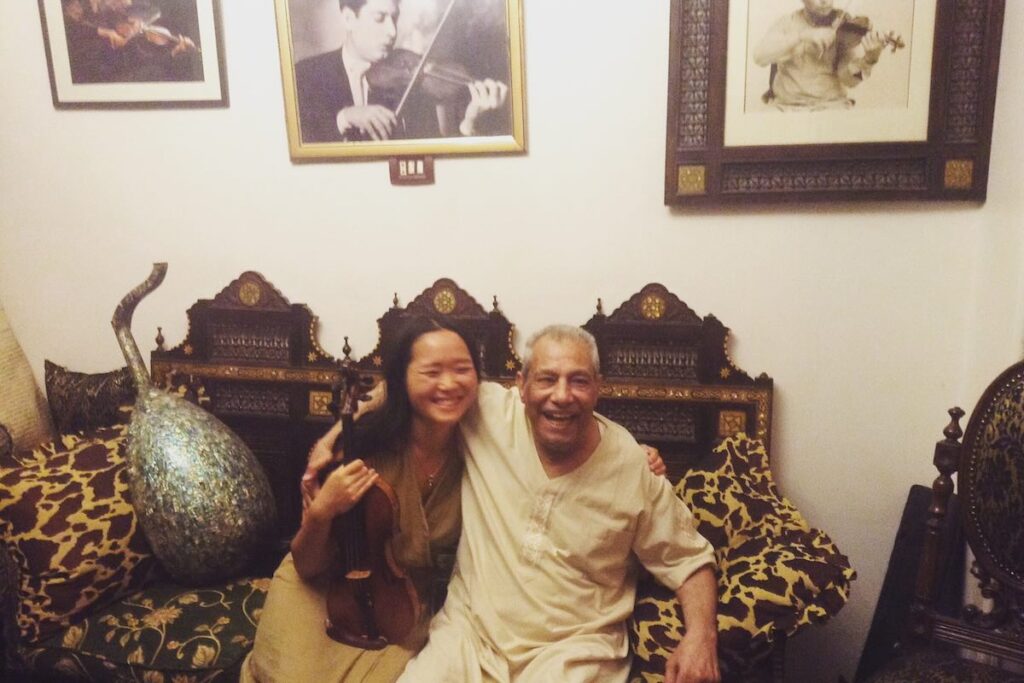
I am a Japanese violinist and composer based in New York City who specializes in Arabic music, particularly from the region between Cairo and Aleppo. I am deeply grateful — and aware of the privilege — to have been embraced by the Arabic music community in Cairo, including the Cairo Opera House. I studied with the late master Abdo Dagher, and my learning continues not only through sound, but through ongoing engagement with the culture that gave rise to this music. As much as I’ve devoted myself to this tradition, I know I will always remain a learner, because I am not Arab.
In recent years, I have been privileged to teach Arabic music, and it is through teaching that I began to notice something clearly. There are things I can teach: the scales, the ornamentation, the structure of a maqam. But there are also things I cannot fully convey through lessons:
The feeling of the air in Cairo
The rhythm of conversation
The way people move, pause, and listen
These are not techniques. They are experiences. And they shape the music in ways no sheet music or Zoom class ever could.
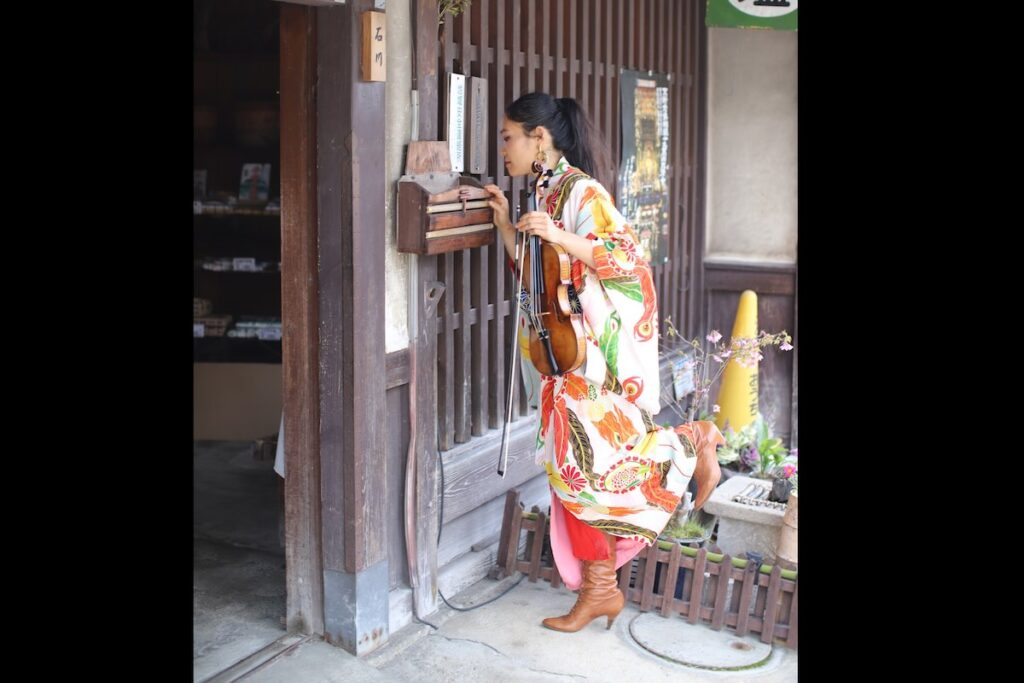
I come from a country where long-standing traditions are not preserved as artifacts, but lived as everyday reality. Japan exists today with the same imperial lineage since its founding 2,686 years ago, and for a significant portion of its history it deliberately limited outside influence. For example, during the Sakoku period (1639–1853), the country remained largely closed to foreign trade and travel for more than 200 years.
People who travel to Japan often tell me there is nothing like it. After living abroad for many years, I feel the same. Japan is deeply peculiar — not in an exotic sense, but in how thoroughly culture is embedded in daily life. Traditions, customs, values, and aesthetics are not performed consciously; they are embodied. Each gesture carries historical weight, yet few people are actively aware of its origins.
If I imagine someone trying to learn a Japanese tradition — whether shakuhachi, tea ceremony, or miygadaiku carpentry — I can immediately sense what that journey truly entails. It is never just about the practice itself. It is about living: language, posture, how one sits on tatami, how one stands, walks, or moves through space. These physical habits differ profoundly across cultures. So does the relationship to seasonal food, temperature, silence, and timing.
All of these sensory experiences — movement, taste, texture, rhythm — collectively shape culture. And music is no exception.
Studying music without engaging in the culture that produces it offers only a surface-level understanding. What gives music depth and gravity is the invisible accumulation of lived experience beneath the sound. Deep culture does not reveal itself quickly; it asks for time, humility, and a willingness to be reshaped.
Geography
Physical location shapes culture in profound ways. Geography influences how people move, gather, build, eat, listen, and speak. Over time, these environmental conditions seep into daily life and into the body itself, shaping artistic expression from the inside out.
Learning from immigrant musicians is deeply meaningful, and for many people, it is the first point of encounter with a new musical tradition. Many traditions survive and continue precisely because of immigrant communities, whose generosity sustains these practices far from their places of origin. But at the same time, there are limits to what can be transmitted outside the place where a tradition originated.
When I was struggling to feel comfortable in Cairo, I found myself deeply missing Japanese food. At one point, I brought with me a high-quality miso from a company founded more than 350 years ago in Japan. I treated it almost like an emergency kit — something that would help me survive emotionally while living far from home. I made miso soup in Cairo using this miso and local vegetables. It was terrible. I could not believe how flat and unappealing it tasted. Even with the best possible ingredients, something essential was missing.
I am still not entirely sure how to explain this experience, but it taught me something fundamental: without the right context, even the finest materials cannot reveal their true quality. The same is true of music.
Language
Language plays a similar role. Learning a language does not necessarily improve one’s technical skill, but it profoundly transforms the feel of the music. When you truly understand the language, phrasing, timing, and emotional contour begin to change.
I experienced this vividly during a rehearsal at the Cairo Opera House. A violinist sitting next to me showed me a video of one of his students. The student had been playing the violin for only two years, so my expectations were modest. But when I heard him play, I was stunned. He performed a short taqasim on the violin, and although his technical command was still developing, the sound was deeply convincing and emotionally grounded.
In that moment, the connection between language and music became undeniable. What emerged was not technical mastery, but something more elusive: an internalized understanding that cannot be taught through sound alone.
Context
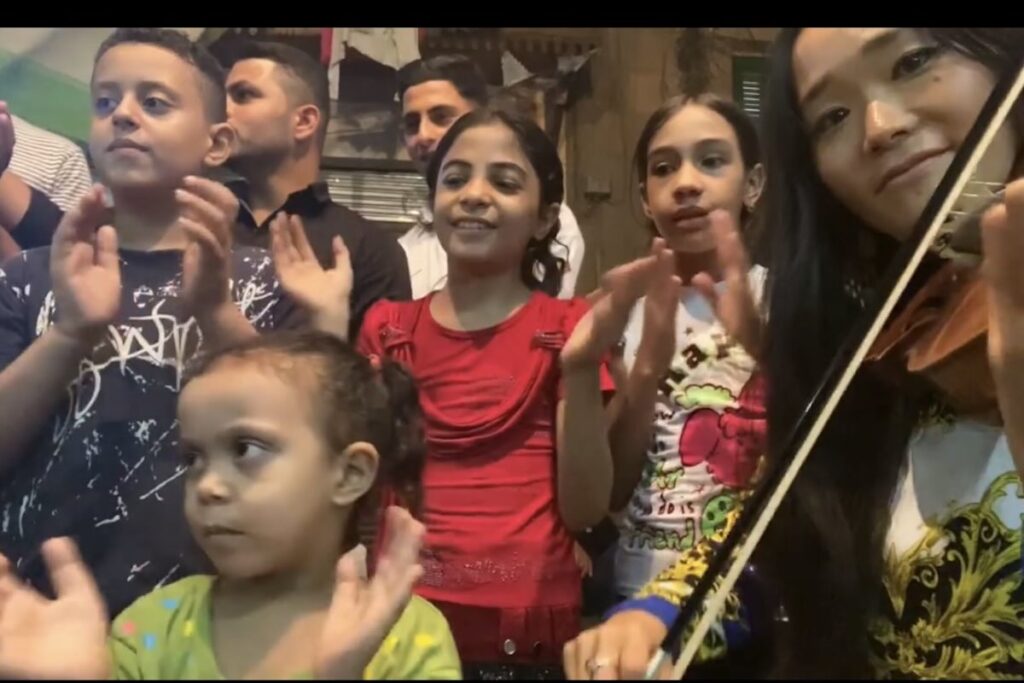
When cultural traditions are removed from their original context, they lose some of their meaning. Hearing classical music inside a church often feels right — as if this is where the music belongs. The architecture, reverberation, and height of the space shape how sound is perceived and how it moves the body. By contrast, playing the violin on tatami mats in a traditional Japanese house creates an entirely different relationship to sound. The notes are absorbed rather than projected, and the space itself teaches the musician how to listen, how to shape tone, and how to leave room for silence.
Sound is connected to place. Music is not only what is played, but where — and how — it is allowed to exist. I have never witnessed anything more beautiful than moments when all the elements are aligned: Arabic music performed in centuries-old buildings in Old Cairo, or a tea ceremony held in an old teahouse in Kyoto, where seasonal flowers and clothing reflect the time of year. In such moments, the art reveals itself in its fullest form.
Assimilation
As my body learned how to live within the culture of Cairo, my sound changed with it. Crossing the street in Cairo requires a highly developed form of bodily awareness. In a city of nearly 22 million people, traffic laws offer little guidance, and vehicles have priority over pedestrians. For many foreigners, crossing the street is genuinely intimidating. I remember hesitating at the curb, gathering courage before stepping forward.
The only way to learn is by doing — by stepping into the flow of traffic and allowing the body to adapt. Egyptians move with a steady, calibrated timing. They neither rush nor hesitate. Once the body learns this vocabulary, the street becomes navigable.
Around the same time that I was praised by a bandleader for noticeable growth in my playing, a friend remarked that I was crossing the street with more ease. He said, “You move like an Egyptian.” The timing of these two comments stayed with me.
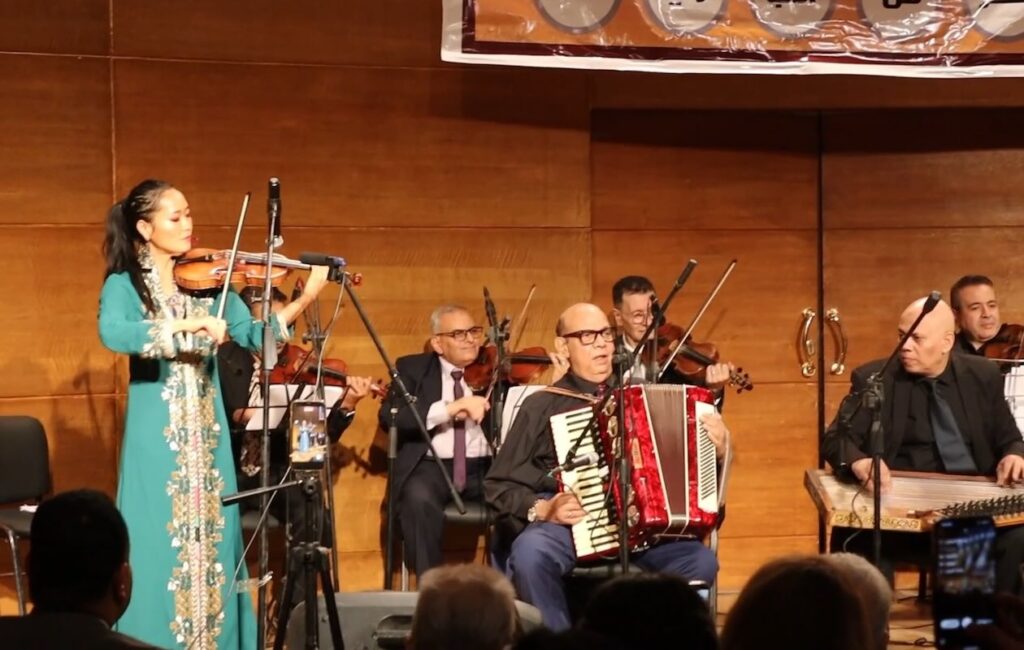
Almost simultaneously, my spoken Arabic became more fluid. Conversations felt intuitive. I also noticed a shift in my cooking; as Egyptian spices became familiar, the sense of missing home through food gradually faded. These changes were not separate achievements, but interconnected signs of deeper assimilation — musical, linguistic, physical, and sensory.
We live in a time when global access is often mistaken for global understanding. But embodiment cannot be downloaded. Technique matters. Discipline matters. Focused study on the instrument is essential. Yet patience is equally necessary, and what can feel like wasted time is often part of the learning.
When we engage with musical traditions from other cultures, we should seek their most authentic expressions, ideally in their original locations. Without experiencing the convergence of place, time, atmosphere, and embodied practice, our understanding remains incomplete.
Arabic music is available on YouTube, and maqam can be studied online. But if you have never heard the call to prayer echo between buildings, never stood in the Cairo heat, never shared a meal in a home where that music lives, then you have not learned the whole thing. You have learned a part.
That is not a failure. It is simply a limitation. What matters is not mistaking the part for the whole. Some things cannot be taught — only lived. And that, too, is part of learning.
I CARE IF YOU LISTEN is an editorially-independent program of the American Composers Forum, and is made possible thanks to generous donor and institutional support. You can support the work of ICIYL with a tax-deductible gift to ACF. For more on ACF, visit composersforum.org.