
By Katie Gerbasich
Since the first Olympic Games, athletes have used natural supplements or other substances to enhance performance. Today, doping has become far more chemically sophisticated. Chris Chouinard, Ph.D., assistant professor in the Department of Chemistry in the College of Science and Faculty Fellow of the Robert H. Brooks Sports Science Institute, researches anti-doping, specifically focusing on developing new techniques to identify designer drugs.
“What we’ve tried to develop as a field are techniques that increase our sensitivity and ultimately our ability to detect not only known drugs but also potentially new compounds,” Chouinard said.

Chouinard began his anti-doping research during his time as a graduate student at the University of Florida, and later as a postdoctoral researcher at Pacific Northwest National Laboratory in Richland, Washington. He was part of a team that developed a new ion mobility technology called Structures for Lossless Ion Manipulations (SLIM). This paradigm-shifting, high-resolution ion mobility technique was eventually patented and licensed to a startup company, MOBILion Systems.
High-resolution ion mobility spectrometry, when combined with mass spectrometry, allows scientists to separate and identify molecules with remarkably similar chemical structures.
One of the biggest challenges in anti-doping science is detecting small molecules at extremely low concentrations. Many anabolic steroids fall into this category, making them particularly difficult to distinguish from naturally occurring compounds in the body using traditional ion mobility techniques.
“Historically, high-resolution ion mobility has struggled with really small molecules,” Chouinard said. “But with this new approach, we can measure those compounds with much better sensitivity, which is exactly what we need for detecting anabolic steroids and other performance-enhancing drugs.”
Chouinard’s lab was the first to install this newest version of the technology, which was implemented in December 2024 in partnership with MOBILion Systems.
“From a chemical standpoint, we can think about this as our ability to identify a needle in a haystack when we don’t necessarily even know what the needle is,” Chouinard said.
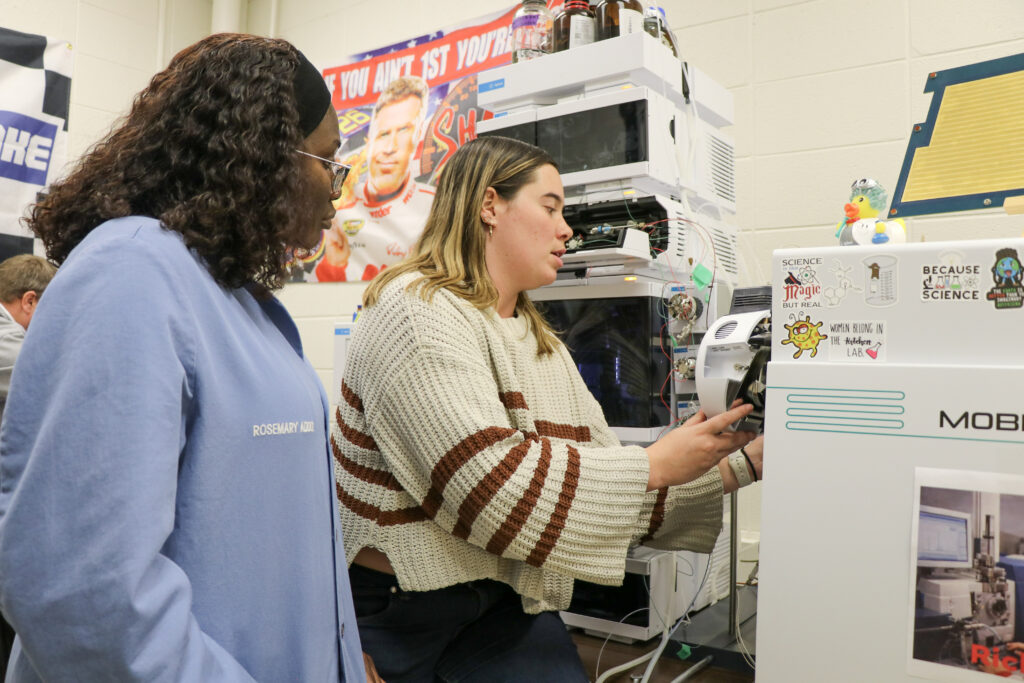
MOBILion Systems continues to provide funding that supports graduate and undergraduate students in Chouinard’s lab. Working out of Hunter Hall, Chouinard applies high-resolution ion mobility techniques to the study of anabolic steroids and a wide range of other prohibited substances.
One significant milestone came in 2023, when Chouinard published a paper with several Clemson student co-authors demonstrating the ability to differentiate 40 anabolic steroids in urine samples in just two minutes per sample. The study used a combination of chromatographic separation and ion mobility techniques.
“Anti-doping is all about protecting athletes,” Chouinard said. “This is where anti-doping science has to evolve from being reactive to being proactive; we’re not just looking for drugs we already know about, but developing techniques that allow us to identify substances we don’t even know exist yet.”
Chouinard’s group has continued to advance the field and this semester earned its fourth round of funding from the Partnership for Clean Competition to continue its research.
The World Anti-Doping Agency (WADA) aims to standardize testing methods worldwide so that testing at large-scale events like the Olympics or the World Cup remains consistent regardless of location.
Athletes can sometimes avoid detection by microdosing or cycling on and off anabolic steroids. To counter this, scientists rely on long-term profiling rather than single test results. An athlete’s biological passport tracks multiple steroid metabolites over time, enabling longitudinal monitoring.
“These are all high priorities right now for WADA, the U.S. Anti-Doping Agency and the Partnership for Clean Competition,” Chouinard said. “They are key areas where we hope to make significant progress over the next two years.”
As detection methods evolve, they strengthen efforts to protect athlete health and preserve the integrity of competition, ensuring that success in sport reflects training and talent rather than chemistry.