

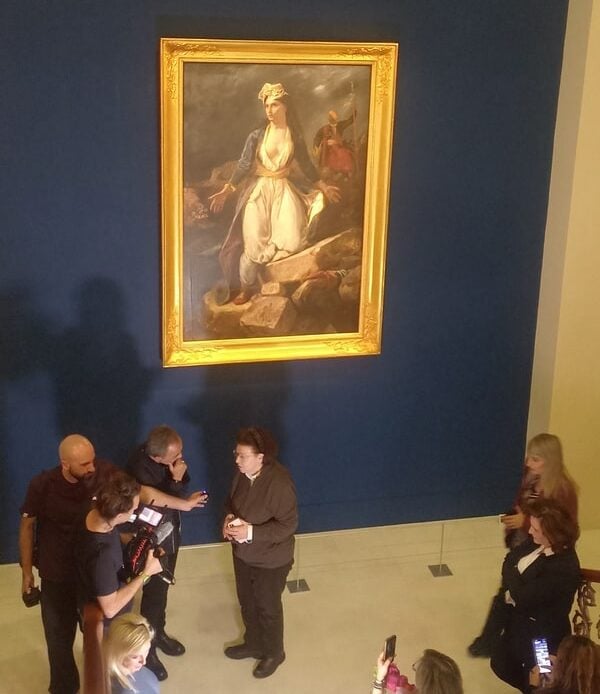
Eugène Delacroix’s iconic masterpiece, “Greece on the Ruins of Missolonghi,” has arrived in Greece’s Sacred City of Missolonghi (Greek: Μεσολόγγι) for the first time. The transport took place on the occasion of the bicentennial of the heroic 1826 Exodus, bringing the 19th-century oil painting to the exact location that inspired its creation.
Greek Culture Minister Lina Mendoni, Missolonghi Mayor Spyros Diamantopoulos, General Director of Antiquities Olympia Vikatou, and prominent Greek-French journalist Nikos Aliagas formally welcomed the 2.13-by-1.42-meter artwork at the Xenokrateion Archaeological Museum of the city.
On loan from the Museum of Fine Arts in Bordeaux, France, the painting depicts a wounded but resolute woman kneeling among rubble, symbolizing the Greek fight for independence.
During the presentation, Minister Mendoni addressed the historical importance of the 200-year anniversary. She explained that for 19th-century intellectuals driving the philhellenic movement, the Greek revolution mirrored their core values.
“She is wounded, but she is standing. She is humble, but she is dignified,” Mendoni said regarding the painting’s allegorical figure that symbolizes the Greek nation. She noted that the bloody hand emerging from the ruins was the people’s sacrifice. Mendoni said the piece is a timeless symbol of resistance, hope, and regeneration.
Delacroix’s Missolonghi-inspired painting is the “Mona Lisa” of Bordeaux
The artwork rarely leaves France. Sophie Barthélémy, director of the Bordeaux museum, told the Greek newspaper Ta Nea that the piece functions as the “Mona Lisa” of their collections. Acquired in 1852, it was last loaned out in 2018 for a retrospective at the Louvre and the Metropolitan Museum of Art in New York.
Barthélémy pointed out that Delacroix’s universal declaration of freedom retains its relevance amid modern geopolitical conflicts, referencing the war in Ukraine. She authorized the complex transfer, which required specialist conservators and strict security protocols, after witnessing how deeply the artwork resonates with the Greek public. She will attend the official opening events in person too.
Upcoming bicentennial exhibitions in Missolonghi
The painting will be on public display at the Xenokrateion from April through November 2026. The official thematic exhibition opens on April 3. Alongside Delacroix’s work, the museum will host two artifacts loaned by the National Historical Museum of Greece: Pierre-Jean David d’Angers’ marble sculpture “The Maiden of Greece” and the coat of Konstantinos Xenokratis, the only surviving uniform piece of the Sacred Band.
These displays anchor a wider commemorative program. On March 20, the Chrysogelos Building will open the “Exodus, 1826-2026” exhibition. Co-organized by the National Historical Museum and the Region of Western Greece, and curated by Natasa Kastriti, Regina Katsimardou, and Ifigeneia Vogiatzi, this parallel event features: Theodoros Vryzakis’s painting “The Sacrifice of Kapsalis,” alongside works by A. Jacquand and Horace Vernet, the wooden figurehead from Andreas Miaoulis’s ship Aris, historical weapons, documents, and portraits of the besieged as well as interactive dioramas, shadow theater compositions, and pages from Soloup’s graphic novel “21: The Battle of the Square” detailing the historic breakout.