
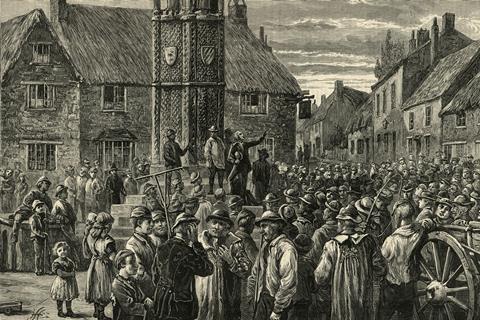
Claims abound that AI will democratise science. What does that really mean though, and is this the first time that science has been democratised? I’m happy to say that this is not unprecedented. In fact, a closer look at how science — and chemistry in particular — has historically developed reveals that there have been several advances that contributed to what we like to refer to as the democratisation of science.
Very simply, democracy is a form of government. It corresponds to what Aristotle referred to as the ‘rule of many’, which he juxtaposed to the rule of the few (i.e. an oligarchy) and the rule of the one (i.e. a monarchy). In general, democracy is considered a superior form of governance. Aristotle put it quite nicely: “(T)he many, who are not as individuals excellent men, nevertheless can, when they have come together, be better than the few best people … just as feasts to which many contribute are better than feasts provided at one person’s expense”.1
One of the reasons for democracy’s superiority is because it is considered a more reliable way of getting to the truth. In the field of social epistemology and political science this has been expressed in different ways. The Condorcet Jury Theorem (established by Marquis de Condorcet) states that the likelihood of a group of people getting the right answer to a question increases with the group’s size. Similarly expressed as the wisdom of the crowd, this principle was tested in 1907 by Sir Francis Galton, who asked around 700 villagers to guess the weight of an ox. While none of them guessed its exact weight, the average of their guesses was surprisingly close to the actual value.
The many meanings of democratisation
The idea of democratising science can refer to different things. For example, by ‘democratising science’ one may refer to the act of including or incorporating as many people, ideas or methods to its practice, as possible. Or, it may refer to science’s social function, by setting the expectation that science’s fruits serve the needs of many different groups of people, or of the majority. These two meanings do not necessarily coincide. Tracking how science has been democratised throughout its history constitutes a research programme in its own right, and by no means am I able to sufficiently track it here. Nevertheless, I think it is useful to highlight some events that contributed to making science democratic and which took place long before AI was even conceivable.
From a self-funded amateurish hobby, practicing science became a profession
One major event that led to the democratisation of science is the so-called Scientific Revolution. Spanning the 16th and 17th centuries, the Scientific Revolution transformed how people investigated nature by taking the practice from the private space into the public. This was done gradually and in multiple ways. At first individuals started to group into private associations, which then turned into what we now recognise as scientific societies or national academies of science. They started to exchange ideas, present their work in printed journals and test each other’s scientific claims. From a self-funded amateurish hobby, practicing science became a profession.2
A second very important thing that democratised chemistry was the construction of laboratories first within the university setting, and thereafter in schools. The first chemical laboratories (or workshops, as they were initially called) appeared in the late 16th century. As historian of chemistry Mary Jo Nye says, ‘(s)ystematic laboratory instruction in exact science, first as a program of collaboration and apprenticeship, then as a program of school training and systematic chemical investigation, was the contribution preeminently of chemists to modern science’.3
Simple techniques and diverse values
Another thing that has contributed to the democratisation of science (and still does) is the development of cheap and easily reproducible experimental techniques. Take, for example, litmus paper. Measuring the acidity of a substance is one of the most common chemical experiments that one comes across from a very young age. Developing such simple techniques has been crucial not only because it allows more scientific centres to develop their own research but also because it renders scientific education much more accessible.
The last and most recent attempt to democratise science is by discussing how values shape scientific research agendas and by developing procedures within academia that allow many different views and methods of inquiry to be explored.4 The latter is also something that has been discussed within feminist analyses of science, bringing out specifically the importance of marginalised groups’ viewpoints for the advancement of science.5
So, while AI is expected to contribute to the democratisation of science by facilitating access to scientific knowledge and allowing more people to engage in its practice, let’s not exaggerate its impact. This is not the first time human ingenuity has allowed us to advance scientific practice – nor will it be the last.
References
1 Aristotle, Politics III, 11, 1281a41–1281b, trans. Reeve 1998: 83
2 L Principe, The scientific revolution: A very short introduction. Oxford University Press, 2011, p128
3 MJ Nye, From chemical philosophy to theoretical chemistry: dynamics of matter and dynamics of disciplines, 1800-1950. University of California Press, 1994, p50
4 P Kitcher, Science in a democratic society. Poznan Studies in the Philosophy of the Sciences & the Humanities, Volume 101, Brill, 2011
5 H Longino, The Social Dimensions of Scientific Knowledge. The Stanford Encyclopedia of Philosophy (Spring 2025 Edition), EN Zalta and U Nodelman (eds.).