
- Catch up on the key stories and developments shaping the financial world.
- Top stories: Banks develop agentic AI; Private credit seizes 15% of global lending; African firms turn to stablecoins to hedge currency risks.
- For more on the World Economic Forum’s work in finance, visit the Centre for Financial and Monetary Systems.
In the first quarter of 2026, the global economy faces familiar headwinds.
Two emerging trends illustrate how businesses are putting those priorities into practice: banks scaling more autonomous AI systems into core operations, and a continuing shift towards private credit as companies seek faster, more flexible funding amid tighter bank capital rules and lending standards.
1. A new era of AI-driven decision-making
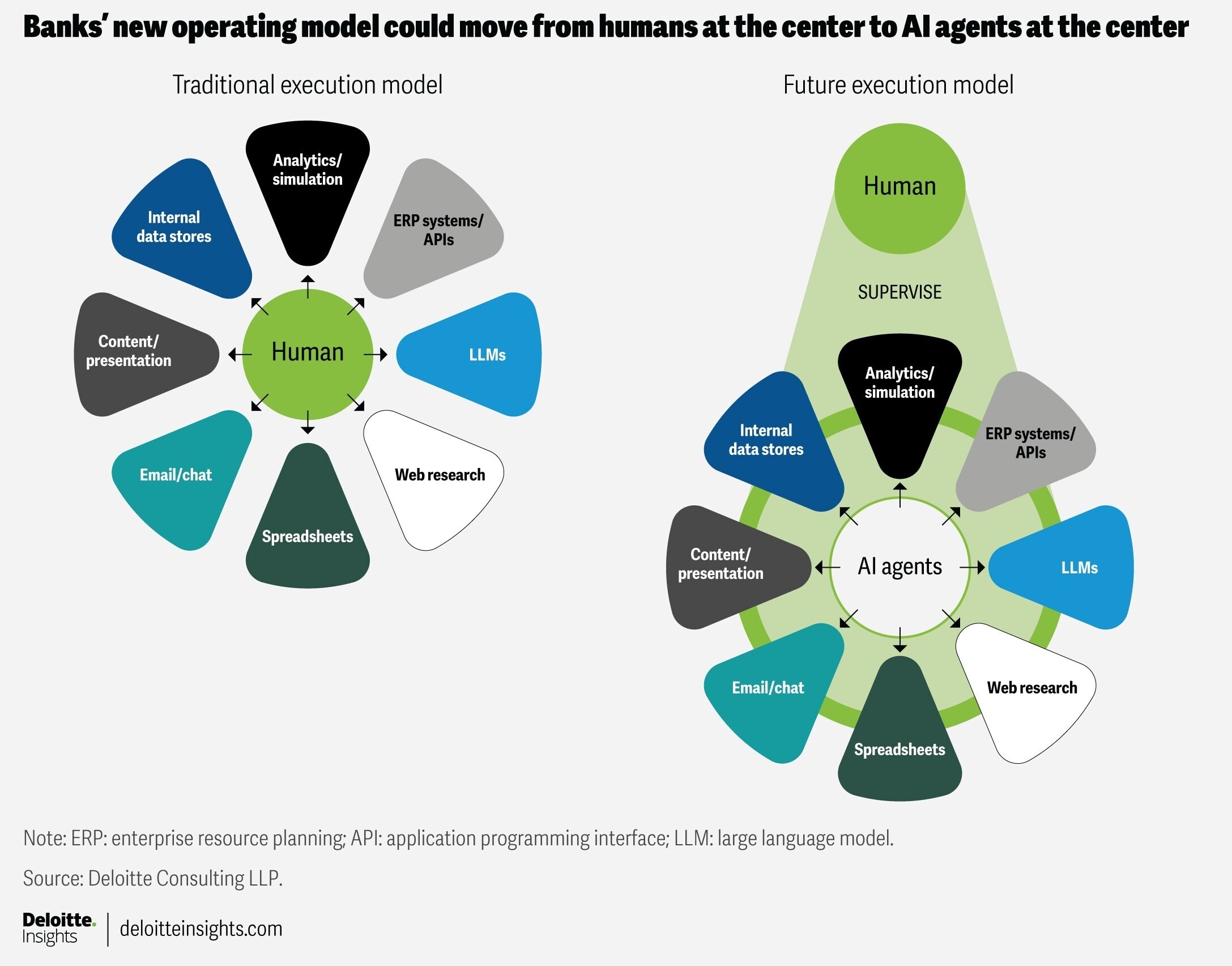
In 2026, the banking industry – as anticipated in the November 2025 finance roundup – is moving from AI “assistance” to “transactional authority”. These systems are no longer just summarizing reports; they are being integrated as semi-autonomous “digital co-workers” designed to settle routine trades and manage compliance checks under human oversight.
Meanwhile, Lloyds Banking Group has said 2026 will see “enterprise-wide deployment” across financial services of agentic AI. The bank expects these systems to add £100 million in value this year by automating fraud investigations and complex complaints – diverting routine cases to AI while reserving human staff for the most nuanced client escalations.
2. Private credit’s $41 trillion expansion
As traditional bank lending remains constrained by tighter capital standards, corporate funding is continuing to migrate towards private credit.
The market for trading private deal stakes (secondaries) reached a record $226 billion in total volume, Evercore’s 2025/2026 market data shows. This surge is driven by a critical need for liquidity, as limited partners (LPs) increasingly use secondaries to manage portfolios in the absence of a robust Initial Public Offering (IPO) market.
Regulators are focusing on the growing “interconnections” between banks and private funds. The Basel Committee recently stated that the boom in “significant risk transfers” (SRTs) – where banks pay private funds to take on the risk of their loan books – requires continued supervision. Excessive reliance on SRT could reduce the resilience of the banking system if the risk-bearing capacity of transactions were to fail, it said.
3. More finance news to know
And several US IPOs are being trimmed or delayed as market volatility and tighter valuation checks weigh on new listings. Firms including Clear Street and Brazilian fintech Agibank have scaled back or postponed offerings amid investor caution.
Fears of AI disruption have driven a recent pullback in US software stocks, but strategists at JP Morgan and Morgan Stanley see buying opportunities in higher-quality, AI-resilient companies, Reuters reports.
Africa’s biggest economies are driving a surge in stablecoin use, with firms in Nigeria and South Africa turning to digital dollars to hedge against local currency depreciation. Corporates are increasingly using stablecoins for cross-border trade and as a steadier unit of account amid persistent dollar shortages, a new study shows.
4. Read more on Forum Stories
How are central banks balancing price stability, independence, and credibility in a world marked by geopolitical tensions, fragmented markets and rapid technological change? Learn how central bankers are navigating these challenges and redefining their role in the 2026 global financial system.
Stablecoins are moving beyond niche experiments to become prominent tools for financial inclusion. From speeding cross-border payments and supporting small businesses to delivering humanitarian aid, these digital currencies offer faster, cheaper and more transparent ways to access money. Interoperability and collaboration with existing systems are key to unlocking their full potential in a resilient global financial network.

