
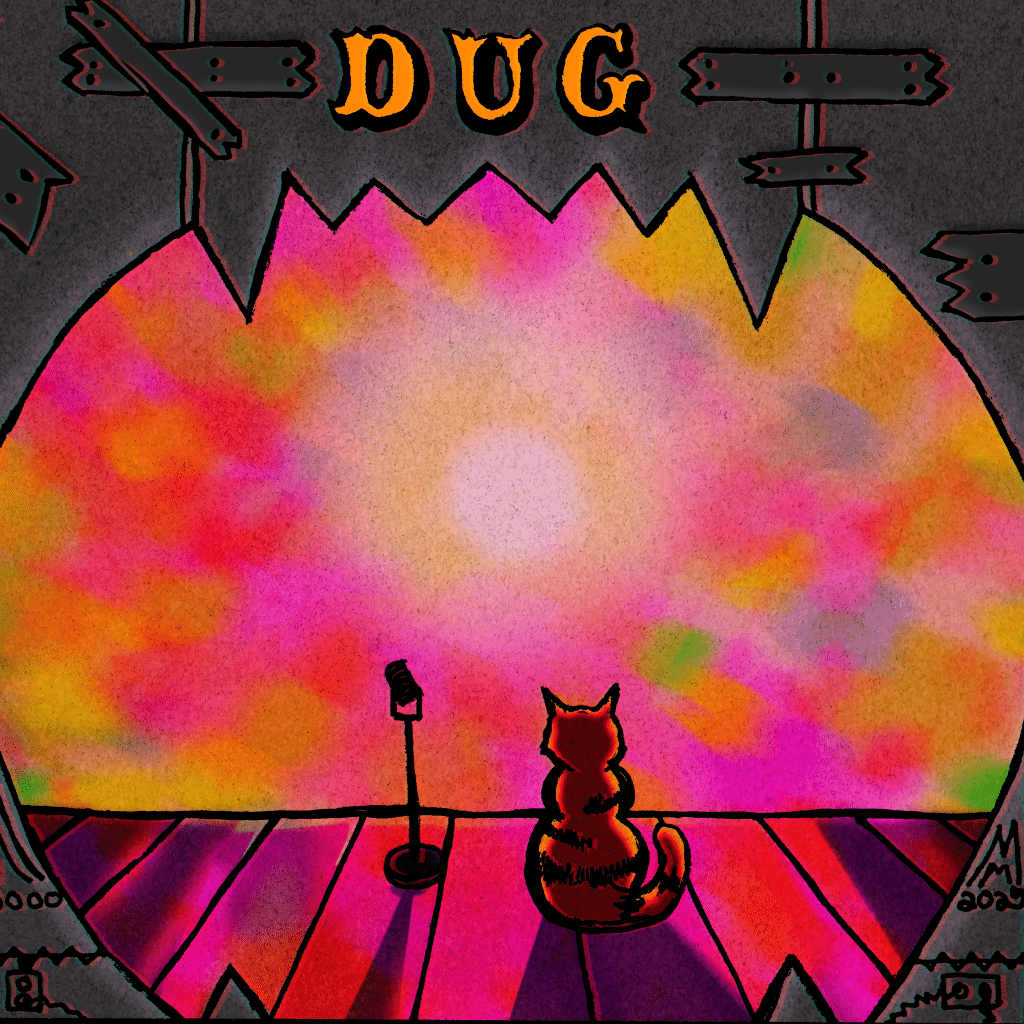
The Columbus rapper Dug never intended years to pass without releasing new music. But that’s precisely what happened, with the pandemic, creative burnout, a mental health breakdown, and the decision to return to school amid a career pivot combining to slow the musician’s creative process to a crawl, which then introduced an entire new slate of issues.
“It became this thing where things were changing about the world, and I was talking about the world or the country in certain parts of [the album], and then I would have to go back and change what I had written to update it,” said Dug, born Doug Gamble, whose new The Cat EP released digitally this week via Flowerpot Records. “And that would happen with my emotional state, too, where I would process stuff by writing about it, and then I’d be like, ‘Well, I like this song, but I don’t like this line anymore because I feel it represents the situation differently than how I feel about it now.’ And I think that’s part of the reason I used to make things so quickly, because then I didn’t have to worry about it, and by the time I was done, I still felt the same way.”
Even at just six tracks, The Cat EP traverses expansive internal and external ground, with Dug writing about his struggles to maintain his grip in a world sliding deeper into economic disparity and political fascism – “It’s hard to think about a future anymore,” he raps on “Dork,” a track that opens with him offering his one-star review of the panopticon. At the same time, the musician stubbornly refuses to throw up his hands. “You gotta do it for the part of you that lives,” he raps on the album-opening “Pure Euphoria,” introducing an idea to which he returns throughout the EP’s cascade of dense, lyrically adroit verses.
“I’ve been trying to work on improving my mental health somewhat,” Dug said of this slight upward turn. “But as anybody currently doing that could probably tell you, it’s an interesting time to be doing that work, because things are rapidly deteriorating. I feel like a lot of trying to get over being in distress is trying to bring yourself down from the idea that everything is in danger, but everything kind of is in danger.”
At the height of this crisis, which coincided with the most intense Covid months, Dug said he stopped writing and recording altogether, with the sense of detachment he felt from the form becoming so intense that he couldn’t even listen to music. “I liked music so much, and I wanted to be a part of it, but it felt like it had cut off completely from me,” continued the rapper, who filled his time in this stretch by walking alone around his neighborhood and playing video games, keenly aware in the moment that the sense of connection he once felt to his surroundings had begun to evaporate.
“You only get a little time,” he raps of this period on “Dork,” “I started to spend it checked out.”
A series of turning points eventually arrived, beginning with the rapper’s decision to start therapy and then later with his embrace of sobriety, though Dug shared with typical candor that the benefits to come from giving up drinking were not immediately evident to him.
“Things initially got much worse, which was part of the reason I threw out the album I was working on, because it was increasingly becoming about how much worse my life got after I got sober, and I was like, man, that’s not an idea I want to portray,” Dug said. “But after a while, that wasn’t true anymore, and my life did get better. … But for a while it was like, yes, I did have to get sober. Yes, I’m proud of myself for doing it. Do I feel better? No, I feel worse.”
Though atypical of sobriety messaging, the rapper’s willingness to acknowledge that the upshots to some decisions are not always immediately discernible could be invaluable to people going through similar struggles, and he said he’s always felt a draw toward those artists willing to expose these vulnerabilities in their own music. “Before I got into therapy, what I had was that music where I heard somebody say something,” Dug said, pausing briefly to gather his thoughts. “There have been times where I’ve been fully seated … and I’ll hear a line and I’ll get so excited that I physically jump out of my chair, like, ‘Oh, that’s it. That’s it.’”
This sort of connective tissue is present throughout songs such as “Dug Forbid,” with the rapper addressing his idiosyncrasies and mental health issues not as wholly unique tics but as something common to many currently doing their best to navigate these times. “There is community and strength in finding out there are other people like you,” the Dug said. “One of the reasons I called it The Cat EP is because cats are weird and awkward and slow to warm up to people, but I also like cats a lot, and I think they’re very loyal and cool. And so, it’s kind of an expression of me owning the things about myself that I had been trying to get rid of, and that I eventually just recognized as a part of me.”
Though modest, this acceptance marks a radical shift from the previous releases in Dug’s catalogue, with the rapper describing his earlier albums as a collective “scream of pain.”
“And it was good, and I’m not saying I didn’t like it,” he said, and laughed. “I’m just saying, that was a person who needed help, and then I got help, and now I’m better. And I don’t act like I’m doing fantastic now, but at the rate that other rappers would say something positive, bragging about themselves, I used to castigate myself. So now I’m trying to move toward being more positive about myself, which is hard and scary. … But at this point, I think I’ve definitely spent enough time at the other extreme end of the spectrum.”