

BPAN Heroes, the association founded by the families of the only two diagnosed BPAN patients in Greece, is leading a campaign to raise awareness of the rare brain disorder through a benefit concert and calls for research funding and international support.
The effort will take center stage on April 5, 2026, when the Municipal Conservatory of Kozani in Northern Greece, together with around one hundred volunteers aged eight to eighty, presents Hymns of Hope, a concert of Easter hymns arranged for symphony orchestra and choir. The event will also be available via live stream, reaching audiences beyond Greece.
Behind the initiative are Nadia Tziola, mother of Alexandra, and Michalis Kouziakis, father of Maria, whose daughters are the only two diagnosed BPAN cases in Greece. According to Kouziakis, who spoke with Greek Reporter, the concert grew out of a broader effort to mobilize communities and support the search for a treatment for a disease that currently has no approved therapy.
BPAN, a rare brain disorder with devastating consequences
BPAN, short for Beta-propeller protein-associated neurodegeneration, is a rare brain disorder caused by a mutation in the WDR45 gene, one of roughly 20,000 genes in human DNA. The condition is not inherited but occurs due to a random mutation, and most diagnosed patients are girls. First identified in 2012, BPAN remains extremely rare, with only about five hundred cases diagnosed worldwide and just two in Greece, according to the families.
Children with BPAN are usually born appearing healthy. The first symptoms typically appear in infancy or early childhood, as developmental progress slows and milestones begin to fade. Even so, many children continue to grow and develop skills, often alongside their peers, though at a slower pace. Alexandra and Maria followed this same pattern.
BPAN often worsens with age
What makes BPAN especially cruel is the way it progresses. The disorder, said Kouziakis, often becomes far more aggressive in adolescence or adulthood, although in many cases the decline can begin earlier. At that stage, it attacks the nervous system with symptoms resembling Parkinson’s disease and Alzheimer’s disease.
Patients can lose abilities they spent years developing and may eventually become fully dependent on care. According to the families in Greece, people with the brain disorder BPAN rarely reach their 30s or 40s, and many may die much younger. For parents, that makes time the most unforgiving obstacle.
Turning diagnosis into collective action
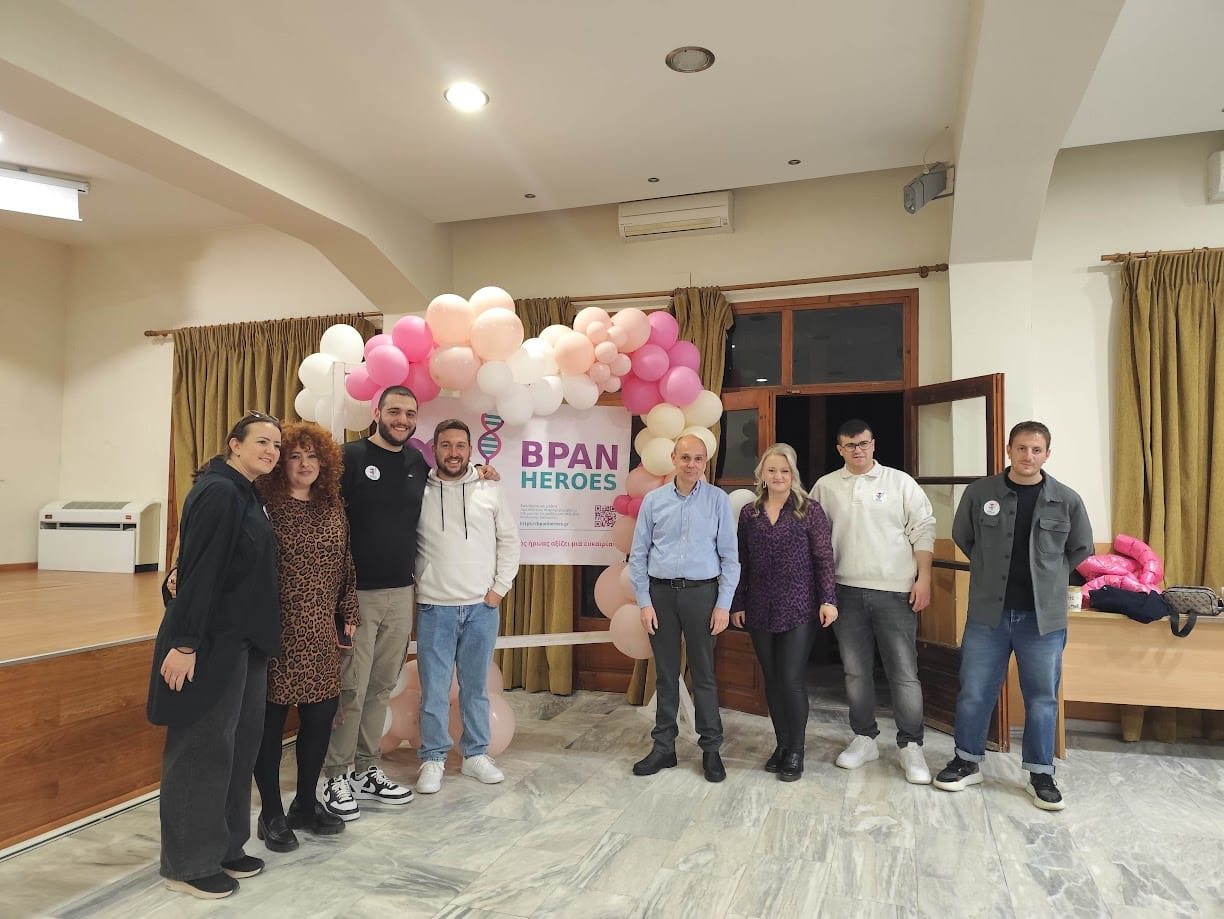
The association Heroes of BPAN was founded in September 2025 about a year and a half after Alexandra’s diagnosis and a few months after Maria’s. Its main goal is to help make treatment for BPAN possible.
The families say there is real reason for hope. Over the past fifteen years, gene-based therapies designed to correct defective genes have begun changing the outlook for diseases once considered untreatable. They point to conditions such as thalassemia and spinal muscular atrophy as examples of how rapid progress is possible.
BPAN, however, faces a major challenge beyond the science itself. Its extreme rarity means it has not become a priority for large pharmaceutical companies, forcing the families to seek support elsewhere—reaching out to universities, hospitals, and research centers already working on rare neurological disorders.
Why the focus on London?
Among the research programs they explored, the most accessible for the Greek families is a project at University College London in collaboration with Great Ormond Street Hospital. Researchers there have established a dedicated laboratory and are already conducting animal testing as part of efforts toward BPAN gene therapy.
Developing and gaining approval for a treatment is a costly process. According to the families, part of that expense can be covered by the university’s own resources. Even so, approximately £2.3 million (over $3 million) in private funding is still needed to secure a key tool in the clinical pathway: the AAV9 viral vector, which would be used to deliver the therapy.
A transnational effort in Greece by families against the brain disorder BPAN
For two families acting alone, raising the necessary funds was impossible. This reality led the Greek association to join forces with two other parent-led groups: Action for BPAN in the United Kingdom and BPAN Matters in Spain. Together, they are building the kind of international support that ultra-rare diseases often struggle to attract.
In Greece, the families’ approach has been distinctive. Rather than relying solely on large donations, they have focused on raising awareness, encouraging volunteerism, and mobilizing communities—inviting people to contribute through their skills, knowledge, and personal interests.
The strategy has quickly gained momentum in Grevena and Kozani, where residents have organized dozens of events to support the cause. These have included football matches and other sporting events, children’s theater performances, school celebrations, dance evenings, public information sessions, and outdoor seasonal gatherings such as Christmas festivities and bazaars.
Through these initiatives, the association has already raised €130,000 (about $150,000), mostly from donations by ordinary citizens. As Kouziakis revealed in speaking with Greek Reporter, the total continues to grow day by day, bringing the campaign steadily closer to its goal.

Families in Greece and their concert message on BPAN
Out of that grassroots momentum came the idea for Hymns of Hope. The families say their love of music, combined with their commitment to a cause larger than themselves, inspired the event. The Municipal Conservatory of Kozani and a large team of volunteers then took on the task of bringing it to life.
The concert will feature some of the best-known Easter hymns, newly arranged for symphony orchestra and choir while preserving the spirit of the original works. For the organizers, it is meant as an event of solidarity and hope—capable of uniting not only the local community but also supporters across Greece and among the Greek diaspora.