

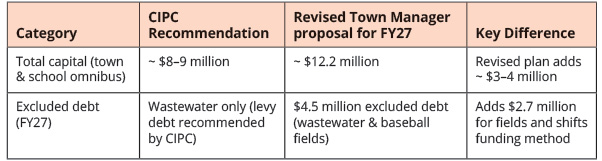
Consolidating the five year view of all the capital to be paid by the taxpayer anticipated at this point is about $85.7 million. The capital breaks out as the $40.4 million five-year omnibus capital total that covers town and school capital only, the planned for $7.3 million in enterprise capital over five years by article, and the water enterprise-funded $38 million MWRA water connection appropriation authorized previously by separate article.
CIPC’s budget approach focused on project prioritization, timing discipline and adherence to recently adopted policies. Keveny’s view focused on financial system stability and reserve protection. Keveny cautioned that the town’s capital budget is driven primarily by the debt capacity and long-term forecasting discipline, not individual project preferences.
“When a five-year capital plan is working properly, you should only see minor adjustments in the first year and then bring in a new fifth year,” Keveny said. “When we inject 15 new items into year one, we have to reset the entire five-year forecast.”
He emphasized that levy-supported debt remains the main funding engine for capital projects. He added that free cash must be used cautiously to preserve reserve levels and maintain compliance with Moody’s updated requirement that governmental and enterprise fund balances total at least 25% of revenues.
“If we don’t replenish free cash, the capital budget will be impacted,” he said.
McCall said this year’s plan reflects recommendations from the Capital Improvement Planning Committee, created under a new bylaw adopted at the 2025 Annual Town Meeting. He acknowledged that the committee’s inaugural review resulted in a markedly different prioritization than prior five-year plans and that staff attempted to incorporate as many of those recommendations as feasible (see CIPC story starting on page 4).
Among the largest FY27 requests are $2 million for a new Title 5 wastewater septic treatment system at the high school, $2.7 million for reconstruction and potential relocation of the varsity and JV baseball fields, $881,000 for road repair, $615,000 for a fire truck, and $225,000 for public safety building HVAC upgrades.
Keveny said only one of four compressors serving the public safety building is currently functioning, requiring $250,000 in immediate work moved forward from a future year.
McCall said the high school wastewater project would eliminate ongoing pump-and-haul costs of approximately $10,000 per month and address MassDEP concerns with the current temporary solution. The $2 million estimate includes construction costs and a contingency.
Committee members questioned whether sufficient engineering and site coordination has occurred between the wastewater project and the proposed field reconstruction or if the town had enough staffing for owner project manager oversight of all the proposed and open projects. The field reconstruction cost seems to have been escalated off a 2017 estimate based on the original phase three design plans for the high school. Despite repeated requests, no site plan has been presented on how much overlap exists for the septic system and field’s renovation areas.
Capital planning for town buildings remains unsettled. Aside from the public safety building HVAC, the plan includes $310,000 for immediate roof repairs to the Town Building gym but not the larger rafter problem over the field facing wing, $271,000 for elevator repairs recently discovered but not previously identified in the five-year plan, and $80,000 for gym wall pads.
McCall said the town must step back before committing millions in incremental repairs to the aging Town Building, built in 1935 as a school.
“We really have four things to consider,” McCall said, referencing renovation, leasing, public-private partnership or new construction options. “Rather than continue to react to unanticipated building needs, we need to put together a visioning group and determine what the long-term plan for this building should be.”
CIPC had not previously included school infrastructure additions in FY27; several were identified as safety or infrastructure issues arising this year. New in the revised plan are:
Middle School hot water system: $359,000
Happy Hollow fire alarm additional funding: $148,000
School security system radio communications: $135,000
Pre-K/elementary literacy curriculum: $200,000.
Keveny highlighted the 15 new FY27 capital items not previously programmed, including $350,000 for urgent cybersecurity remediations and $150,000 for public safety regional dispatch infrastructure associated with the town’s intermunicipal agreement with Natick and Framingham. He cautioned that the frequent first-year additions undermine five-year forecasting discipline and complicate free cash planning.
The committee also discussed the town’s financial policies, including a guideline that total debt service not exceed 10% of the operating budget and that excluded debt generally apply to projects over $5 million. Keveny said projected FY27 debt service equals approximately 6% of the budget but agreed to provide further calculations incorporating enterprise funds.
On the operating budget, members raised concerns about long-term growth in health insurance and retirement costs and requested updated projections, including West Suburban Health Group rates.
The committee agreed to continue capital review next week, including further discussion of the high school field and wastewater projects after input from Facilities and Recreation department heads, before taking a formal recommendation vote.