
Published as part of the ECB Economic Bulletin, Issue 2/2026.
Very long-term interest rates have risen significantly in several advanced economies over the past year, leading to a steepening of the slope at the very long end of the yield curve (Chart A). In the euro area, this steepening of the 30‑year to ten‑year slope has been relatively pronounced compared with previous episodes, reflecting a move towards more normally shaped yield curves amid higher long-term real rates, global factors and a fiscal repositioning of euro area countries (Böninghausen and Vladu, 2026). This box studies the implications of the steepening of the long-end yield curve for government funding costs, private-sector portfolios, bank lending and macroeconomic performance.
Chart A
Slope of the 30-year to ten-year yield curve for the euro area and selected sovereign bonds
(basis points)
Sources: LSEG and ECB calculations.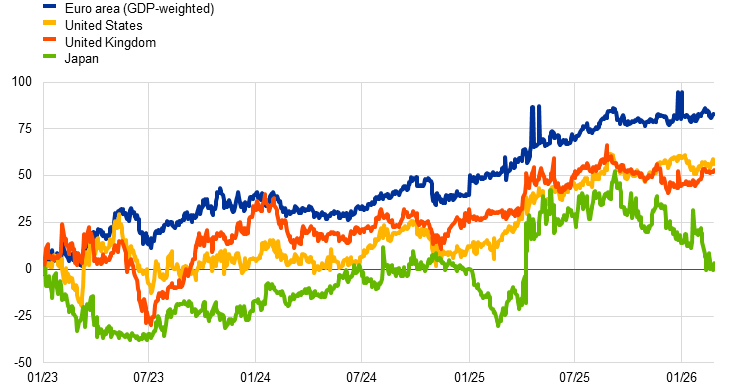
Notes: The chart shows cumulative changes in the steepness of each sovereign yield curve, as captured by the 30‑year to ten‑year slope. The latest observations are for 25 February 2026.
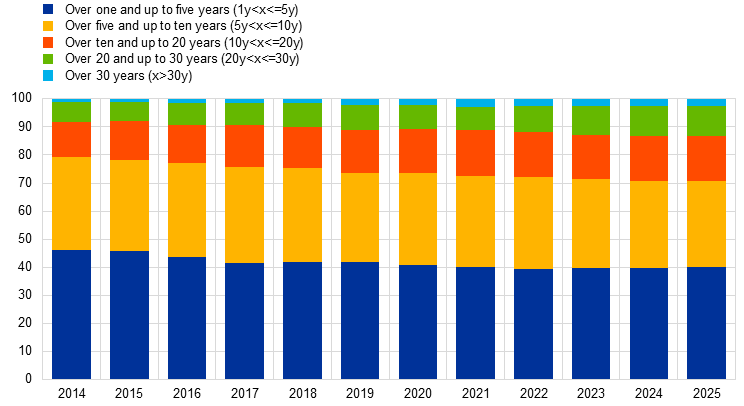
The direct effects of a rise in very long-term yields on government funding costs are likely to be limited. The supply of very long-term sovereign debt has increased in recent years, both in absolute terms and relative to the share of debt outstanding (Chart B, panel a). This increased supply contributes, ceteris paribus, to higher yields at the very long end of the curve. However, any effects on overall government financing costs from the steepening of the 30-year to ten-year slope are expected to be limited. Around 70% of issuance is still in maturities of less than ten years and is therefore not directly affected by the higher very long-term rates. Furthermore, debt management offices can flexibly adjust the maturity structure of their issuance in response to changes in interest rates, enabling them to contain the implications of the yield curve steepening for sovereign funding costs.[1]
Chart B
Euro area sovereign debt outstanding
a) By maturity bucket
(percentage of debt outstanding)
b) By holder sector
(percentage of debt outstanding)
Sources: ECB Securities Holding Statistics, Centralised Securities Database and ECB calculations.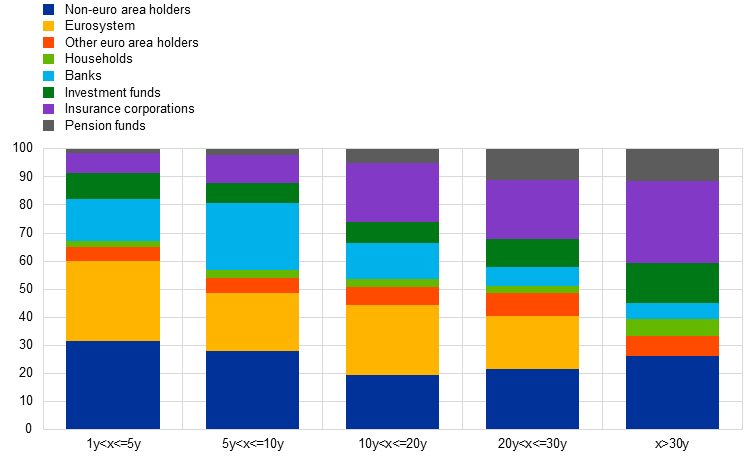
Notes: Non-euro area holders include investors outside the euro area. The chart depicts information for Germany, Spain, France and Italy.
Portfolio rebalancing by insurance corporations and pension funds (ICPFs) in response to very long-term yield changes may affect private-sector financing costs. ICPFs are the main holder sectors for very long-term debt, with a combined share of over 40% of bonds with maturities above 30 years (Chart B, panel b). As the balance sheets of ICPFs usually exhibit negative duration gaps (i.e. the duration of their liabilities exceeds that of their assets), their capital positions improve when long-term yields rise, reducing the need for duration-matching strategies and hence the demand for long-term bonds (see Domanski et al., 2017). The transition of Dutch pension funds from defined benefit to defined contribution schemes, which is set to be completed by 2028, could also contribute to some rebalancing away from very long-term bonds, as it will reduce the need to hedge very long-term interest rate risk. The impact of these shifts on private-sector financing costs will depend on how ICPFs choose to rebalance their portfolios. If they purchase significantly more private-sector assets, such as corporate bonds or stocks, this will drive up returns on these assets, thereby lowering private-sector financing costs (see Kubitza, 2026). Conversely, to the extent that the yield curve steepening coincides with generally higher long-term interest rate levels along the curve, ICPFs are less inclined to search for yield in riskier assets, such as corporate bonds or stocks (see Kaufmann et al., 2024). Instead, insurers may shift towards sovereign bonds across maturity levels, exerting upward pressure on private-sector financing costs. Hence, there are several potentially offsetting channels through which portfolio rebalancing by ICPFs can affect private-sector financing costs, leaving the overall impact ambiguous.
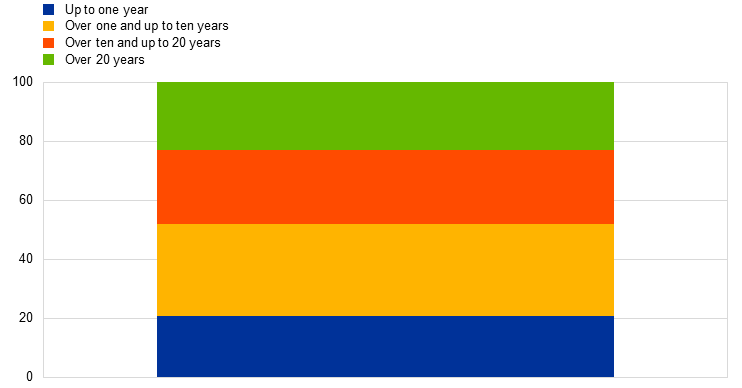
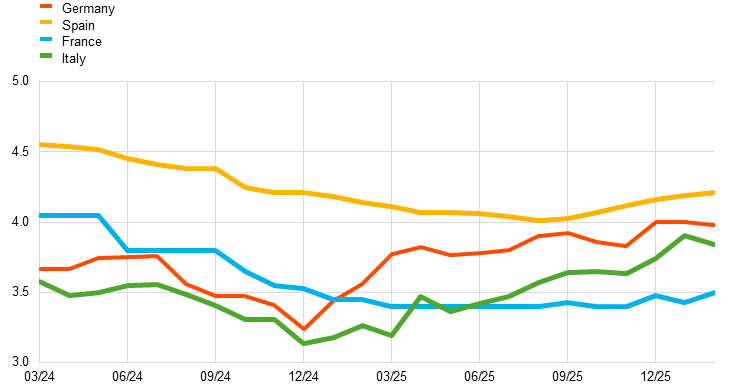
The steepening of the yield curve translates into upward pressure on interest rates for mortgages with an initial rate fixation period of over ten years. In the February 2025 ECB Consumer Expectations Survey (CES), close to half of households with mortgages reported a rate fixation period at origination of longer than ten years, and around a quarter reported a rate fixation period of longer than 20 years (Chart C, panel a). Advertised very long-term mortgage rates, as collected from online sources, have increased significantly since January 2025, especially in Germany and Italy (Chart C, panel b).[2] The additional interest rate that households pay to obtain mortgage contracts with a very long rate fixation, relative to those with a ten-year fixation, has also increased significantly, especially in Germany and Italy (Chart C, panel c). Overall, this can exert a tightening effect on households’ financing costs.
Chart C
Mortgage rate fixation periods, offered interest rates for very long-fixation mortgages, and the change in spreads between very long-fixation and long-fixation mortgage rates
a) Mortgages by fixation period
(percentage of mortgages outstanding)
b) Offered interest rates for very long-fixation mortgages
(percentages per annum)
c) Changes in spreads between very long-fixation and long-fixation mortgage rates since January 2025
(basis points)
Sources: CES, online advertised rates (MutuiSupermarket, Idealista, Verivox and Empruntis) and ECB calculations.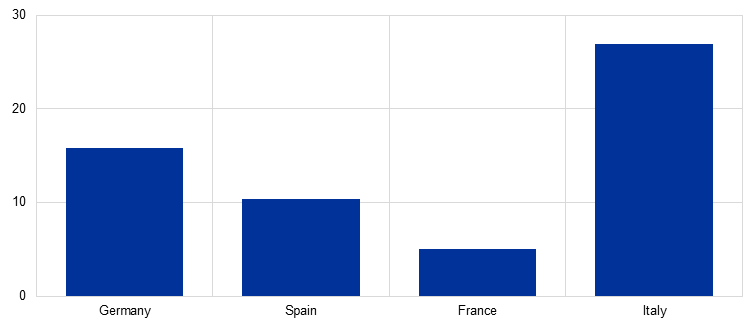
Notes: Panel a): replies from households in the bottom two groups of financial literacy have been discarded. Replies are weighted using population sampling weights and mortgage volumes at origination. Panel b): rates advertised online for mortgages with very long fixation periods. Panel c): changes in mortgage spreads since January 2025. In each country, mortgage spreads are the difference between the rates for mortgages with interest rate fixation periods as close as possible to 30 years and the rates for mortgages with interest rate fixation periods as close as possible to ten years. These are 30-year and ten-year periods in Germany, 25-year and ten-year periods in France, and 30-year and 15-year periods in Italy and Spain. The latest observations are for February 2025 for the CES and February 2026 for online advertised rates.
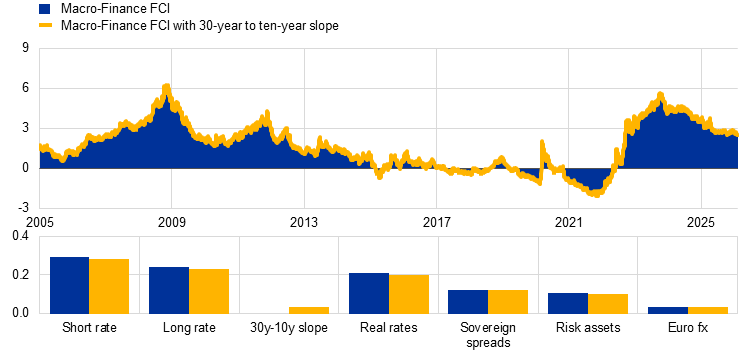
Interest rates with very long-term maturities have little influence on financial conditions indices that summarise asset prices of macroeconomic relevance. The Macro-Finance Financial Conditions Index (FCI) developed by Bletzinger et al. (2026) can be used to assess the importance of financial market variables for the joint dynamics of key macroeconomic variables and financial conditions. Adding the 30-year to ten-year slope measure of the overnight interest swap (OIS) curve to the baseline specification leaves the resulting index essentially unchanged due to the small weight estimated for that slope measure (Chart D, panel a). Accordingly, once standard maturities (such as overnight and ten-year rates) are factored in, very long-term maturities provide no additional information for financial conditions and thus for macroeconomic dynamics in the euro area. Relative to the baseline FCI, the augmented specification shows no improvement in the in-sample fit of headline inflation, the output gap and financial conditions.
Chart D
Financial conditions and macroeconomic responses to curve steepening
a) Financial conditions
(upper chart: index; lower chart: ratio)
b) Response of inflation, as measured by the Harmonised Index of Consumer Prices (HICP), and real GDP to interest rate changes
(percentages)
Sources: Bletzinger et al. (2026), LSEG and ECB calculations.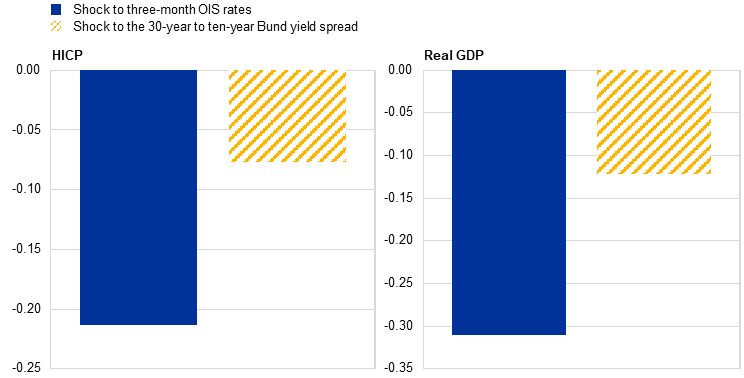
Notes: Panel a): in the upper chart, the blue area marks the baseline Macro-Finance FCI of Bletzinger et al. (2026). The yellow line shows a re-estimated version that includes a long-term slope measure of the OIS curve as an additional variable. In the lower chart, the bars denote the normalised weights of the different asset classes in the baseline and in the re-estimated Macro-Finance FCI. 30y-10y slope stands for 30-year to ten-year slope. Euro fx stands for euro nominal effective exchange rate. Panel b): local projections estimated for a one‑standard‑deviation high-frequency ECB monetary policy shock to three-month OIS rates (blue) and to the 30-year to ten-year Bund yield spread (yellow) based on Altavilla et al. (2019). The bars show peak responses over a three-year horizon. Solid fillings indicate statistical significance of the overall response at 10% levels. The model is estimated at monthly frequency between January 2002 and September 2025, with two lags. The control variables are the 30-year to ten-year German Bund yield spread, ten-year Bund yields, OIS three-month yields, the EUR/USD exchange rate, the log of the Composite Indicator of Systemic Stress, and the International Monetary Fund Primary Commodity Price Index.
Overall, the macroeconomic implications of a steepening at the very long end of the yield curve are limited. While the above discussion indicates several counterbalancing transmission channels working through government financing costs, portfolio rebalancing and mortgage markets, empirical estimates show only limited effects from shocks to the long-end yield curve slope on euro area inflation and real GDP (Chart D, panel b). Compared with the effects of a conventional short-term rate shock, the response of HICP inflation – the ECB’s key metric for price stability – to changes in the long-end yield curve slope is more than three times smaller and not statistically significant. Similarly, real GDP declines somewhat after a steepening shock, but compared with a short-term rate shock the response is substantially smaller and statistically insignificant. Taken together, while a long-term yield curve steepening affects funding costs and financial intermediaries to different degrees, financial conditions and macroeconomic dynamics remain broadly unaffected.
References
Altavilla, C., Brugnolini, L., Gürkaynak, R., Motto, R. and Ragusa, G. (2019), “Measuring euro area monetary policy”, Journal of Monetary Economics, Vol. 108, pp. 162-179.
Bletzinger, T., Martorana, G. and Mistak, J. (2026), “Looser, tighter, clearer: a new Financial Conditions Index for the euro area”, Working Paper Series, No 3193, ECB, February.
Böninghausen, B. and Vladu, A. (2026), “Sloping up: the repricing of euro area yields in 2025”,The ECB Blog, ECB, 16 January.
Domanski, D., Shin, H.S. and Sushko, V. (2017), “The Hunt for Duration: Not Waving but Drowning?”, IMF Economic Review, Vol. 65, No 1, pp. 113-153.
Kaufmann, C., Levya, J. and Storz, M. (2024), “Insurance corporations’ balance sheets, financial stability and monetary policy”, Working Paper Series, No 2892, ECB, January.
Kubitza, C. (2026), “Investor-Driven Corporate Finance: Evidence from Insurance Markets”, The Review of Financial Studies (in press).
Plessen-Mátyás, K., Kaufmann, C. and von Landesberger, J. (2023), “Funding Behavior of Debt Management Offices and the ECB’s Public Sector Purchase Program”, International Journal of Central Banking, Vol. 19, No 4, pp. 339-399.