

The international environment remains volatile, and the euro area – an open economy that is well integrated into global supply chains and international financial markets – could face strains ahead. While the acute risk of a widespread trade war appears to have abated since May, tensions remain. Also, adverse spillovers beyond the trade sphere are possible. Market concerns about stretched public finances, for example, could create strains in global bond markets. In turn, this could have repercussions for euro area financial stability through shifts in international capital flows and currency swings, diminishing the competitiveness of euro area goods and causing fluctuations in euro area funding costs.
Global stock markets have reached new all-time highs despite recent volatility, while credit spreads are tight by historical standards. Market sentiment could shift abruptly, not only if growth prospects deteriorate but also if technology sector earnings – especially those of companies associated with artificial intelligence – fail to deliver on expectations. Euro area non-bank financial intermediaries would likely suffer losses in such a scenario, due to the size and concentration of their US exposures. Liquidity mismatches of open-ended investment funds, pockets of high leverage among hedge funds and opacity in private markets could amplify market stress.
At the same time, fiscal fundamentals in some euro area countries have been persistently weak. Fiscal slippage could test investor confidence, especially in countries where political majorities are fragile. A repricing of sovereign risk would be more difficult to absorb today than previously due to a gradual shift in the investor base towards more price-sensitive investors. That said, financial markets have so far accommodated high levels of issuance smoothly, including in more turbulent periods. In addition, the banking system has shown resilience to recent shocks, underpinned by strong capital, liquidity and profitability positions. Yet rising credit risk among tariff-sensitive firms could undermine the performance of bank loans, while growing interlinkages with non-banks could expose bank funding vulnerabilities in stressed market conditions.
This edition of the Financial Stability Review also includes two analytical special features. The first discusses whether the safe-haven properties of US Treasuries and the dollar have changed since the April tariff turmoil and analyses the implications for euro area financial stability. The second examines the systemic risk arising from linkages between banks and non-bank financial intermediaries.
The ECB’s Financial Stability Review has been prepared with the involvement of the ESCB Financial Stability Committee, which assists the decision-making bodies of the ECB in the fulfilment of their tasks. It is intended to promote awareness of systemic risks among policymakers, the financial industry and the public at large, with the ultimate goal of promoting financial stability.
Luis de Guindos
Vice-President of the European Central Bank
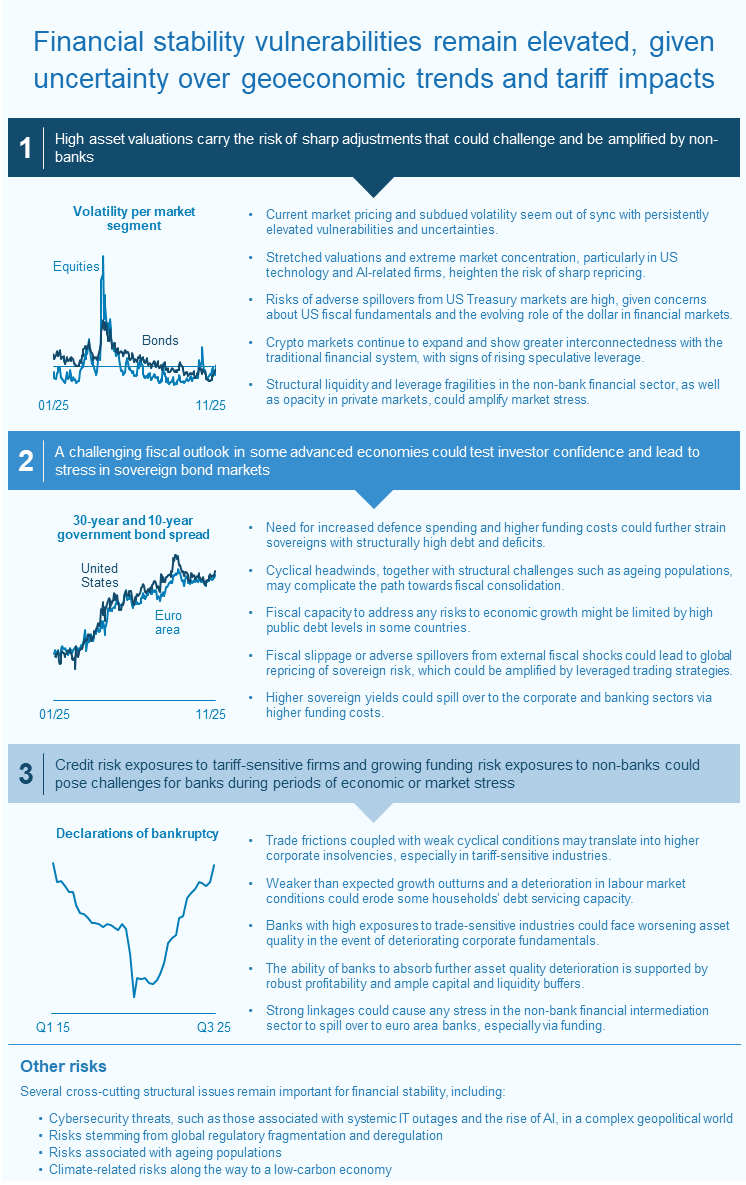
Financial stability vulnerabilities remain elevated, given uncertainty over geoeconomic trends and tariff impacts
Measures of trade policy uncertainty have eased from their April highs, but uncertainty continues to linger, with potential for renewed spikes. Recent trade agreements between the United States and several of its main trading partners, including the EU, have eased trade policy uncertainty since the previous edition of the Financial Stability Review was published (Chart 1, panel a). As a result, market participants now consider certain acute risks, such as the resurgence of a global trade war, less likely to materialise in the near term. This has supported a modest, albeit fragile, improvement in global growth prospects and helped to boost financial market sentiment. As such, market focus has shifted from the risk of immediate escalation in geopolitical tensions to the longer-term economic and financial effects of tariffs and trade frictions, which could have uneven impacts on euro area sectors and countries over time. Despite the easing of trade tensions, the current environment remains one of elevated uncertainty and, if history is any guide, renewed spikes in trade policy uncertainty cannot be ruled out down the road (Chart 1, panel a). Tariff announcements, pauses and reversals are still perceived as structural features of the global environment.
Chart 1
Trade policy uncertainty could surge again, while structural risks stemming from fiscal sustainability and broader geoeconomic shifts are growing
|
a) Trade policy uncertainty |
b) Current account and fiscal balances in the euro area and major advanced economies |
|---|---|
|
(8 Nov. 2016-2 Nov. 2020, 5 Nov. 2024-17 Nov. 2025; indices) |
(average values over 2025-27, percentages of GDP) |
 |
 |
Sources: Caldara et al.*, European Commission and ECB calculations.
Notes: Panel b: balances are calculated as a three-year average of the forecasts for 2025, 2026 and 2027. The vertical red line marks the 3% of GDP budget deficit threshold set in the Maastricht Treaty. The horizontal red line shows the indicative threshold for the current account deficit form the European Commission’s macroeconomic imbalance procedure scoreboard. The blue dots represent euro area countries, while the yellow dots represent major advanced economy peers.
*) Caldara, D., Iacoviello, M., Molligo, P., Prestipino, A. and Raffo, A., “The economic effects of trade policy uncertainty”, Journal of Monetary Economics, Vol. 109, January 2020, pp. 38-59.
Beyond trade, exposure to risk spillovers from the United States has emerged as a key macro-financial vulnerability. Market concerns over US fiscal credibility have risen on the back of persistently high fiscal deficits, expectations of higher debt service costs and high borrowing needs, and are compounded by a considerable current account deficit (Chart 1, panel b). These concerns over long-term debt sustainability and the external financing required to fund the US twin deficit have steepened yield curves. Together with market worries about central bank independence, these developments have weakened the safe-haven properties of US Treasuries and weakened the US dollar. Typically, exchange rate movements tend to offset the impact of tariffs, but a depreciating dollar is likely to amplify US tariff impacts on euro area exporters, as the euro area is a very open economy which is well integrated into global supply chains. These dynamics highlight the risk that global financial conditions – largely shaped by US capital markets where the floor for the global real interest rate tends to be set – could pose challenges for euro area financial stability through disorderly currency swings, adverse effects on trade competitiveness and fluctuations in funding costs for sovereigns, firms and banks. A further reassessment of the risk profile of US assets – reminiscent of the tariff turmoil in April – could trigger significant shifts in global capital flows, with wide-reaching implications for the global financial system (see Special Feature A). Moreover, the potential for policy shocks to disrupt the international order poses significant risks of geoeconomic and regulatory fragmentation across the globe, while ongoing geopolitical tensions further increase the likelihood of more frequent and impactful adverse tail events.
In this context, three main sources of risk and vulnerability emerge as central to euro area financial stability. First, stretched valuations in increasingly concentrated asset markets raise the risk of sharp, correlated price adjustments. Should they occur, such sudden market drawdowns could pose balance sheet challenges for euro area non-banks, given their persistent liquidity and leverage vulnerabilities, increasing the risk of fire sales which could amplify market stress. Opaque private markets could also be a source or amplifier of market downturns. Second, fiscal challenges in some advanced economies could test investor confidence, possibly triggering stress in sovereign bond markets. Third, although banks have demonstrated resilience to recent shocks, credit risk exposures to the tariff-sensitive segment of the corporate sector could yet undermine the performance of bank loans, while growing interlinkages with non-banks could expose bank funding vulnerabilities in stressed market conditions. The potential for these vulnerabilities to materialise simultaneously given common triggers, possibly amplifying each other further, increases the risks to euro area financial stability.
High valuations carry the risk of sharp adjustments that could challenge and be amplified by non-banks
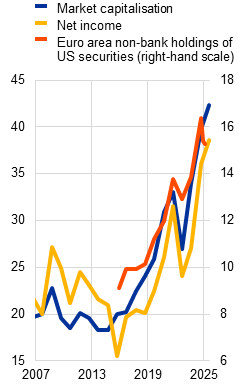
Financial markets, notably equity markets, remain vulnerable to sharp adjustments due to persistently high valuations and increasing market concentration. Global stock markets rebounded swiftly from their early April lows, repeatedly reaching all-time highs in recent months (Chart 2, panel a). This renewed risk-on sentiment, which drove already high valuations even higher, was the result of perceptions of diminishing trade tensions, strong corporate earnings, growing expectations of further monetary policy easing in the United States and continued optimism surrounding the productivity-boosting potential of artificial intelligence (AI). At the same time, market concentration among, and interconnection between, a handful of large US-based tech firms has risen further (Chart 2, panel b). This leaves global public markets − and increasingly also private markets − exposed to risks stemming from potential shocks to these firms (see Section 2.3). Unlike the asset price inflation seen during the dotcom bubble in 2000, which pushed the valuations of unprofitable firms to levels that were hard to explain, these “hyperscalers” combine high profit margins, strong earnings growth, little debt and diversified underlying businesses beyond AI, explaining their high current valuations. Beyond equity markets, credit spreads remain compressed. Meanwhile, less mainstream asset classes like crypto-assets remain highly volatile and show greater interconnectedness with the traditional financial system, with total crypto market capitalisation reaching short-lived new highs and stablecoin use growing (see Box 5).
Chart 2
High valuations and increasing risk concentration render financial markets and non-bank portfolios vulnerable to the risk of sudden price adjustments
|
a) Evolution of crypto-assets and global equity markets |
b) Share of top ten S&P 500 firms in market capitalisation and net income, and euro area non-banks’ US exposures |
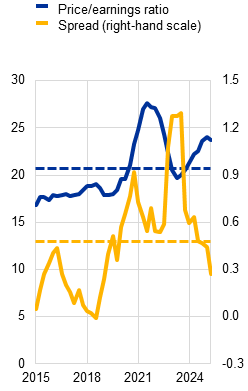
c) Weighted average equity price/earnings ratio and bond spreads in euro area non-bank portfolios |
|---|---|---|
|
(1 Jan. 2024-18 Nov. 2025, indices: 1 Jan. 2024 = 100) |
(1 Jan. 2007-18 Nov. 2025, percentages) |
(Q1 2015-Q2 2025; ratio, percentage points) |
 |
 |
 |
Sources: Bloomberg Finance L.P., LSEG, ECB (SHS, ICB, IVF, PFBR) and ECB calculations.
Notes: Panel a: “Crypto-assets” refers to the Bloomberg Galaxy Crypto Index which is a benchmark designed to measure the price performance in US dollars of the largest cryptocurrencies. “Global equity markets” refers to the MSCI ACWI index, which measures the performance of large- and mid-cap stocks across both developed and emerging markets worldwide. Panel b: euro area non-bank holdings of US securities are shown as a share of total assets. Panel c: the price/earnings ratio calculation is limited to non-bank holdings within the S&P 500, EURO STOXX 600, Nikkei 225 and FTSE 100 indices, accounting for their changing compositions over time. The metric used is the 12-month forward price/earnings ratio. The spreads are calculated as the difference between an individual security’s yield to maturity and a corresponding benchmark rate. Euro-denominated holdings are benchmarked against the euro area ten-year government benchmark bond yield while US dollar and all other currency holdings are benchmarked against the ten-year US Treasury yield. Each security’s yield is compared with a common ten-year benchmark, regardless of its individual maturity.
The apparent disconnect between prevailing economic policy uncertainty and benign market pricing leaves room for sudden shifts in sentiment. Current market pricing does not appear to reflect persistently elevated vulnerabilities and uncertainties. One possible explanation is that this might be based on optimism that tail risks will not materialise. Alternatively, it may reflect fears of missing out on a continued rally, as markets have proved to be resilient to recent shocks, or it could be related to an increasingly complex and hard-to-price risk environment (see Section 2.2). Negative surprises – including sharply deteriorating economic growth prospects, a re-escalation of trade and geopolitical tensions, market concerns over central bank independence and US fiscal credibility, or disappointing news on AI adoption and associated corporate earnings expectations – could trigger abrupt sentiment shifts, with spillovers across asset classes and geographies.
High valuations and risk concentration, coupled with liquidity and leverage vulnerabilities, could challenge non-banks’ balance sheets and amplify market stress via forced asset sales. Overall, non-banks navigated the April tariff turmoil relatively well, remaining a key source of funding for the real economy and euro area sovereigns. Fund flows of European investors into risky assets have rebounded, with a notable shift towards shorter maturities and some further evidence of diversification towards euro area assets (see Section 4.2). That said, the portfolio holdings of investment and pension funds reflect buoyant market conditions by showing signs of elevated valuations (Chart 2, panel c), exposing these segments to the risk of sudden and broad-based valuation adjustments. Exposures in the euro area non-bank financial intermediation (NBFI) sector remain heavily concentrated in US dollar assets (Chart 2, panel b), increasing the sector’s vulnerability to US-specific shocks and exchange rate fluctuations. More broadly, structural vulnerabilities in the NBFI sector remain significant. Liquidity mismatches in open-ended investment funds (e.g. corporate bond funds) and pockets of elevated financial and synthetic leverage in some entities (e.g. hedge funds) could trigger procyclical asset sales and exacerbate market volatility under stress through procyclical selling behaviour (see Box 4).
Liquidity and leverage vulnerabilities in the NBFI sector merit an appropriate policy response as market-based finance expands in terms of size and interconnectedness. Recent stress episodes underscore the need to broaden monitoring and strengthen the macroprudential framework for non-banks. Progress will depend on improving data availability and cross-border information sharing, ensuring timely implementation of international reforms and developing a more comprehensive toolkit to address the risks posed by NBFI leverage, combining both entity and activity-based measures. Improving data availability is particularly important in private markets, where difficulties in exiting private equity deals, and credit defaults in the United States, have raised concerns over opaque valuations and lax lending standards. At the EU level, stronger supervisory coordination, new macroprudential tools to address liquidity mismatches and leverage, and the development of system-wide stress testing would help reinforce resilience. Accelerated efforts to advance the savings and investments union in parallel, by deepening equity markets, mobilising retail and institutional savings and enhancing integrated supervision, will be essential for supporting growth and competitiveness across the EU while safeguarding financial stability.
A challenging fiscal outlook in some advanced economies could test investor confidence and lead to sovereign bond market stress
Euro area sovereigns are benefiting from lower risks to economic growth and flight-to-safety dynamics. International trade agreements, including between the United States and the EU, have helped reduce near-term tail risks for global and euro area growth outlooks. While the long-term economic implications remain uncertain, worst-case scenarios appear to have been averted, supporting sovereign debt sustainability. In addition, euro area sovereign bond markets have benefited from flight-to-safety dynamics following the April tariff turmoil as investors questioned the safe-haven status of US assets. Improved fiscal fundamentals and recent sovereign rating upgrades in several euro area countries have compressed bond spreads, although they have widened in countries facing fiscal challenges and rating downgrades, notably France. As a result, bond spreads have converged between countries with significantly different underlying ratings (Chart 3, panel a).
Chart 3
Higher issuance and funding costs could strain weak sovereigns, with fiscal slippage or external fiscal stress potentially leading to renewed sovereign fragmentation
|
a) Sovereign credit ratings and spreads vs German Bund |
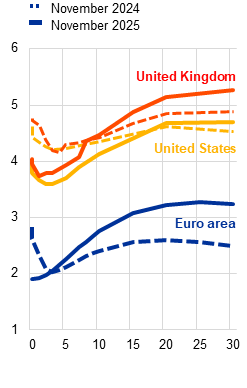
b) Yield curves in the euro area, United States and United Kingdom |
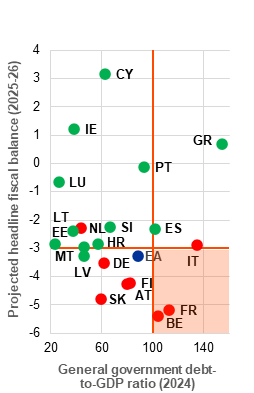
c) Government indebtedness and projected average fiscal balance over 2025-26 |
|---|---|---|
|
(20 Nov. 2024-18 Nov. 2025, basis points) |
(percentages, years to maturity) |
(2024, 2025-26; percentages) |
 |
 |
 |
Sources: LSEG, Fitch Ratings, Moody’s Analytics, S&P Global Market Intelligence, Bloomberg Finance L.P., European Commission and ECB calculations.
Notes: Panel a: the chart shows only euro area countries with revised ratings since November 2024. Average rating of the long-term issuer ratings assigned by Moody’s, Standard & Poor’s and Fitch Ratings. The latest observations are for 18 November 2025. Panel b: yields reflect monthly averages. November 2025 figures based on data up to 18 November. Panel c: projected headline fiscal balance is calculated by taking the average of 2025 and 2026. The horizontal red line marks the 3% of GDP budget deficit threshold set in the Maastricht Treaty. The vertical red line marks the threshold of 100% of GDP for sovereign debt and is based on findings in the empirical literature. The green (red) dots indicate projected real GDP growth rates for 2026 above (below) the euro area average. EA stands for euro area.
Planned defence spending and persistent structural challenges may strain sovereign balance sheets in the medium term. Elevated geopolitical tensions and hybrid threats highlight the urgency of increasing defence spending to meet the new NATO target of 5% of GDP by 2035. Most euro area countries currently fall substantially short of this figure and limited fiscal space may make it hard for some to reach it (see Section 1.2). Necessary defence spending could unlock positive growth effects if well targeted. It may, however, further limit the fiscal space needed to shelter the economy from future adverse shocks and to address structural challenges associated with digitalisation, low productivity, population ageing and climate change. As such, there have so far been few concrete pledges to greatly increase defence spending.
Fiscal expansion could pose risks from higher issuance needs and funding costs. High defence spending and major infrastructure investment plans in some euro area countries are expected to boost sovereign bond issuance. Given the Eurosystem’s reduced presence in euro area bond markets, the capacity of the investor base to absorb this additional supply will be key for ensuring orderly sovereign bond market functioning. However, experience has shown that foreign investors have proved to be “flighty” in times of stress. In addition, leveraged positions by hedge funds on European sovereign bond markets, while more limited than on other markets such as the US Treasuries markets, can significantly amplify shocks when such positions need to be unwound. At the same time, shifts in the investor base are ongoing. There is lower demand for longer-dated debt from some institutional investors, notably Dutch pension funds which are moving from defined benefit to defined contribution schemes. As a result, investors may require higher yields to absorb new issuance or a compressed maturity profile. Market expectations of higher government financing needs have already seen yield curves steepen (Chart 3, panel b). Rising debt service costs and structural headwinds to potential growth from weak productivity could further strain fiscal positions and rekindle concerns about sovereign debt sustainability.
Weak fiscal fundamentals in some euro area countries and external fiscal risk spillovers could test investor confidence and trigger stress in bond markets. Despite the substantial progress that has been made with fiscal consolidation across much of the euro area since the COVID-19 pandemic, some countries are still burdened by elevated debt levels with high budget deficits expected to persist in the coming years (Chart 3, panel c). Fiscal slippage and non-compliance with the new EU fiscal framework could yet test investor confidence, notably in countries with more fragile political landscapes. In addition, fiscal fragilities in major advanced economies, including the recent US budget impasse and government shutdown, could heighten sovereign debt sustainability concerns, trigger stress in global benchmark bond markets and prompt a broader reassessment of sovereign risk in the euro area. Any repricing of sovereign risk could spill over to the corporate and financial sectors via higher funding costs and rating downgrades.
Credit risk exposures to tariff-sensitive firms and stronger funding ties with non-banks could strain euro area banks
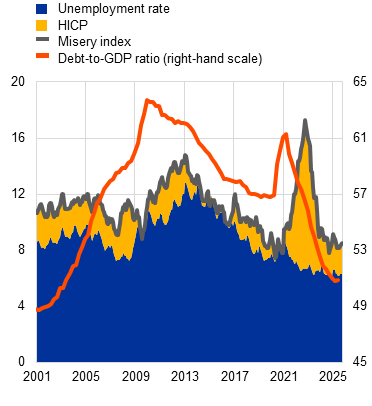
Vulnerabilities in the euro area corporate sector remain elevated as the impact of tariffs unfolds, with potential spillovers to the household sector. Euro area corporate balance sheets have improved in recent years and indebtedness has fallen below levels last observed before the global financial crisis. Nonetheless, profitability remains under pressure from subdued demand, elevated debt service burdens and higher labour costs. Insolvencies have been rising across sectors and countries in light of continued weak and uncertain business prospects (see Box 1). Trade frictions and the recent appreciation of the euro have compounded these pressures, eroding price competitiveness abroad at a time when Chinese firms are increasing their exports to global markets due to weak domestic demand. Tariff-sensitive and export-oriented sectors, such as manufacturing, account for a large share of total value added, credit and employment, implying that shocks affecting these sectors could have broader repercussions (Chart 4, panel a). Although conditions in commercial real estate markets have improved, real estate firms remain highly vulnerable to the ongoing macroeconomic and geopolitical uncertainty given their exposure to both international capital flows and local economic conditions. Euro area households continue to benefit from high savings, rising real wages, resilient labour markets and the marked reduction in the debt-to-GDP ratio which has taken place over recent years (Chart 4, panel b). However, this resilience could be tested if stress in the corporate sector were to push up unemployment or dampen wage growth, potentially weighing on household consumption and debt servicing capacity.
Chart 4
Corporate vulnerabilities remain elevated as the effects of tariffs take hold, potentially weakening household resilience if layoffs affect their debt servicing capacity
|
a) Share in euro area employment, gross value added and credit, by sector and tariff sensitivity |
b) Misery index and household indebtedness in the euro area |
|---|---|
|
(Q2 2025, percentages) |
(Jan. 2001-Sep. 2025, percentages) |
 |
 |
Sources: Eurostat and ECB (ICP, MNA, QSA), Eurostat (LFSI), ECB (supervisory data) and ECB calculations.
Notes: Panel a: bubble size represents the share of total loans. Panel b: the misery index is an economic indicator that measures economic hardship by adding the unemployment rate to the inflation rate. HICP stands for the Harmonised Index of Consumer Prices measure of inflation.
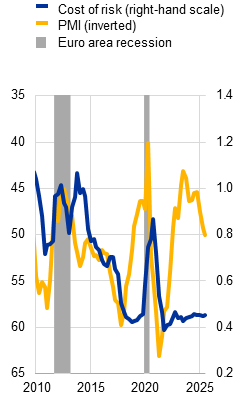
Strong investor sentiment and continued earnings outlook upgrades have lifted bank valuations, but non-performing loans and provisioning needs may rise as tariff effects ripple through the real economy. The stock prices of euro area banks have been driven by sustained strong earnings momentum and record profit distributions (dividends and buybacks) in recent months (Chart 5, panel a), with price-to-book ratios rising to new post-financial crisis highs and gradually catching up with those of US peers. At the same time, euro area banks’ non-performing loan ratios remain near historical lows on aggregate. However, there is continued deterioration in some sectors, notably for small and medium-sized enterprises and consumer lending, albeit with significant variation across countries. Looking ahead, asset quality could worsen for corporate exposures should trade fragmentation increase or economic conditions weaken further. These exposures could weigh on banks’ asset quality through both direct credit losses and indirect effects, such as knock-on impacts on suppliers or a broader macroeconomic slowdown, especially if layoffs undermine the debt servicing capacities of households. As such, banks may yet face higher provisioning costs should risks actually materialise in non-financial sectors (Chart 5, panel b).
Chart 5
Euro area banks’ resilience supports rising valuations, but credit risk exposures to tariff-sensitive firms and stronger funding ties with non-banks could pose a challenge
|
a) Euro area bank stock prices, dividend futures and profit expectations |
b) Cost of risk of listed euro area banks and euro area manufacturing PMI |
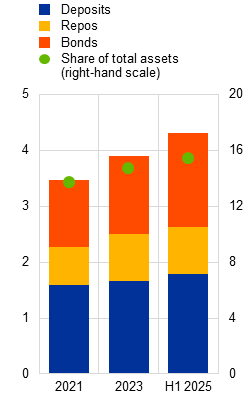
c) Euro area banks’ funding from non-banks, by instrument |
|---|---|---|
|
(1 Jan. 2024-18 Nov. 2025; index:1 January 2024 = 100, percentages) |
(Q1 2010-Q3 2025; diffusion index, percentages) |
(2021, 2023, H1 2025; € trillions, percentages) |
 |
 |
 |
Sources: Bloomberg Finance L.P., S&P Global Market Intelligence, CEPR and Haver Analytics, ECB (supervisory data) and ECB calculations.
Notes: Panel a: ROE stands for return on equity. Panel b: “Cost of risk” is defined as impairments on loans divided by loans. PMI stands for Purchasing Managers’ Index. The grey bars indicate recession periods, as determined by the CEPR Euro Area Business Cycle Dating Committee. Panel c: non-banks comprise insurance corporations, pension funds, investment funds, money market funds and other financial institutions. Deposits and repos from non-banks are obtained from ECB supervisory data and are collected at the consolidated level. For data on bonds from non-banks obtained from the SHS dataset, all bonds issue by euro area significant institutions are aggregated at the consolidated level.
The ability of banks to absorb further asset quality deterioration is supported by strong profitability and ample capital and liquidity buffers. Euro area banks maintained robust return on equity levels, averaging close to 10% in the first half of 2025, albeit with some cross-country variation (see Section 3.1). Banks’ resilience has also been bolstered by capital and liquidity ratios that are well above regulatory requirements. Maintaining this resilience is essential in the context of elevated geopolitical and trade uncertainty. The 2025 EU-wide stress test confirmed that euro area banks are adequately capitalised to withstand severe shocks, not least thanks to the macroprudential policy measures implemented by the authorities in recent years. As such, releasable capital buffer requirements should be preserved, with targeted increases considered in countries where releasable buffers are low, provided such measures do not pose procyclicality risks. Proper calibration of borrower-based measures is also essential to uphold sound lending standards (see Section 3.5). The prevailing regulatory and supervisory framework, including in the macroprudential remit, has been effective in safeguarding financial stability. There is, however, scope for making the framework more efficient and effective by reducing unwarranted complexities, without compromising bank resilience or undermining compliance with the Basel framework, and by completing the banking union.
Rising interlinkages with non-banks may reveal bank funding vulnerabilities if market conditions turn volatile or corporate fundamentals deteriorate. Weak economic conditions and elevated trade policy uncertainty may impair the asset quality of non-bank portfolios, exposing the non-bank financial intermediation (NBFI) sector to the risk of revaluation losses from unexpected downgrades and increasing default risk. The importance of non-bank funding for banks has grown in recent years (Chart 5, panel c), with the share of volatile, short-term liabilities constituting a significant portion of overall funding from non-banks. Some of these liabilities arise from intermediation activities and are offset by corresponding asset exposures. Funding from non-banks may be difficult to substitute, due to their high concentration among a few large banks and the preference of non-banks for specific funding instruments. As a result, short-term non-bank funding outflows and counterparty credit losses on exposures to non-banks, possibly caused by asset price shocks, could lead banks to deleverage. In turn, as banks would then reduce funding to non-banks, these entities might need to unwind positions and sell assets. The loss-absorbing capacity of banks closely interlinked with the NBFI sector and sufficient liquidity buffers in non-banks are thus essential to maintain the smooth provision of financial services in times of stress (see Special Feature B). In addition, euro area banks are exposed to the opaque private markets via direct lending to private market funds and via lending to private market-backed firms.
Financial stability vulnerabilities remain elevated, given uncertainty over geoeconomic trends and tariff impacts
All in all, the financial stability landscape continues to be shaped by trade policy uncertainty, which despite recent measured declines remains elevated and leaves scope for renewed volatility. Notwithstanding reduced uncertainty and multiple sources of resilience in euro area financial as well as non-financial sectors, vulnerabilities persist and warrant close monitoring. In fact, the macro-financial effects of the tariff shock have yet to fully materialise and, together with possible spillovers from US-centric risks − notably those associated with fiscal and institutional credibility − remain important vulnerabilities. Additionally, it is possible that risk sentiment could deteriorate again as some risky asset valuations remain high, with relatively benign pricing seemingly at odds with prevailing uncertainties about macro-financial and geoeconomic conditions. At the same time, sizeable defence spending needs and higher funding costs could yet weaken fiscal positions and test market confidence. In parallel, credit risk exposures to tariff-sensitive firms and deepening funding links with non-banks could add to the pressures faced by euro area banks. Against this background, there is a pressing need for accelerated progress to be made on the savings and investments union, encompassing both the banking and capital markets union. This initiative is aimed at fostering a single, deep and liquid market that will contribute to safeguarding financial stability and supporting investment-led growth and competitiveness.
Beyond the macro-financial environment, several overarching structural issues remain pivotal for safeguarding financial stability and have the potential to exacerbate existing cyclical vulnerabilities. These include cybersecurity weaknesses and hybrid threats in an increasingly complex geopolitical landscape, the growing importance of AI – offering both opportunities and risks of destabilisation along the innovation path − risks arising from global regulatory fragmentation and deregulation, challenges linked to ageing populations and climate-related risks along the way to a low-carbon economy. The potential for these cyclical and structural vulnerabilities to crystalise simultaneously and amplify each other heightens the materiality of risks to financial stability.
1.1 External headwinds continue to weigh on euro area growth
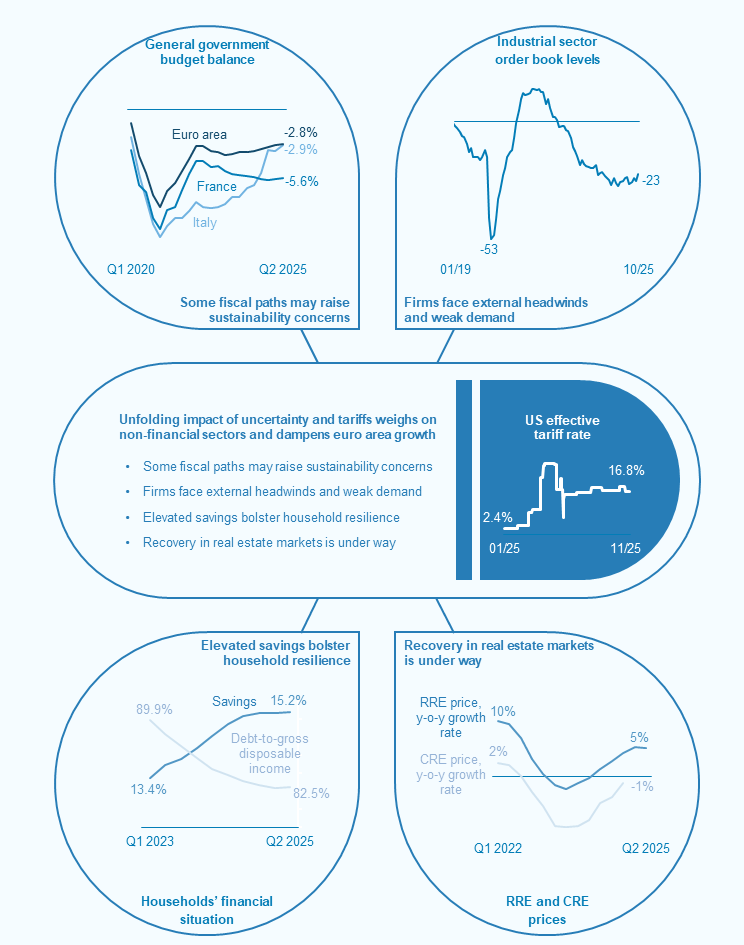
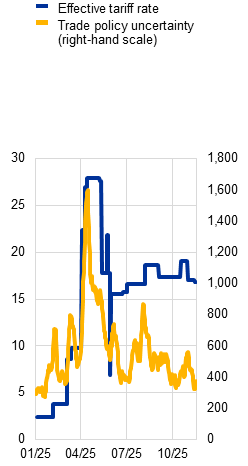
Lingering global uncertainties are posing risks to the growth outlook in the euro area, with trade tensions among the key factors. Tariffs on euro area exports to the United States have increased considerably since the start of the year. The recent US-EU agreement has capped tariffs for most goods, resulting in a notable decline in trade policy uncertainty. That said, it remains elevated by historical standards and renewed spikes cannot be ruled out (Chart 1.1, panel a).[1],[2] Persistent uncertainty about the longer-term impact of higher tariffs is continuing to weigh on global activity, adding to downside risks for growth in the euro area. Exporters in particular are facing a challenging environment as subdued external demand and intensified competition from abroad erode growth prospects. Beyond its impact on direct trade flows, heightened uncertainty may also be weighing on firms’ investment plans and hiring decisions.[3] This is dampening activity in those sectors closely integrated into global value chains, with knock-on effects on consumer confidence.
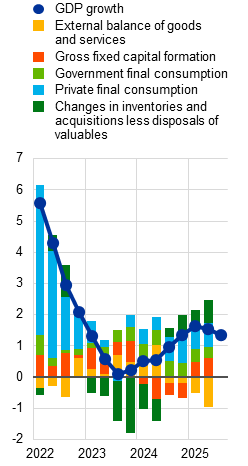
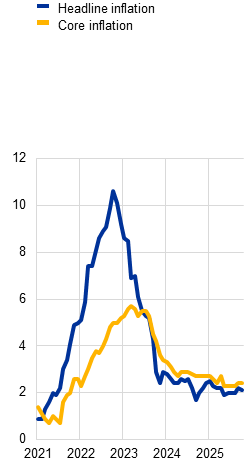
Chart 1.1
Global uncertainties and tariff rates weigh on euro area growth, while inflation continues to moderate
|
a) US effective tariff rate and global trade policy uncertainty |
b) Euro area year-on-year real GDP growth |
c) Euro area headline and core inflation |
|---|---|---|
|
(1 Jan.-17 Nov. 2025, left-hand scale: percentages, right-hand scale: index) |
(Q1 2022-Q3 2025, percentages) |
(Jan. 2021-Oct. 2025, percentages) |
 |
 |
 |
Sources: The Budget Lab at Yale, Caldara et al.*, Eurostat, ECB and ECB calculations.
Notes: Panel a: the effective tariff rate for 2025 is measured pre-substitution (i.e. assuming there are no shifts in the import shares of different countries compared with 2024). The trade policy uncertainty index is as presented in Caldara et al.* Panel b: the chart shows average annualised year-on-year GDP growth rates and average contributions from different components. Panel c: headline inflation is measured by the Harmonised Index of Consumer Prices (HICP), while core inflation is defined as the HICP excluding energy and food.
*) Caldara, D., Iacoviello, M., Molligo, P., Prestipino, A. and Raffo, A., “The economic effects of trade policy uncertainty”, Journal of Monetary Economics, Vol. 109, 2020, pp. 38-59.
Growth in the euro area has proven to be resilient over the first three quarters of 2025 and higher than foreseen in the June 2025 Eurosystem staff macroeconomic projections for the euro area. After a strong first quarter driven by frontloaded exports and resilient services activity, GDP growth slowed, partially reflecting the expected unwinding of frontloading effects. The external balance of goods and services has exerted a drag throughout the year so far, while private consumption, government spending and investment have made a positive contribution (Chart 1.1, panel b). Meanwhile, inflationary pressures have eased markedly. Headline inflation has fallen sharply from its 2022 peak, stabilising close to the ECB’s target level of 2% on the back of declining energy prices and food inflation. Core inflation has been more persistent but is continuing to moderate gradually, supported by easing wage growth and lower services inflation (Chart 1.1, panel c). Disinflation has been accomplished in the euro area economy without an associated sharp slowdown so far. At the same time, growth has remained positive and is expected to recover further in the fourth quarter of 2025.[4] However, the outlook could prove vulnerable to external shocks like revived trade tensions and a further escalation of geopolitical conflicts and domestic challenges, in particular sovereign risks (see Section 1.2), that could trigger broader market reassessments.
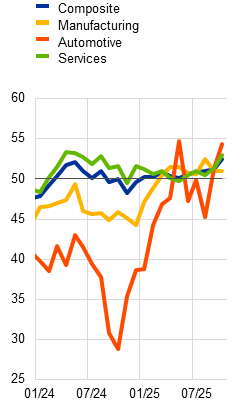
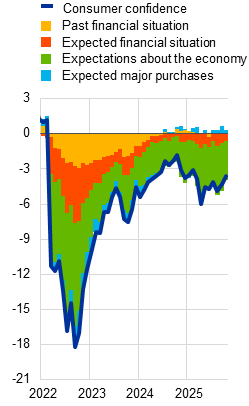
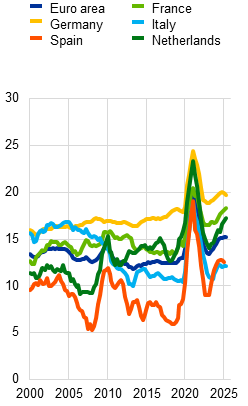
Chart 1.2
Euro area business sentiment stabilises as trade tensions ease, but subdued consumer confidence limits near-term prospects for domestic demand
|
a) PMIs for economic activity in the euro area |
b) Consumer confidence in the euro area |
c) Households’ gross saving in selected euro area countries |
|---|---|---|
|
(Jan. 2024-Oct. 2025, indices) |
(Jan. 2022-Oct. 2025, indices) |
(Q1 2000-Q2 2025, percentages) |
 |
 |
 |
Sources: Eurostat, S&P Global Market Intelligence, European Commission, ECB and ECB calculations.
Notes: Panel a: a Purchasing Managers’ Index (PMI) value above (below) 50 implies an improvement (deterioration) in economic activity. Panel b: consumer confidence indicator (seasonally adjusted and demeaned). Euro area 20 (fixed composition) as of the 1 January 2023 European Commission (including Eurostat) Consumer Survey. Panel c: households’ gross saving as a share of adjusted gross disposable income.
Although there are tentative signs of stabilisation in business confidence, households remain cautious. The risk of escalating trade tensions, with widespread retaliation to the import tariffs announced by the United States, has eased notably since the previous edition of the Financial Stability Review, providing some support to business sentiment. Purchasing Managers’ Indices (PMIs) show a modest recovery at the margin. Services and manufacturing remain in expansionary territory, while the automotive sector has been volatile and remains fragile (Chart 1.2, panel a). By contrast, consumer confidence is still subdued, reflecting households’ concerns about both the general economic outlook and their own financial situations (Chart 1.2, panel b). Their spending decisions remain cautious, as evidenced by the highest aggregate level for the gross saving ratio ever recorded (apart from during the COVID-19 pandemic) across major euro area economies (Chart 1.2, panel c). Indirect evidence suggests that the elevated saving ratio may, to some extent, reflect households’ expectations that their financial health will not improve in response to increased public spending.[5] However, these accumulated savings also provide a buffer and could underpin a stronger rebound in domestic demand once sentiment improves.
Looking ahead, the macroeconomic outlook for the euro area is balancing pockets of resilience against sustained challenges. While factors such as moderating inflation, a strong labour market and accumulated household savings provide the conditions for a gradual recovery in private consumption, the external environment is set to remain difficult. US tariffs, an appreciating euro and rising import competition from China are likely to continue to weigh on export-oriented sectors, particularly manufacturing (see Section 1.3). Investment is also expected to remain subdued as firms face weaker profitability and heightened uncertainty. Overall, growth is projected to recover only gradually.[6] A sharper deterioration in global trade conditions, stronger currency appreciation or other shocks that could prolong a persistent weakness in consumer confidence could materially weigh on the recovery, underscoring the fragile nature of the current outlook.
1.2 Some fiscal paths may raise debt sustainability concerns
International agreements on trade have reduced short-term uncertainty, but cyclical and structural fiscal challenges remain. International trade agreements, including the US-EU deal announced in August, have averted the worst-case scenario of a trade war involving widespread retaliation. While the euro area growth outlook remains weak overall, it now appears to be more resilient, as tail risks from trade shocks are less likely in the near term (see Section 1.1). However, the full economic and financial impact of past shocks – notably tariff measures and trade frictions – will unfold over time. In addition, governments face a long list of structural issues that need to be addressed and may require public resources. These include the green and digital transitions, ageing populations, low productivity and the need to upgrade infrastructure and expand defence capabilities.
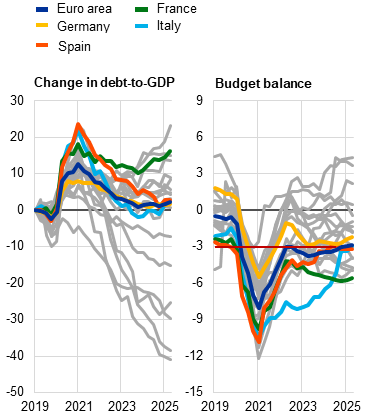
Fiscal fundamentals are on greatly differing trajectories across countries and remain particularly weak in some. While many euro area countries have made substantial progress on fiscal consolidation since the pandemic, some have not materially reduced their debt levels from the pandemic-era peaks and are still running sizeable budget deficits (Chart 1.3, panel a). This is less of a problem for countries that still have low or medium-sized levels of debt. For more highly indebted euro area countries, however, such a trajectory for fiscal fundamentals could raise debt sustainability concerns among investors, especially where consolidation efforts are complicated by small or unstable parliamentary majorities. Furthermore, the Next Generation EU programme finishes at the end of 2026, and there is a risk that substantial amounts of available funds will not be disbursed to Member States in time.[7] If additional flexibility is applied to speed up disbursement, it will still be important to ensure that funded projects and structural reforms are of appropriate quality. Overall, euro area deficits are expected to increase in the coming years.[8]
Chart 1.3
Euro area countries face divergent fiscal paths, with some struggling to reduce deficits and meet rising defence spending targets
|
a) Change in debt levels and budget balance |
b) Defence spending over time across euro area NATO members |
|---|---|
|
(Q1 2019-Q2 2025; percentage points, percentages of GDP) |
(2014-25, percentages of GDP) |
 |
 |
Sources: ECB and Eurostat (GFS), NATO and ECB calculations.
Notes: Panel a: the left graph shows percentage point changes in the debt-to-GDP ratio since Q1 2019. The horizontal red line in the right graph denotes the target for the budget balance under the Stability and Growth Pact. Panel b: data on defence spending come from NATO, with the figures for 2024 and 2025 being estimates. Data may differ from official euro area statistics because of differences in the way defence spending is classified.
Increasing geopolitical tensions and hybrid threats underscore the need to boost defence spending, which may prove difficult for some countries. In June 2025 NATO allies agreed on a new defence spending target of 5% of GDP, to be reached by 2035. This new target comprises a minimum of 3.5% for core defence and up to 1.5% for broader security-related spending, including some expenditure on infrastructure.[9] Despite the faster progress made after Russia’s invasion of Ukraine in 2022, many euro area countries still fall substantially short of this new target (Chart 1.3, panel b). Governments widely agree that defence capabilities need to be significantly enhanced, and economic analysis suggests that this could have a positive impact on growth.[10] Given the fact that fiscal space is low, however, there have so far been few concrete pledges to greatly increase defence spending. Accordingly, initiatives to create fiscal space under the European Commission’s Readiness 2030 plan are of particular importance. For instance, activating the Stability and Growth Pact’s national escape clause for several euro area countries would provide greater budgetary flexibility over the next four years.[11] In addition, the full €150 billion envelope of the Security Action for Europe instrument has been tentatively allocated. Disbursements could start in early 2026.[12]
Chart 1.4
Euro area debt sustainability faces challenges from rising interest costs and a potential reassessment of risk by investors
|
a) Distribution of ten-year sovereign spreads versus Germany across the euro area |
b) Difference between 30-year and two-year sovereign bond yields |
c) Debt issuance volumes and yield at issuance |
|---|---|---|
|
(basis points) |
(1 Jan.-18 Nov. 2025, basis points) |
(Jan. 2013-Sep. 2025; € trillions, percentages) |
 |
 |
 |
Sources: ECB and Eurostat (GFS), LSEG, Bloomberg Finance L.P. and ECB calculations.
Note: Panel a: spreads are shown as monthly averages. The latest observations are for 18 November 2025. Panel c: the chart shows 12-month moving sums for debt issuance and 12-month moving averages for the yield at issuance.
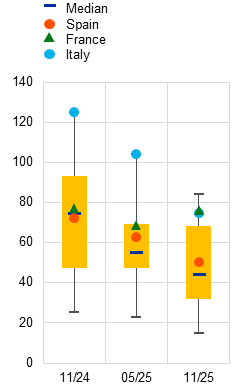
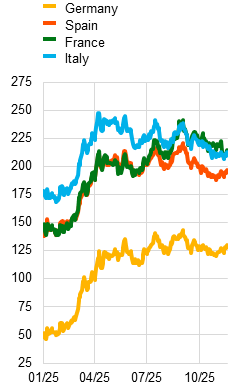
Market pricing reflects changes in investors’ risk perceptions towards individual euro area countries. The flight-to-safety dynamics seen in the aftermath of the April tariff turmoil have led to an overall decline in sovereign bond spreads across most euro area countries (Chart 1.4, panel a and Special Feature A). More recently, investors’ perceptions of risk have focused on the deteriorating trajectory of fiscal fundamentals in France. As a result, French sovereign bond spreads have moved closer to those for Italian debt (see Chapter 2). That said, French sovereign bond spreads have remained within the same range since June 2024 and markets have stayed liquid.
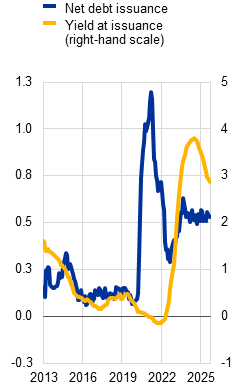
Shifts in demand among institutional investors and a weak growth outlook will weigh on interest costs and debt levels. While ECB policy rate cuts have reduced the costs associated with short-term borrowing, longer-term rates have increased as the yield curve has steepened over the course of 2025 (Chart 1.4, panel b). As most sovereign debt is issued at longer maturities and debt that was issued at much lower rates needs to be rolled over, interest burdens are set to increase further and will weigh on budgets for years to come (Chart 1.4, panel c). At the same time, shifts in the investor base, notably in the context of Dutch pension fund reform, will likely lower demand from some euro area institutional investors for longer-dated debt (see Chapter 4). Investors might therefore only absorb additional bond issuance at higher yields or with shorter maturities, increasing interest rate and rollover risks for sovereigns. Higher interest rates, coupled with inflation stabilising around the ECB’s 2% target and subdued real economic growth, imply that the favourable impact of the interest rate-growth differential on debt levels will fade.
A reassessment of sovereign risk could lead to stress in bond markets, underpinning the importance of ensuring debt sustainability. Creditors’ confidence might be tested if consolidation efforts and reforms are delayed. Triggers such as (unexpected) rating downgrades, weak demand in sovereign auctions or stress in global benchmark bond markets could lead to a repricing of euro area sovereign risk. In particular, foreign investors might be sensitive to such signals and could quickly reverse investment flows. The repricing of sovereign risk also carries the potential for spillovers to the funding costs of corporates and banks. However, such dynamics have not been seen recently. To retain investor confidence, governments should ensure that the public finances are sustainable and in line with the EU’s economic governance framework, while prioritising essential growth-enhancing structural reforms and strategic investment. At the euro area level, it will be necessary over the coming years to consolidate the public finances in a growth-friendly manner and manage medium-term fiscal challenges.
1.3 Firms face a fragile recovery given external pressures and high debt service costs
Euro area corporations still appear reluctant to expand their borrowing, even though financing costs are more favourable than they were six months ago. According to the latest survey data, firms continue to report a decline in bank lending rates. However, both large firms and small and medium-sized enterprises have indicated a further slight net tightening of other loan conditions, relating to both other financing costs and collateral requirements.[13] Banks reported a small, unexpected net tightening of credit standards in the third quarter amid perceived risks related to the economic outlook, while the terms and conditions for new loans were broadly unchanged.[14] The demand for loans increased slightly, albeit from levels that had remained weak, suggesting that firms remain cautious over taking on new debt amid elevated uncertainty (see Section 1.1). Against this backdrop, lending flows to non-financial corporations (NFCs) in the euro area were generally subdued in 2025 (Chart 1.5 panel a).[15] This suggests that while financing costs have become more favourable overall, firms remain reluctant to expand borrowing in the face of uncertain prospects for profitability and demand.[16]
Chart 1.5
The euro area corporate sector faces uncertain prospects amid elevated debt service costs and bankruptcies
|
a) Lending to NFCs: new loan volumes |
b) Debt service ratio and bank lending rates |
c) Corporate bankruptcies and new car registrations |
|---|---|---|
|
(Jan. 2022-Sep. 2025, € billions) |
(Jan. 2022-Sep. 2025, percentages) |
(Q1 2022-Q3 2025, left-hand scale: index: Q4 2019 = 100, right-hand scale: percentages) |
 |
 |
 |
Sources: Eurostat, ECB and ECB calculations.
Notes: Panel a: adjusted loans to euro area non-financial corporations (NFCs) reported by monetary financial institutions in the euro area (transactions). Panel b: the debt service ratio is the sum of the interest paid in the current and the past three quarters divided by the sum of net operating surplus and property income in the current and the past three quarters for the NFC sector. Bank interest rates are for loans to corporations (new business) in the euro area. Panel c: the grey area shows the minimum-maximum range of index values across the following sectors: construction, trade, transport, accommodation and food services, information and communication, finance and real estate and professional services, industry excluding construction, education and health care. New passenger car and commercial vehicle registrations are for the euro area 20 (fixed composition).
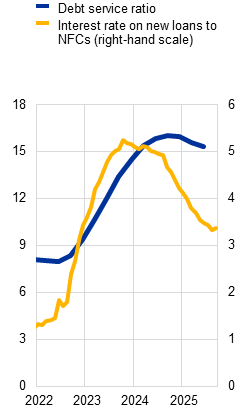
Despite some relief from lower interest rates, euro area firms continue to face high debt service costs. While the recent cuts in interest rates have reduced costs for new corporate borrowing, the stock of outstanding debt is continuing to reprice at less favourable conditions, keeping debt service ratios elevated (Chart 1.5, panel b). Survey data show that most firms believe their financial positions are under strain from weaker external demand, which is squeezing their profitability. At the same time, bankruptcy has shown mixed trends (Chart 1.5, panel c). Aggregate corporate bankruptcies are increasing and are above pre-pandemic levels, but recent data point to declines in sectors such as information and communication and modest improvements in manufacturing. This coincides with a recovery in new passenger car and commercial vehicle registrations, which rose by 5.9% year on year in the third quarter of 2025, suggesting that demand for durable goods has stabilised to some extent. Taken together, these dynamics suggest that while there are some signs of an incipient recovery, overall corporate resilience remains fragile. Small firms and firms operating in export-dependent sectors are facing particular challenges.[17]
International trade dynamics remain a key source of pressure on the euro area corporate sector. The tariffs introduced by the United States in early 2025, capped at 15% for most goods by the new US-EU trade agreement, are weighing most on manufacturing, which is one of the euro area’s most export-oriented sectors.[18] The frontloading of shipments in the first quarter of 2025 was followed by weaker exports to the United States in the second quarter, underlining the drag from trade frictions. A much greater impact from trade tensions is reported by firms that export to the United States than by those that do not. Many are indicating that they need to redirect sales towards domestic and intra-EU markets and they also need to restructure their supply chains. The appreciation of the euro in recent months has compounded these pressures, eroding price competitiveness abroad at a time when Chinese firms, facing weak domestic demand, are increasing their exports to global markets. This is reflected in declining order book balances for industry in the euro area. These remain in negative territory despite some stabilisation at the margin (Chart 1.6, panel a), pointing to continued weakness in external demand.
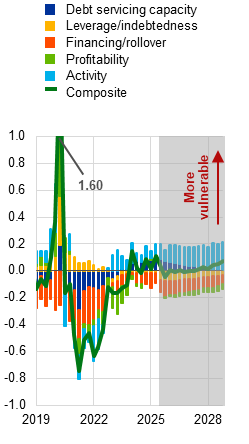
The broader corporate vulnerability picture remains mixed. The composite vulnerability indicator has increased from previous quarters and suggests that overall risks related to debt servicing, profitability and especially activity remain above their historical average levels. However, projections point to a stabilisation over the forecast horizon (Chart 1.6, panel b). Altman Z-scores point to particular stress among manufacturing firms, which are generally continuing to show greater distress than other real-economy sector firms (Chart 1.6, panel c). Notably, recent dynamics diverge between the manufacturing and the non-manufacturing sectors across the distribution.[19] These pressures underline the sectoral discrepancies in the corporate outlook. While services, construction and parts of the retail trade have shown relative resilience, manufacturing remains the most severely affected by tariffs, the appreciation of the euro and intensified import competition. These developments are consistent with the notion of rolling corporate recessions, where sector-specific downturns emerge sequentially and do not immediately translate into broader stress (see Box 1), although there could be greater correlation between sectoral vulnerabilities if shocks were to align.
Chart 1.6
Vulnerabilities in the euro area corporate sector remain elevated, especially for manufacturing firms, as the broader impact of US tariffs is felt
|
a) Order book levels in the euro area |
b) Corporate vulnerability indicator |
c) Distribution of Altman Z-scores in euro area sectors |
|---|---|---|
|
(Jan. 2019-Oct. 2025, percentage balances) |
(Q1 2019-Q4 2028E, Z-scores) |
(Q1 2019-Q4 2025, Z-scores) |
 |
 |
 |
Sources: ECB (BSI, MIR), S&P Global Market Intelligence, Eurostat and ECB calculations.
Notes: Panel a: order book levels in the euro area 20 (fixed composition). Panel b: for details on the construction of the corporate vulnerability index, see the box entitled “Assessing corporate vulnerabilities in the euro area”, Financial Stability Review, ECB, November 2020. Positive values indicate higher vulnerability while negative values indicate lower vulnerability. The grey shaded area refers to the forecast. Panel c: the Altman Z-score calculation is sector specific, according to Altman*, ** and Altman, Hartzell and Peck***. A higher Altman Z-score corresponds to a healthier balance sheet structure. Other real sectors include firms in agriculture, arts and recreation, construction, information and communication, other industry, professional services, real estate, and wholesale and retail trade.
*) See Altman E.I., “Financial Ratios, Discriminant Analysis and the Prediction of Corporate Bankruptcy”, The Journal of Finance, Vol. 23, September 1968, pp. 589-609.
**) Altman, E.I., “Corporate Financial Distress: A Complete Guide to Predicting, Avoiding, and Dealing With Bankruptcy”, Wiley Interscience, John Wiley and Sons, Hoboken, 1983.
***) Altman, E.I., Hartzell, J. and Peck, M., “Emerging market corporate bonds — a scoring system”, in Levich, R.M. (ed.), Emerging Market Capital Flows, Vol. 2, The New York University Salomon Center Series on Financial Markets and Institutions, Springer, Boston, MA, 1998.
Overall, the outlook for the euro area corporate sector remains fragile, amid easing domestic financing conditions but persistent external headwinds. While lower lending rates and some degree of stabilisation in bankruptcy trends are providing support, many firms are continuing to struggle with high debt service burdens and weak profitability. Adjusting to US tariffs, a stronger euro and increased competition from Chinese exporters are proving particularly challenging for manufacturing and other export-oriented sectors, whereas more domestically focused industries are showing greater resilience. On balance, the risks to the euro area NFC sector remain tilted to the downside, as any further intensification of trade frictions or renewed weakening of global demand could materially test corporate resilience.
Box 1
From localised shocks to systemic risks: the hidden threat of rolling recessions
Rolling corporate recessions mask underlying vulnerabilities and complicate risk analysis. Despite increased broader macroeconomic challenges and corporate vulnerabilities in the euro area in recent years, as indicated for instance by the marked rise in business bankruptcies, credit metrics such as the non-performing loan (NPL) ratio have remained surprisingly low (Chart A, panel a).[20] This disconnect between major macroeconomic shocks (e.g. the COVID-19 pandemic and the energy price shock after Russia’s invasion of Ukraine) and the absence of broad-based stress across corporate and bank balance sheets is often attributed to fiscal support cushioning the economy and inflation dynamics indirectly improving firms’ debt servicing capacity and profit margins.[21],[22] However, it may also reflect a structural shift in how downturns unfold. Unlike traditional recessions, which affect the economy uniformly, rolling recessions – defined as sectoral downturns that propagate sequentially – exacerbate weaknesses in specific sectors over time.[23] This staggered pattern obscures the overall health of the economy, leading to heightened uncertainty. While structural shifts such as climate change and digitalisation pose medium to long-term sectoral risks, rolling recessions entail the short-term risk of non-linearity, potentially triggering an unexpected economy-wide downturn. This box explores how rolling recessions may create hidden vulnerabilities and complicate the assessment of macro-financial risks.
1.4 Elevated savings bolster household resilience
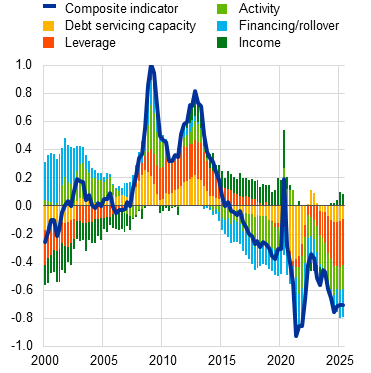
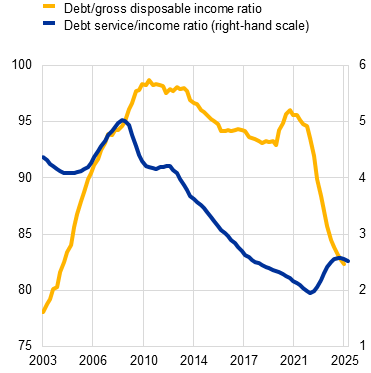
Household vulnerabilities are still low by historical standards. The ECB’s composite indicator of household vulnerabilities points towards high household resilience, underpinned by lower debt levels, a strong labour market and easier financing conditions. More recently, households’ debt servicing capacity has improved at the margin as interest rates have declined since inflation peaked. Meanwhile, lower income growth has tended to cause a marginal rise in the composite vulnerability indicator (Chart 1.7, panel a). Households’ improved debt servicing capacity is also evidenced by the continued, albeit slower, decline in the ratio of debt to gross disposable income. Falling interest rates are gradually allowing the debt service/income ratio to stabilise at modest levels, albeit with some delay (Chart 1.7, panel b).
Chart 1.7
The overall financial situation of households remains strong as they continue to deleverage
|
a) Composite indicator of household vulnerabilities |
b) Household indebtedness and interest debt service |
|---|---|
|
(Q1 2000-Q2 2025, standard deviations from long-run average) |
(Q1 2003-Q2 2025, percentages) |
 |
 |
Sources: Eurostat, ECB and ECB calculations.
Notes: Panel a: the composite indicator is based on a broad set of indicators along five dimensions: (i) debt servicing capacity (measured by gross interest payments/income ratio, saving ratio and expectation of personal financial situation); (ii) leverage (gross debt/income and gross debt/total assets ratios); (iii) financing (bank lending rate, short-term debt/long-term debt ratio, quick ratio (defined as current financial assets/current liabilities) and credit impulse (defined as the change in new credit issued as a share of GDP)); (iv) income (real income growth and income/GDP ratio); and (v) activity (labour participation rate and unemployment expectations). The indicators are standardised by transforming them into z-scores, meaning that they are converted into a common scale with a mean of zero and a standard deviation of one. Composite sub-indicators are calculated for each of the five dimensions by taking the simple arithmetic mean of the respective underlying z-scores of the individual indicators. Finally, the overall composite indicator is obtained by equally weighting the composite z-scores of the five sub-categories. Positive values indicate higher vulnerability while negative values indicate lower vulnerability.
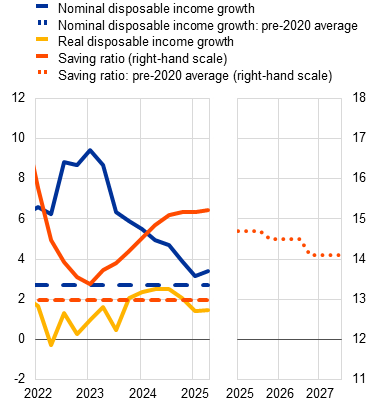
Nominal disposable income growth has normalised recently while the saving ratio has remained elevated by historical standards. After the strong catch-up dynamics seen following the period of higher inflation, nominal disposable income growth returned to pre-pandemic levels in the first quarter of 2025. At the same time, households’ saving ratios stabilised at a high level (Chart 1.8, panel a), despite the lower rates of return offered by typical retail saving instruments such as time deposits. This likely reflects precautionary behaviour in response to elevated global uncertainty and anticipation of possible future higher taxes and worsening financial situation. Looking forward, growth in household consumption is expected to pick up and saving ratios to move closer to historical averages. That said, domestic or foreign shocks – such as a further escalation of trade tensions or stronger appreciation of the euro – could dampen consumer confidence, which is already below historical averages.
Chart 1.8
Households remain very cautious with regard to spending despite a solid labour market and high levels of income growth over the last two years
|
a) Growth in nominal and real disposable income and saving ratio |
b) Unemployment rate |
|---|---|
|
(Q1 2022-Q4 2027E, percentages) |
(Q1 2005-Q3 2025, percentages) |
 |
 |
Sources: Eurostat and ECB.
Notes: Panel a: the dashed lines represent the pre-2020 averages for nominal disposal income growth and the saving ratio. The dotted line is the saving ratio shown in the September 2025 ECB staff macroeconomic projections for the euro area.
The labour market remains strong despite subtle signs of potential weakening. The aggregate unemployment rate in the euro area remains close to record lows, with noticeable convergence among countries (Chart 1.8, panel b). Unemployment rates have declined particularly sharply in those countries that suffered from pronounced weakness in their labour markets a decade ago. By contrast, unemployment rates in some countries with greater exposure to global trade are beginning to exhibit a modest trend upwards, albeit from a low starting point. Other labour market indicators, such as vacancy rates and hours worked, also point to a modest slowdown, particularly in specific sectors like manufacturing. However, it remains uncertain whether these dynamics are significant enough to trigger a broader economic downturn or whether they merely indicate a reallocation of activity between sectors. A broader economic downturn, if accompanied by a notable increase in unemployment, would materially worsen households’ financial situations. This would have a disproportionate impact on less wealthy individuals, who rely almost exclusively on wage income. In such a scenario, downward pressure on residential real estate prices would most likely emerge, and banks’ credit risk would rise beyond its current levels.
1.5 As a recovery in real estate markets gains traction, tail risks remain elevated in some countries and segments
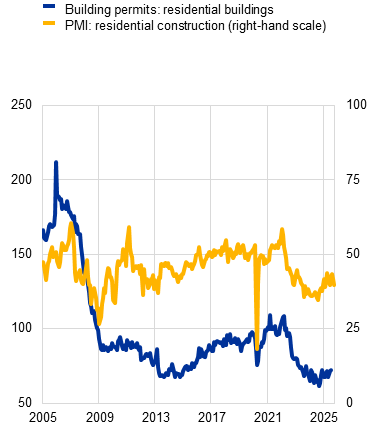
Demand for residential real estate (RRE) remained robust in the third quarter of 2025, while construction activity continued to be subdued. The sustained demand seen for mortgages was driven largely by the prevailing levels of interest rates and improved market prospects for the housing sector. This occurred as credit standards remained largely unchanged during the period, following on from a slight tightening in the previous quarter. Banks anticipate that these dynamics will persist, with mortgage demand projected to rise further in the fourth quarter of 2025, albeit at a more moderate pace, and credit standards expected to tighten only modestly, supporting this trend (Chart 1.9, panel a). However, improved financial conditions have not yet translated into a meaningful recovery in housing supply. The Purchasing Managers’ Index for residential construction in the euro area remains in contractionary territory, despite some recent improvements. In addition, the issuance of building permits for residential construction – a forward-looking indicator of supply – remains close to historical lows (Chart 1.9, panel b). The imbalance between strong demand and constrained supply is likely to exert upward pressure on RRE prices in the short term.
Chart 1.9
Financial conditions and the improved housing market outlook are boosting demand for residential real estate, while housing supply remains subdued
|
a) Changes in demand and credit standards for housing loans |
b) Construction activity indicators |
|---|---|
|
(Q1 2019-Q3 2025, net percentages) |
(Jan. 2005-Oct. 2025, indices) |
 |
 |
Sources: ECB (BLS), Eurostat and S&P Global Market Intelligence.
Note: Panel b: the latest observation for data on building permits is for July 2025.
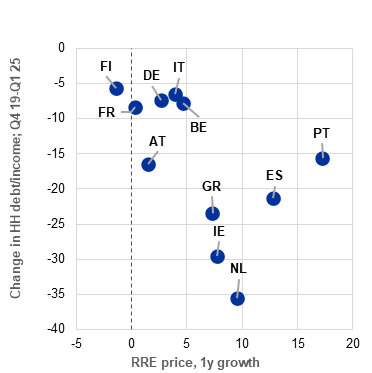
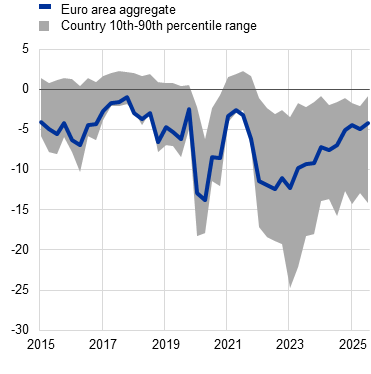
Growth in RRE prices has continued to vary across euro area countries, with tail risks remaining elevated in some jurisdictions. While RRE prices rose on aggregate across the euro area in the second quarter of 2025, there was significant cross-country variation. Several euro area economies experienced robust growth in RRE prices, while more moderate levels were observed in others. The significant household deleveraging seen in a number of countries in recent years may be contributing to the present market upswing in some cases (Chart 1.10, panel a). Moreover, current price dynamics often correlate with credit growth, which has accelerated markedly in more buoyant markets. Aggregate tail risks to housing prices declined slightly in the third quarter of 2025, largely reflecting improved financial conditions (Chart 1.10, panel b). Nonetheless, these risks remain elevated in some countries and could increase in markets in which declining affordability could exacerbate vulnerabilities over the medium term.
Chart 1.10
Housing prices exhibit robust growth in several countries, while tail risks remain elevated in some markets
|
a) RRE price growth and changes in household debt/income ratios |
b) Estimated downside risk to RRE prices over the next year |
|---|---|
|
(x-axis: annual growth rate, percentages, y-axis: change in household debt/income ratio, percentages) |
(Q1 2015-Q3 2025, percentages) |
 |
 |
Sources: ECB and ECB calculations.
Notes: Panel a: the chart includes only countries with household debt/income data available for Q1 2025. The one-year RRE price growth data refer to Q2 2025 for all countries except for Austria, which displays data as of Q3 2025. HH stands for household.
Panel b: the chart shows the results obtained from an RRE price-at-risk model based on a panel quantile regression on a sample of 19 euro area countries. The chart shows the fifth percentile of the predicted RRE price growth for the euro area aggregate and the 10-90th percentile range of this estimate across individual euro area countries. For further details, see the article entitled “The analytical toolkit for the assessment of residential real estate vulnerabilities”, Macroprudential Bulletin, Issue 19, ECB, October 2022.
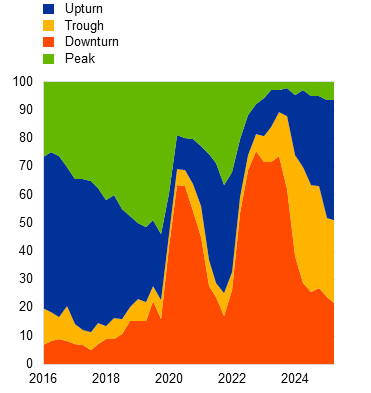
Investor sentiment on commercial real estate (CRE) has improved, indicating a stabilisation in the market, although risks remain. Investor sentiment data continue to show a sharp decline in the share of investors who believe the market is in a downturn compared with the period of monetary tightening (Chart 1.11, panel a). As is the case for residential markets, investors’ views on the current stage of the cycle vary on clear geographical lines. For those countries most affected by the recent downturn (Germany and Austria), investors see the market as having reached its trough. For those countries less affected (Greece, Spain and Italy), investors typically see the market as being in an upswing. Despite the stabilisation, activity remains subdued, and the number of transactions conducted in euro area markets is still about 30% below its 2019 peak (Chart 1.11, panel b). Market intelligence indicates that this may be down to ongoing investor uncertainty. As CRE markets are exposed to both international capital flows and local economic conditions, they are highly vulnerable to the ongoing macroeconomic and geopolitical uncertainty. Activity is particularly subdued in office markets, where the shift towards hybrid working practices continues to pose a challenge. As previous editions of the Financial Stability Review have noted, the outlook for the lower-quality end of the market is particularly poor.
Chart 1.11
Euro area CRE markets show signs of stabilisation but market activity remains subdued, particularly among offices, amid broader investor uncertainty
|
a) CRE market sentiment |
b) Number of CRE transactions |
|---|---|
|
(Q1 2016-Q2 2025; share of investors surveyed, percentages) |
(Q4 2019-Q2 2025; total transactions, four-quarter rolling sum: index: 100 = Q4 2019) |
 |
 |
Sources: RICS, MSCI and ECB calculations.
A recovery in real estate markets is under way, but risks to financial stability could still materialise and should be monitored closely. Real estate markets are highly sensitive to developments in the broader real economy and to changes in medium to long-term interest rates. Accordingly, a sharp deterioration in the economic outlook or an unexpected rise in interest rates could cause prices to start falling again. This is particularly the case in countries where housing affordability is low or declining and countries that have a large commercial office segment coupled with still-high vacancy rates. This makes it important to continue closely monitoring the associated risks, taking current economic policy uncertainty and geopolitical risks into consideration. Against this background, maintaining resilience in the banking sector is key to limiting financial stability risks stemming from property markets. This is being achieved by applying adequate releasable buffers and appropriately calibrated borrower-based measures to preserve sound lending standards (see Section 3.5).
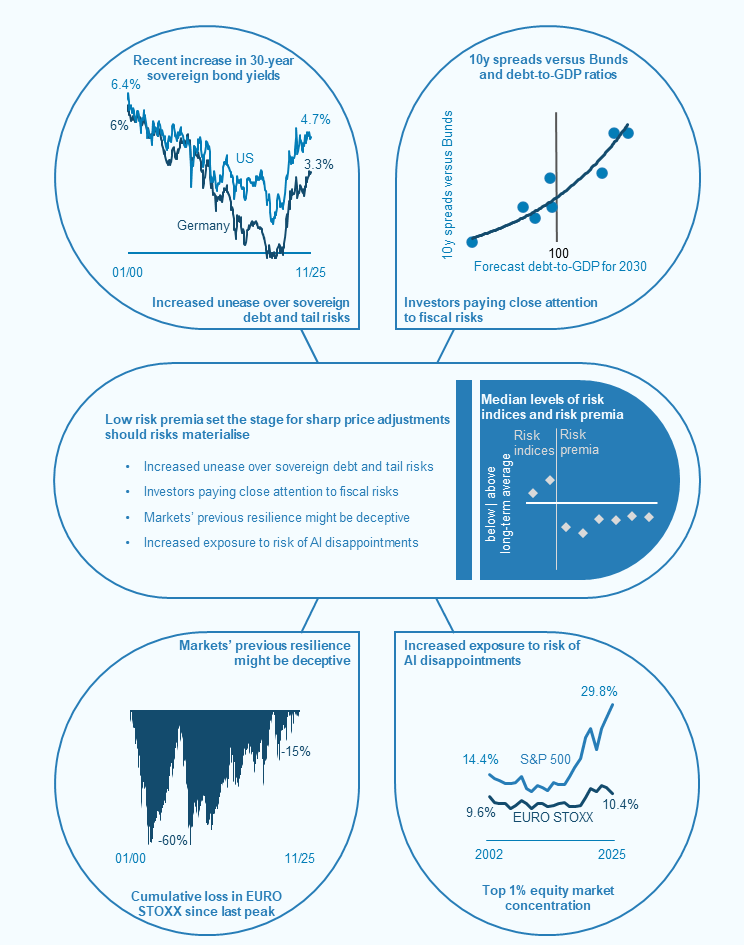
2.1 Steepening yield curves signal growing unease over sovereign debt trajectories
After April’s tariff turmoil, sovereign bond markets were dominated by worries over fiscal debt and tail risks, while risk assets mostly stayed calm. Yields on ultra-long sovereign bonds have continued to rise globally amid unease over fiscal sustainability and changes in supply-demand dynamics in sovereign bond markets.[24] Despite some volatility, the price of gold has risen significantly, which is consistent with increased demand for tail risk hedging, among other factors. At the same time, valuations in most risky asset markets are still high. This could be an indicator of strong optimism, but it could also reflect the fear of missing out on a rally and the difficulties associated with pricing financial assets in an environment characterised by elevated uncertainty and several concurrent structural shifts (see Section 2.2). One such shift under way is being caused by AI, with its promise to boost productivity. While there is considerable potential for upside and the high valuations of AI-related firms are underpinned by exceptionally strong earnings, any setbacks in AI advances could lead to sharp asset price adjustments, including in the opaque private markets (see Section 2.3).
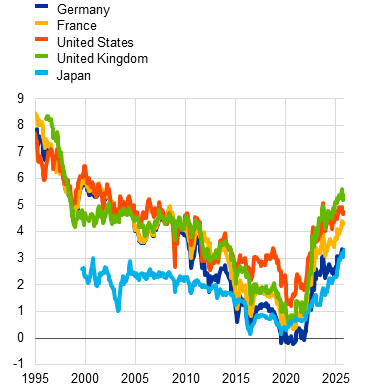
Yields on ultra-long sovereign bonds have risen sharply across the globe, reflecting growing concerns over fiscal and debt sustainability. Since the beginning of the year, euro area GDP-weighted 30-year yields have risen by roughly 50 basis points, whereas two-year yields have declined by around 10 basis points.[25] While at first the steepening of the yield curve was broad based across maturities, the most recent move has been concentrated at the ultra-long end. Steepening yield curves are a global phenomenon, with 30-year yields reaching multi-year highs across major advanced economies including the United States, the United Kingdom and Japan (Chart 2.1, panel a). Investors are demanding higher term premia to compensate for fiscal and debt sustainability concerns, according to market contacts. The outsized rise in 30-year yields suggests that one-off factors, such as the Dutch pension fund reform and regulatory changes in Japan, which disproportionately affect ultra-long maturities, could have played a role as well. The latter is, however, likely to be less significant, given the strong global factor underlying the rise in 30-year yields in the euro area and the high correlation of the change in 30-year yields with changes in the debt outlook.
Chart 2.1
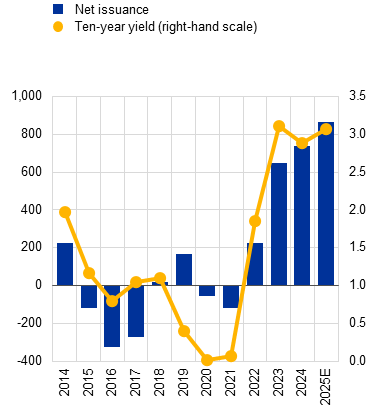
Yield curves have steepened on the back of rising ultra-long yields, while financing needs are high
|
a) 30-year benchmark sovereign bond yields |
b) Net issuance and euro area sovereign bond yields |
|---|---|
|
(Jan. 1995-Nov. 2025, percentages) |
(2014-25; € billions, percentages) |
 |
 |
Sources: Bloomberg Finance L.P., ECB, national central banks and ECB calculations.
Notes: Panel a: sovereign bond yields are shown at monthly frequency (month-end). The latest observations are for 18 November 2025. Panel b: net issuance is defined as gross issuance minus redemptions of central government bonds by euro area national governments and minus Eurosystem purchases. Yield data refer to the GDP-weighted average ten-year yield of euro area sovereign bonds, averaged over the respective year. The 2025 yield value represents the average up to 18 November 2025.
Changes in supply-demand dynamics have also contributed to the rise in yields. On the supply side, euro area governments face elevated financing needs (Chart 2.1, panel b). These are being driven by expectations of rising defence spending amid geopolitical tensions, the structural requirements of the green and digital transitions and infrastructure investment. At the same time, demand patterns are changing because of shifts in the investor base. While quantitative tightening has already removed the largest price-insensitive buyer from sovereign bond markets, foreign investors and other price-sensitive investors have become more prominent, especially since 2022. Going forward, the reform of the Dutch pension system may also affect demand dynamics. Dutch pension funds, which account for around 65% of euro area pension funds’ sovereign bond holdings, are expected to reduce their long-term euro area sovereign bond positions in the coming years, following the reform (see Chapter 4). This combination of fundamental concerns over sovereign risks and the growing funding needs of governments leaves sovereign bond markets vulnerable to further repricing. The presence of hedge funds in sovereign bond markets can significantly amplify financial shocks when leveraged positions need to be unwound. [26] These positions are particularly exposed to deteriorating funding conditions in the repo market and heightened volatility in bond markets (see Section 4.2).
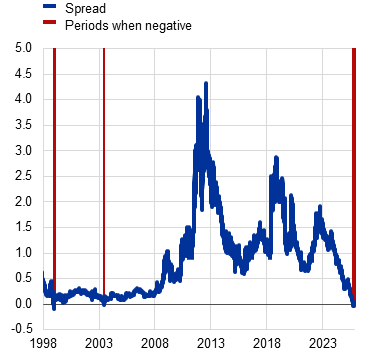
Chart 2.2
The French yield has risen above the Italian yield amid the convergence of bond spreads in the euro area
|
a) Spread between Italian and French ten-year bond yields |
b) French spread and average of euro area sovereign spreads versus Germany |
|---|---|
|
(1 Jan. 1998-18 Nov. 2025, percentage points) |
(1 Jan. 2024-18 Nov. 2025, percentage points) |
 |
 |
Sources: Bloomberg Finance L.P., ECB and ECB calculations.
Notes: Panel a: Italian and French spreads are the respective ten-year sovereign bond yields versus the German Bund yield. Panel b: average spread is the GDP-weighted average of the Belgian, Irish, Greek, Spanish, Italian, Dutch, Austrian, Portuguese and Finnish sovereign bond yields versus the German Bund yield. The spreads shown are for ten-year sovereign bonds.
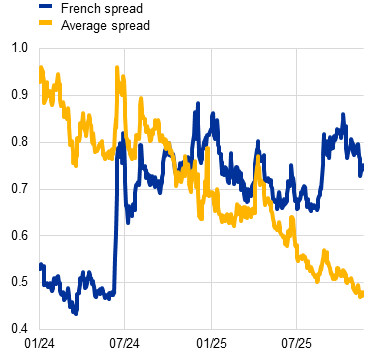
Debt sustainability concerns have resurfaced in some countries amid political uncertainty, but the broader convergence of bond spreads is a positive signal. Following the collapse of the French government in September, the spread between French and German sovereign bonds widened, but has remained within the range seen over the last year, and markets have remained functional and liquid. By contrast, yields on Italian sovereign bonds have declined in relative terms to the extent that Italian yields fell below French yields for the first time since 2003 (Chart 2.2, panel a). This may be part of a broader convergence between previously higher-rated and lower-rated sovereigns in the euro area, with average euro area sovereign bond spreads (excluding France) on a downward trend (Chart 2.2, panel b). This compression of spreads has recently been driven less by changes in German yields and more by declining yields in other countries. This suggests that there is no contagion at this stage from developments in France to other euro area sovereign bonds. However, disappointments over fiscal consolidation efforts, weak demand at auctions or further political instability could trigger a broader repricing of sovereign risk in the euro area, especially given the currently tight levels of spreads.
Chart 2.3
Sovereign bond spreads are sensitive to changes in sovereign debt trajectories
|
a) Spreads versus five-year forward debt-to-GDP ratios |
b) French five-year sovereign and corporate bond yields |
|---|---|
|
(ratios, basis points) |
(2 Jan. 2023-18 Nov. 2025, percentages) |
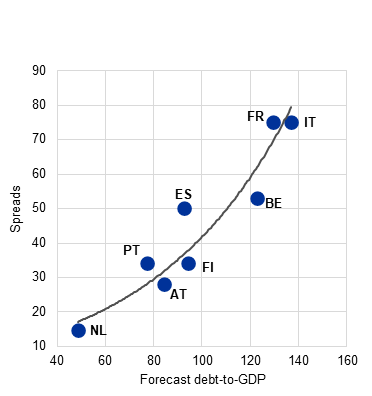 |
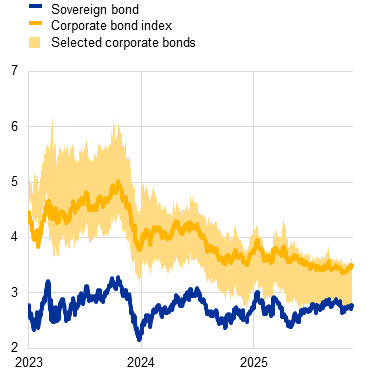 |
Sources: Bloomberg Finance L.P., IMF and ECB calculations.
Notes: Panel a: spread is versus Germany (ten-year yield). Debt-to-GDP ratios are IMF projections for the year 2030 as of October 2025. The latest observations are for 18 November 2025. Panel b: “Corporate bond index” refers to the yield of the Bloomberg France Corporate Index. “Selected corporate bonds” is the range of yield-to-worst values for six different bonds of French issuers. Bonds were selected by filtering the 20 bonds in the Bloomberg France Corporate Index with the highest amount outstanding covering euro-denominated bonds with a residual maturity of between three and seven years.
Sovereign risk pricing appears to be broadly aligned with fiscal fundamentals. Expected trajectories for debt-to-GDP ratios correlate strongly with the current sovereign bond spread levels seen across the euro area (Chart 2.3, panel a). Moreover, for many countries the compression of sovereign bond spreads is on the back of improvements expected in budget balances over the next few years. This suggests that bond investors are paying close attention to the fiscal outlook. Current pricing may, however, provide limited compensation for adverse scenarios. At the same time, the yields of selected high-grade French corporates have recently traded below those for French sovereign bonds (Chart 2.3, panel b). While this partly reflects a robust credit market, the pattern is also consistent with international investors seeking euro-wide exposure via large, diversified corporates as opposed to single-country exposures via sovereign holdings.
Chart 2.4
Gold price rally may reflect rise in tail risk while swaps indicate little concern about upside inflation risks in the United States
|
a) US inflation swap curve |
b) Gold price and flows into gold ETFs |
|---|---|
|
(years, percentages) |
(3 Jan. 2022-18 Nov. 2025; US dollars per ounce, USD billions) |
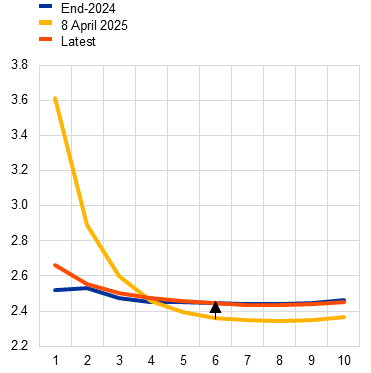 |
 |
Source: Bloomberg Finance L.P.
Notes: Panel a: x-axis is tenor of inflation swaps in years from the selected date point. The latest observation is for 18 November 2025. Panel b: for gold ETF flows, the largest gold ETF was used (Bloomberg ticker: GLD US Equity). ETF stands for exchange-traded funds.
The risks of spillovers from US Treasury markets to euro area sovereign bond markets are high, amid growing concerns over US fiscal sustainability and the changing role of the US dollar in global financial markets. Expectations that large US budget deficits will persist have intensified worries about long-term US fiscal sustainability. Surveys of market participants have also revealed increasing concerns over tail risks. The most frequently cited risks to financial stability include the possibility that the Federal Reserve System’s independence could be reduced and the diminishing safe-haven status of the dollar. Since the tariff announcements in April, market dynamics have been suggesting a potential shift in the US dollar’s role in global financial markets (see Special Feature A). Despite the rally in US equity markets, the US dollar has depreciated by around 10% against the euro so far this year. Increased foreign exchange hedging activity indicates that international investors are losing their appetite for unhedged exposure to US dollar-denominated assets (see Chapter 4, Chart 4.3, panel b). The slight rise in longer-term inflation swap rates is signalling that markets may show little concern about upside inflation risks (Chart 2.4, panel a). At the same time, despite the slight adjustment seen recently, the price of gold remains historically high, which is consistent with tail risk hedging. Furthermore, market contacts also attribute the rise in the gold price to elevated geopolitical risk, persistent policy uncertainty, central bank purchases and rising demand from retail investors. The latter is reflected by rising inflows into exchange-traded funds that invest in gold and may signal increasingly speculative behaviour (Chart 2.4, panel b).
2.2 Compressed risk pricing in equity and corporate bond markets
Valuations in risky assets remain stretched, which leaves room for sudden adjustments. Having recovered strongly from their lows in early April, euro area equity and corporate bond markets have seen further gains. The strong overall performance of risky assets was driven by de-escalating trade tensions, solid corporate earnings and expectations of (further) monetary policy easing across major developed markets. In the United States, policy rates are expected to fall sharply and the end of quantitative tightening has been announced, while the probability of recession has recently declined.[27] This may provide substantial support to valuations of risky assets, as the positive effect on valuations from lower discount rates is not expected to be offset by significantly lower growth. These developments have led to equity risk premia, credit spreads and implied volatility in risky asset classes and oil prices staying mostly at or below long-term averages since the May 2025 edition of the Financial Stability Review was published. Equity market volatility has seen several short-lived spikes and stood at levels above the long-term average at the cut-off date, but equity risk premia and corporate bond spreads remain well below their long-term averages (Chart 2.5). While geopolitical risk and trade policy uncertainty declined, they could quickly re-emerge and much of the impact of tariffs may still be ahead, which could challenge elevated valuations. Compressed spreads in euro area high-yield bonds also stand in contrast to a significant level of issuance this year and the uptick in default rates seen since April (see Overview).
Chart 2.5
Equity risk premia and credit spreads remain well below their long-term averages, while implied equity market volatility has recently increased
Distribution of the deviation from ten-year average for risk, financial assets valuation and volatility indicators since the May 2025 edition of the Financial Stability Review was published
(19 May-18 Nov. 2025, z-scores)
Sources: Bloomberg Finance L.P. and ECB calculations.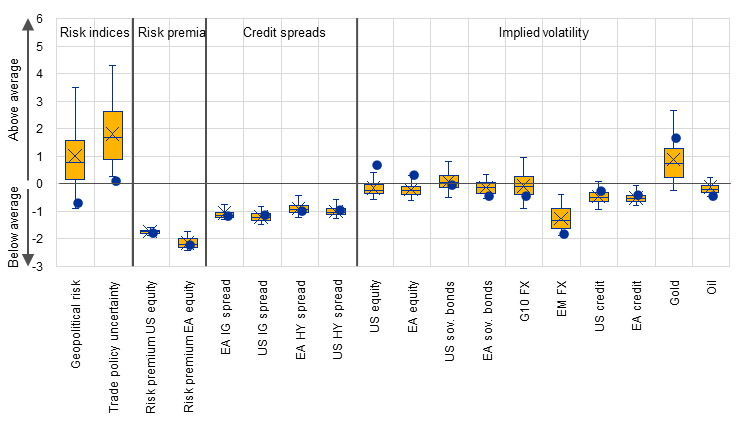
Notes: While z-scores are computed over a ten-year period (June 2016 to 18 November 2025), the depicted boxplots show z-score values only for the period since the May 2025 edition of the Financial Stability Review was published. X denotes average values; – denotes median values; blue dots denote the latest values. EA stands for euro area; IG stands for investment grade; HY stands for high yield; FX stands for foreign exchange; EM stands for emerging markets. Equity risk premia are calculated as earnings yield minus ten-year sovereign bond yields.
Along with high levels of optimism, valuations in markets might also reflect the fear of missing out on gains from a rally in risky assets and difficulties in pricing complex risks. Equity markets have shown remarkable resilience to shocks in recent years, as evidenced by faster recoveries and smaller drawdowns in the euro area (Chart 2.6, panel a), with similar findings for the United States. This might have increased the fear of missing out on quick recoveries after a shock or on a continued rally. Moreover, markets appear to have become less sensitive to tariff-related news, as illustrated by the reaction of the broad euro area equity index to recent tariff announcements (Chart 2.6, panel b). By contrast, assets directly affected by individual tariff announcements have continued to react, as evidenced by the sharp movements in copper prices seen in July. Another factor explaining the calmness in markets is that at this time, it is particularly difficult to assess the likelihood of risks materialising and their related impact. Uncertainties surrounding several concurrent structural shifts in geopolitics, artificial intelligence, energy and defence, for example, remain elevated and might not be reflected in prevailing market pricing. Additionally, higher tariffs have not so far had any strong adverse impact on global growth or inflation, although these effects could materialise at a later stage.
Chart 2.6
Recent equity market downturns have been short-lived, which might have increased the fear of missing out on a rally and reduced markets’ sensitivity to adverse news
|
a) Drawdown in EURO STOXX |
b) Reaction of EURO STOXX to various tariff announcements |
|---|---|
|
(1 Jan. 2000-18 Nov. 2025, percentages) |
(index = 100 on event day, days from tariff news event) |
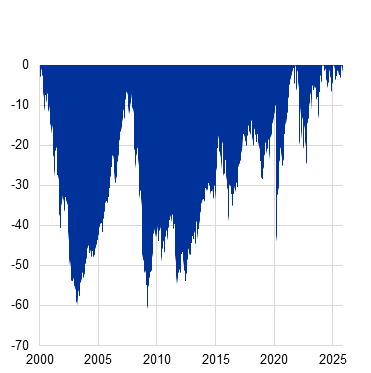 |
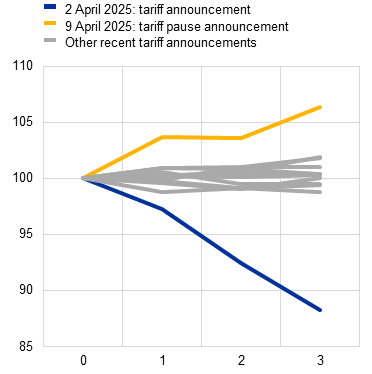 |
Sources: Bloomberg Finance L.P., LSEG and ECB calculations.
Notes: Panel a: drawdown is defined as the cumulative loss since the last peak. Panel b: the chart shows the cumulative equity market reaction to major tariff-related news events until 18 November 2025. Indices are normalised to 100 at the day of the announcement (T), with subsequent days (T+1, T+2, T+3) rescaled relative to that baseline. Besides the tariff announcements shown for the selected week in April 2025, other recent tariff announcements, shown in grey, include the tariffs announced on Canada and Mexico, those tariffs taking effect, the global implementation of steel and aluminium tariffs, subsequent increases in steel and aluminium duties, various tariff deadlines, extensions and trade deals, the announcement of 30% tariffs on imports from the EU, effective on 18 August 2025, the US-EU trade agreement and the revision of reciprocal tariff rates, including higher tariffs on India and the announcement of 130% tariffs on China.
Crypto-asset valuations have profited from broadening investor interest, including from traditional finance, but remain highly volatile. Crypto market capitalisation breached the USD 4 trillion mark for the first time in July (Chart 2.7, panel a). This was driven by a more favourable regulatory climate and growing interest from both retail and institutional investors.[28] In addition, there is evidence for rising speculative leverage, which might have contributed to a sharp adjustment precipitated by escalating trade tensions between the United States and China in October of this year. Since then, market capitalisation has declined to USD 3.3 trillion, roughly the same level that prevailed when the May 2025 edition of the Financial Stability Review was published. Stablecoins, a sub-segment of the crypto universe, have received significant attention in recent months on the back of global regulatory developments. Although comparatively small in amount (USD 290 billion), stablecoins fulfil a central role in the crypto universe, and their strong interconnectedness with the traditional financial system stands out (see Box 5). Financial stability risks from this market segment seem to be limited in the euro area, but further monitoring is still warranted.
Chart 2.7
Crypto markets reach short-lived new highs, driven by institutional and retail investors, the latter also increasing their share in US equity turnover
|
a) Total crypto market capitalisation |
b) Share of retail investors in US equity trading volume and S&P 500 |
|---|---|
|
(5 Jan. 2020-18 Nov. 2025, USD trillions) |
(1 Jan. 2018-18 Nov. 2025; percentages, index level) |
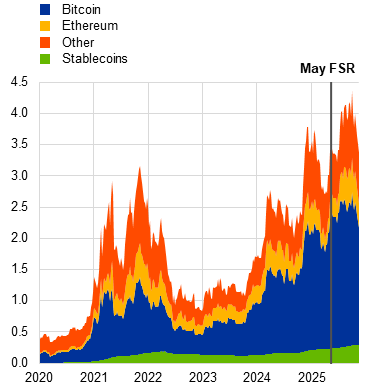 |
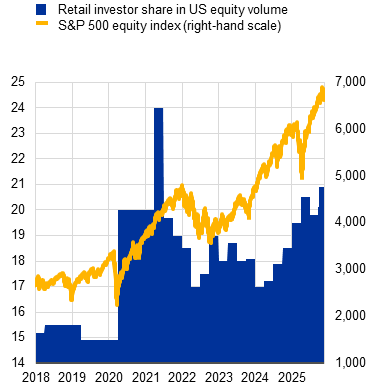 |
Sources: CoinDesk Data, IntoTheBlock, Bloomberg Finance L.P. and ECB calculations.
Note: Panel a: data are shown at weekly frequency. The latest observations are for 18 November 2025. Panel b: shows the share of retail investors in US equity trading volumes as quarterly data forward-filled to daily frequency.
Retail investors can help stabilise the markets, but some retail segments in the United States are showing signs of exuberance, with potential spillovers to the euro area. Evidence from the euro area and the United States suggests that demand from retail investors has remained steady, even during market sell-offs. In the United States, retail investor participation in equity markets has shown a sustained increase since the COVID-19 pandemic. Retail investors accounted for an average of 14% in total equity trading volume between 2010 and 2019, which increased to an average of 19% since 2020.[29] The share increased – or at least remained stable – when equity prices fell (Chart 2.7, panel b), which might indicate that retail investors have been aiming to benefit from low prices (a “buy-the-dip” strategy). While similar data for the euro area are not readily available, flows into euro area-domiciled funds during the market sell-off in April 2025 point to similar dynamics, which might point towards a stabilising role played by retail investors in financial markets (see Box 2). But there are also signs of exuberance in some retail investor segments, including US retail stocks and 0DTE contracts.[30] While quite specific to the United States, these developments are relevant for the euro area, as overheating or sudden adjustments in US markets can spill over to euro area markets.
High valuations set the stage for sharp and sudden moves, should risks materialise. Seemingly calm markets might not adjust gradually to shifting probabilities of risk scenarios, but could instead react non-linearly, with sharp price declines when risks materialise. Currently, high valuations leave more room for negative surprises to have larger effects on financial markets than for positive surprises to do so, as there are several sources of risk. Despite declining risk indices, the probability of negative macro-financial shocks remains elevated and the impact of higher tariffs on inflation and growth is yet to show. Geopolitical tensions could escalate further, and policy uncertainty could re-emerge suddenly. Corporate bond markets are vulnerable to shifts in risk sentiment, as they show tight risk premia despite deteriorating credit risk. In addition, high valuations are partly driven by strong expectations in relation to AI-boosted economic growth and related financing flows. These investments might turn out to be less profitable than expected. The recent pick up in equity market volatility could be a first sign of a turn in risk sentiment.
Box 2
The role of household investors in market downturns
Episodes of high volatility in financial markets have raised concerns about the resilience of investment funds to liquidity shocks. Investment funds running a strategy focused on risky assets such as equities and high-yield bonds may suffer from large investor outflows during episodes of high volatility and declining market prices. Funds that operate with significant liquidity mismatches may thus be forced to sell less-liquid assets at unfavourable conditions.[31] The structure of the investor base can play a significant role in fund fragility during such stress episodes.[32] This box zooms in on the importance of household investors as a stabilising factor for investment fund liquidity during market downturns, with a focus on the April 2025 market turmoil.
2.3 Risk of spillovers across markets as concentration and exposures increase
The recovery seen in US equity markets since their lows in April has been primarily driven by technology and other AI-related firms, leading to new highs in market concentration. The stock prices of the seven dominant US technology companies, known collectively as the “Magnificent 7”, have increased by 58% since 8 April. By contrast, the rest of the S&P 500 (i.e. excluding the “Magnificent 7”) has gained only 24%. This has led to a further increase in US equity market concentration, with the top 1% companies of the S&P 500 now accounting for around 30% of market capitalisation (Chart 2.8, panel a). A further breakdown by sector of the largest companies reveals that sectoral diversification has decreased over the last decade while the IT sector has significantly gained in prominence. Whereas concentration in the EURO STOXX remains around 10% for the top 1%, the IT sector has also gained a higher share in this index.
Parallels with the early 2000s are fuelling concerns that an asset price bubble may be building, but the current high valuations appear to be underpinned by exceptionally robust earnings performance. Survey results show that market participants are split as to whether AI stocks are in a bubble, but they see this as the most prominent tail risk.[33] While some metrics suggest that valuations are similarly elevated, today’s largest companies have more diversified business models than those of the early 2000s. High valuations and the resulting equity market concentration appear to be underpinned by exceptional earnings growth (Chart 2.8, panel b). In turn, earnings are predicated on expectations that AI advancements will boost economic growth. In addition to high market concentration, the interconnection between AI-related firms has also reportedly increased. The currently high earnings growth of the largest companies may therefore also be supported by their interrelated business activities, which could amplify spillover effects if risks were to materialise.
Disappointing news relating to AI progress might lead to direct and indirect spillovers to the euro area financial system. The non-bank financial intermediation sector in the euro area remains highly exposed to US securities and would therefore suffer directly from valuation losses (see Overview). Irrespective of whether the “AI rally” has created an asset price bubble, idiosyncratic events in related stocks could weigh on global risk sentiment, given their high market capitalisation. This might lead to an overall increase in global risk aversion with spillovers to euro area equity markets, even though they are less focused on the technology sector. At the same time, euro area equity markets might also profit from investment flows being redirected to markets that are less focused on technology.
Chart 2.8
Concentration in US equity markets has reached new highs, with valuations backed by outstanding earnings growth and expectations that AI will boost productivity
|
a) Equity market concentration among top 1% of companies |
b) Growth of earnings per share for S&P 500 companies |
|---|---|
|
(2002-25, percentages) |
(1 Jan. 2021-18 Nov. 2025; index = 100 on 1 Jan. 2021) |
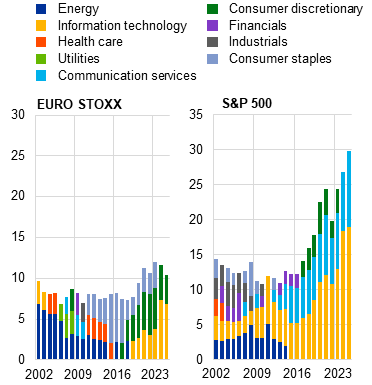 |
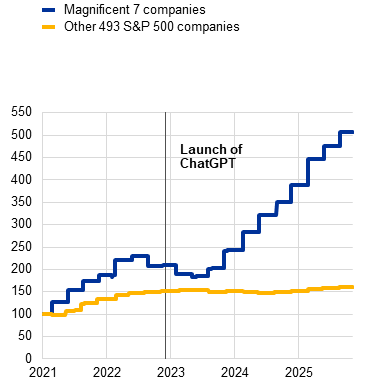 |
Sources: Bloomberg Finance L.P. and ECB calculations.
Notes: Panel a: the columns show the share of the top 1% of EURO STOXX and S&P 500 companies (i.e. the top three and five companies respectively), by market capitalisation, in the total market capitalisation of the indices, broken down by Global Industry Classification Standards (GICS). The latest observations are for 18 November 2025. Panel b: the blue line shows earnings per share of the “Magnificent 7” technology firms (Alphabet, Amazon, Apple, Meta, Microsoft, Nvidia and Tesla), which has been indexed to 100 on 1 January 2021. The yellow line shows the same measure for the remaining S&P 500 companies, i.e. all S&P 500 companies excluding the seven technology firms listed above. The black vertical line marks 30 November 2022, the day ChatGPT was launched to the public by OpenAI.
While a large part of the current AI-induced capital spending boom is funded from profits, private markets and bond markets have started to play a growing role in financing AI-related companies and infrastructure. While private markets would appear to be particularly suitable for financing AI developments owing to their capacity to undertake riskier and long-term investments, current and future financing flows from private markets and bond markets add to the financial system’s overall exposure to any disappointments relating to AI.[34] While AI-related investments in private markets are expected to accelerate further, the share of the IT sector in global private equity, private debt and venture capital transactions has already significantly increased since 2010 (Chart 2.9). In addition, the IT share in private debt transactions is much higher than the IT share in public bond markets.[35] Moreover, there is evidence that issuance of bonds by AI-related firms in the United States has picked up significantly. Overall, this signals a growing role of debt in the financing of AI-related capital spending. The strong acceleration of growth in the IT share in venture capital transactions in recent years is also indicative of an AI-related focus.
Chart 2.9
Private markets are significantly exposed to the IT sector and might be affected by adverse news relating to AI
Share of IT sector firms in global private market transactions
(2010-25; percentages, € billions)
Sources: PitchBook Data Inc. and ECB calculations.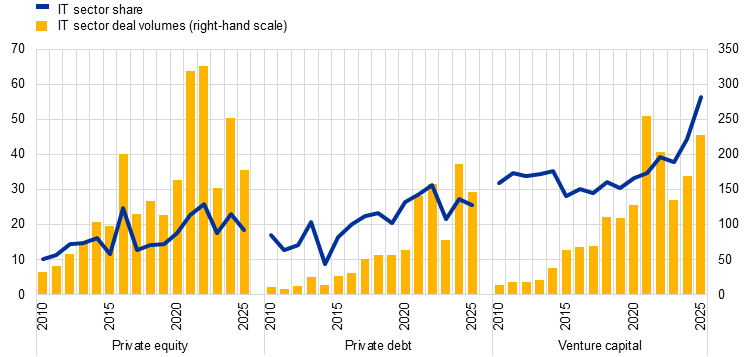
Notes: IT sector share is depicted separately for each of the three private market subsegments. The industry classification system developed by PitchBook is very similar to GICS. Industry sectors include business to business (B2B), business to consumer (B2C), energy, financial services, health care, information technology, and materials and resources. Since only the primary industry sector is used, B2B and B2C might include other IT-related companies. This means that the displayed IT sector share is a lower bound. The latest observations are for 18 November 2025.
While concerns around risks in private markets are growing, the likelihood of further contagion across the wider financial system from stress in private markets remains difficult to assess. Private markets are characterised by significant cross-border flows and a high level of opaqueness. This was highlighted by the default of the US private credit borrower First Brands in September, which caused significant losses for several financial entities in the United States and Switzerland. In addition, the difficulties private equity funds face in exiting their investments may reflect a disconnect between the currently unrealised, and possibly inflated, valuations of private equity-backed companies and the prices that can actually be achieved when they are sold. This can lead to unforeseen losses for private equity investors. The opaqueness in private markets hinders a fully-fledged risk assessment and should be addressed from a policy perspective (see Section 4.4).[36] Recent trends, such as the potential opening up of US pension funds to investments in private markets and retail investors gaining access to private markets (e.g. via neo-broker platforms), allow for more varied sources of funding on the positive side. An increase in retail investment flows does, however, raise concerns about increasing liquidity mismatches.
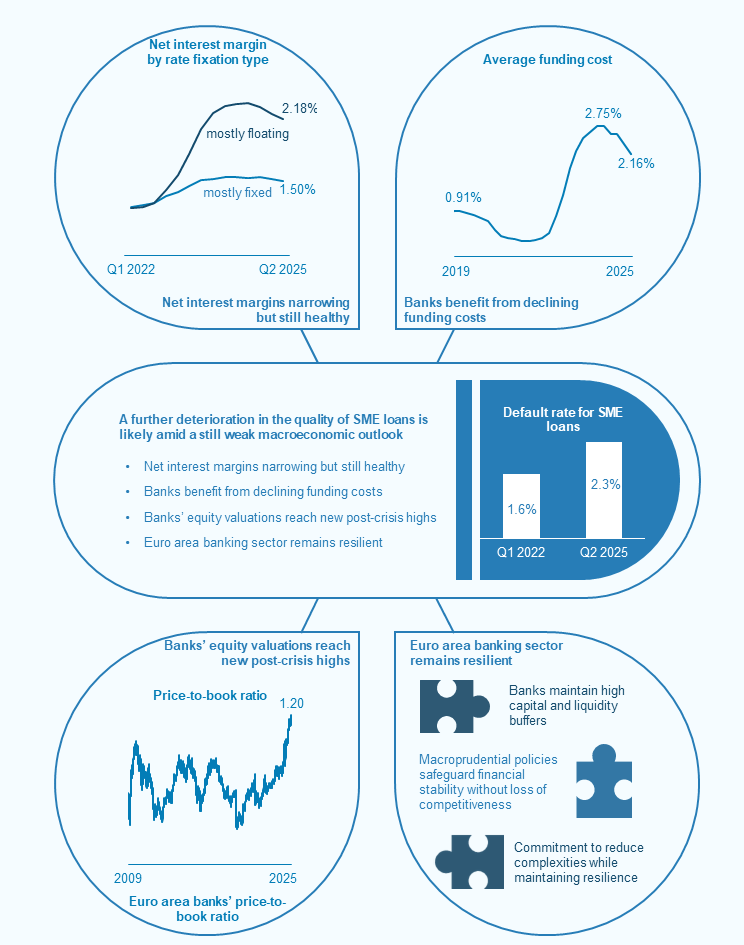
3.1 An improving near-term outlook for banking sector profitability, although some downside risks remain
The profitability of euro area banks remained broadly stable in the first two quarters of 2025, although cross-country disparities persist. The trailing return on equity (ROE) of significant institutions rose slightly to 9.8% in the second quarter of 2025 from 9.6% in the fourth quarter of 2024 (Chart 3.1, panel a). However, revenue growth in recent quarters has mainly been driven by non-core revenues such as trading and investment income. Core revenues were flat in the second quarter of 2025, as a moderate decline in net interest income was offset by continued growth in net fee and commission income. The dispersion of profitability across countries remains significant. Banks in countries which have enjoyed larger profitability gains since late 2021 have mainly benefited from a greater capacity to generate net interest income than their peers in countries with relatively smaller profitability improvements (Chart 3.1, panel b). In addition, a decline in loan loss provisions, partly driven by disposals of non-performing loans, has made a significant positive contribution to profitability for banks in the first group of countries. This contrasts with rising provisions having a moderate negative impact in the underperforming country group. This group mainly consists of countries that have seen non-performing loans increase since 2021, albeit from low starting levels. Furthermore, banks here have been less effective in cost control.
Chart 3.1
Headline profitability remains strong, but the growth of core revenues has come to a halt and cross-country differences in profitability levels persist
|
a) ROE and decomposition of year-on-year change in net income |
b) ROA drivers, by country group |
|---|---|
|
(Q1 2021-Q2 2025; € billions, percentages) |
(Q4 2021, Q2 2025; percentages, percentage points) |
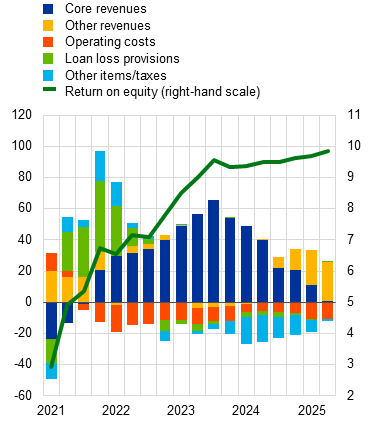 |
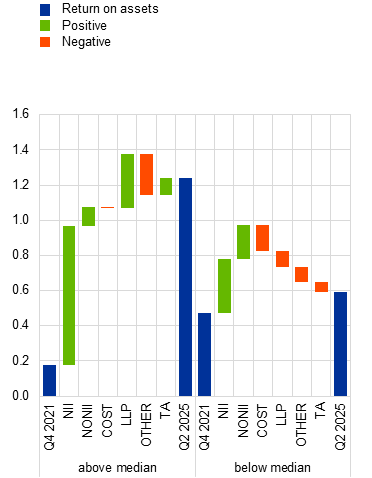 |
Sources: ECB (supervisory data) and ECB calculations.
Notes: Based on a sample of 87 significant institutions. Panel a: based on four-quarter trailing figures. Core revenues consist of net interest income and net fee and commission income. Panel b: country groups are based on whether the change in country-level return on assets (ROA) between Q4 2021 and Q2 2025 was above or below the median change. NII stands for net interest income; NONII stands for non-interest income; COST stands for operating costs; LLP stands for loan loss provisions; TA stands for total assets. OTHER includes impairment on non-financial assets, negative goodwill, results from discontinued operations, extraordinary profit or loss and tax expenses, among other things.
Net interest income growth has dipped into negative territory. The contraction of net interest income has been driven by a further compression in net interest margins (Chart 3.2, panel a), although net interest margin developments at bank level have continued to vary, depending on rate-fixation practices. In particular, margins declined less for banks with a higher share of fixed-rate loans, although the level remains higher for banks relying more on floating-rate loans (Chart 3.2, panel b). While continued lending growth had a positive effect on net interest income, in the second quarter of 2025 it could only partially offset the headwinds from tightening margins.
Meanwhile, net fee and commission income has continued growing in recent quarters, albeit at a slowing pace. Following strong growth throughout 2024, the year-on-year rise in trailing net fee and commission income decelerated somewhat in the first two quarters of 2025. Lower growth rates of fee income earned from payment services, asset management and wholesale banking activities, as well as higher fee expenses, all contributed to the slowdown (Chart 3.2 panel c). The smaller contribution of payment service fees was mainly due to the slower growth of credit card fees, while the growth of fees from asset management and wholesale banking was negatively affected by the slower growth of assets under management and higher market volatility respectively.
Chart 3.2
Net interest income declined due to negative margin effects, while the growth of fee income has slowed
|
a) Decomposition of change in net interest income |
b) Net interest margin levels and changes, by rate-fixation type |
c) Decomposition of NFCI growth and asset management volumes |
|---|---|---|
|
(Q1 2022-Q2 2025; percentages, percentage points) |
(Q1 2022-Q2 2025; percentages, basis points) |
(Q1 2022-Q2 2025; percentages, percentage points) |
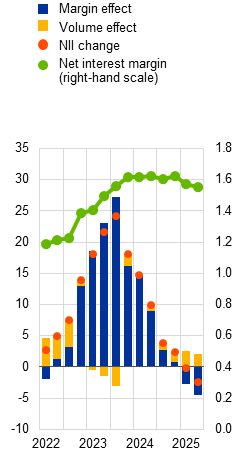 |
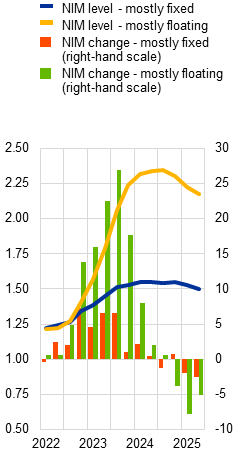 |
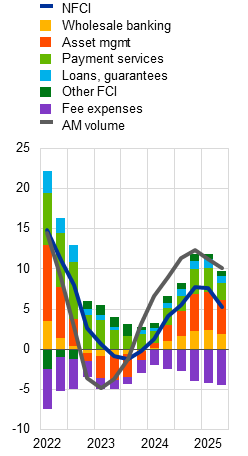 |
Sources: ECB (supervisory data) and ECB calculations.
Notes: Panel a: based on a balanced sample of 78 significant institutions. Net interest income (NII) change and its components refer to year-on-year changes. Panel b: based on a balanced sample of 73 significant institutions. Quarter-on-quarter changes. NIM stands for net interest margin. Banks are split into “mostly floating” and “mostly fixed” groups (53 and 20 banks respectively) based on whether they have a floating- or fixed-rate loan share above 50%. Panel c: based on a balanced sample of 87 significant institutions. Year-on-year growth of trailing net fee and commission income. NFCI stands for net fee and commission income; FCI stands for fee and commission income; AM stands for asset management.
Banks are maintaining their cost efficiency, although some diverging trends are evident across countries. The growth of total operating costs has picked up since early 2024, driven by both staff and non-staff costs. However, the rate of cost growth stabilised in the second quarter of 2025 as staff cost pressures eased somewhat, while contributions to resolution funds and deposit guarantee schemes continue to have a negative effect (Chart 3.3, panel a). Banks’ cost efficiency, as measured by the cost/assets ratio, has been broadly stable in the past few quarters, albeit with some divergence across countries, as less cost-efficient banking sectors have seen this ratio increase (Chart 3.3, panel b).
Chart 3.3
The growth of operating expenses has picked up somewhat since early 2024, while provisioning costs remain subdued
|
a) Growth of total operating costs and its main drivers |
b) Dispersion of country-level cost/assets ratios |
c) Ratio of loan loss provisions to total loans, by country group |
|---|---|---|
|
(Q1 2021-Q2 2025, percentages) |
(Q1 2020-Q2 2025, percentages) |
(Q1 2022-Q2 2025, percentages) |
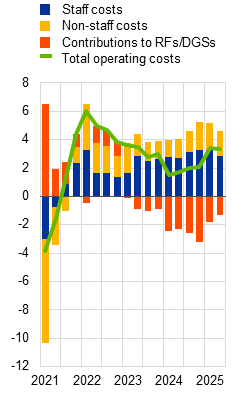 |
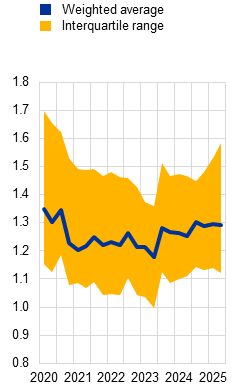 |
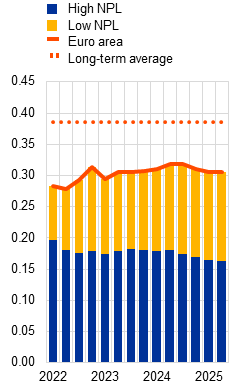 |
Sources: ECB (supervisory data, wage tracker) and ECB calculations.
Notes: Based on a balanced sample of 87 significant institutions. Panel a: year-on-year growth of trailing figures. Non-staff costs include other administrative costs and depreciation. RFs stands for resolutions funds; DGSs stands for deposit guarantee schemes. Panel c: loan loss provisions contain impairments on financial assets. Long-term average is calculated for Q4 2015-Q2 2025. Country groups are based on whether a country’s NPL ratio was above/below the median country-level NPL ratio in Q4 2021.
Banks’ aggregate provisioning costs have remained broadly stable, despite provisioning trends varying across countries. The ratio of loan loss provisions to total loans has been hovering around 30 basis points over the last few quarters and remained significantly below its longer-term average for several years. However, the overall stability of provisioning costs masks contrasting developments. Provisioning costs in countries with higher initial non-performing loan (NPL) ratios have continued to decline while edging up in countries with historically lower NPL ratios (Chart 3.3, panel c). This mirrors diverging asset quality trends across these country groups (see Section 3.3).
The near-term outlook for banks’ earnings has improved over the course of 2025, but some downside risks remain. Analysts’ full-year ROE projections for 2025 and 2026 have been on an upward trend since the turn of the year (Chart 3.4, panel a, left graph), mainly driven by an upgrade of revenue expectations, in particular from non-interest income streams (Chart 3.4, panel a, right graph). The downward revision of loan loss provision estimates has also contributed to a better earnings outlook, albeit to a lesser extent. That said, these benign profitability projections remain subject to downside risks. Weaker than expected growth could cause provisioning costs to rise and contribute to weaker net interest income through negative volume effects. Some components of non-interest income (e.g. fee income from asset management) could be adversely affected by abrupt increases in financial market volatility.
Chart 3.4
The near-term earnings outlook has improved during 2025, propelling banks’ equity valuations to the highest level since before the global financial crisis
|
a) 2025-26 ROE projections and change in projections for main profit drivers |
b) Euro area banks’ (long-term) price/earnings and price-to-book ratios |
c) Decomposition of cumulative changes in bank share prices |
|---|---|---|
|
(left graph: percentages, right graph: |
(Jan. 2005-Nov. 2025, multiples) |
(Jan.-Nov. 2025; percentages, percentage points) |
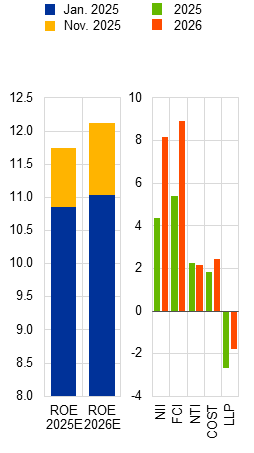 |
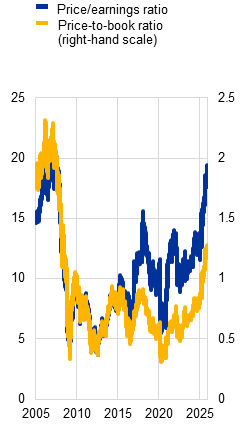 |
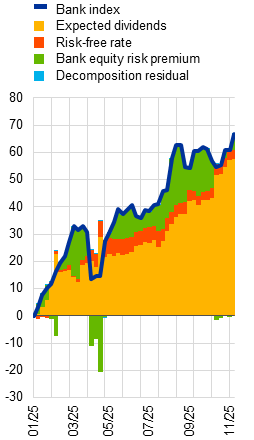 |
Sources: Bloomberg Finance L.P. and ECB calculations.
Notes: Panel a: based on median analyst projections aggregated for a sample of 23 listed banks. Right graph: changes in projections since the beginning of 2025. ROE stands for return on equity; NII stands for net interest income; FCI stands for fee and commission income; NTI stands for net trading income; COST stands for operating costs; LLP stands for loan loss provisions. Panel b: based on the EURO STOXX Banks index. The long-term price/earnings ratio is calculated as last price divided by the ten-year average real earnings per share. Panel c: decomposition of cumulative changes in the EURO STOXX Banks index based on the H-Model set out in Fuller and Hsia*.
*) Fuller, R.J. and Hsia, C.-C., “A Simplified Common Stock Valuation Model”, Financial Analysts Journal, Vol. 40, No 5, 1984, pp. 49-56.
The equity valuations of euro area banks have been boosted by upgrades of their near-term profitability outlook, but remain vulnerable to negative earnings surprises. Since early 2025, the share prices of euro area banks have significantly outperformed the broader market. Both the price-to-book and the long-term price/earnings ratios of large listed euro area banks have reached their highest levels since before the 2008-09 global financial crisis (Chart 3.4, panel b). During 2025 rising share prices have been mainly driven by improving earnings and dividend expectations (Chart 3.4, panel c). In addition, reduced equity risk premia have supported the increase in bank share prices, as also seen in the decline in the cost of equity (Chart 3.12, panel a). Despite these aggregate improvements, there is still a marked dispersion of bank valuations. Around one-quarter of large listed banks (in the EURO STOXX Banks index) had a price-to-book ratio below 1 in mid-November, mainly due to weaker profitability prospects compared with their peers. Looking ahead, bank valuations are vulnerable to earnings disappointments, should revenues grow less than expected or loan loss provisions rise more than currently anticipated due to higher credit risk.
3.2 Banks are benefiting from favourable financing conditions
Bank bond financing conditions have continued to improve since the spring, as the effects of tariff announcements have waned. Secondary market yields have continued to move down from the levels seen in April. This has mainly been driven by a compression in credit spreads which, with the exception of covered bonds, now stand at the lowest level since the start of the hiking cycle and are particularly tight for the most junior instruments (Chart 3.5, panel a). Primary market issuance has also rebounded strongly after the widespread decline in issuance volumes between March and April. Year-to-date issuance is now largely in line with historical averages for bank bonds denominated in both euro and foreign currency (Chart 3.5, panel b). Banks are benefiting from tighter spreads, which partly reflect a fundamental reduction in credit risk thanks to higher capitalisation and resilient earnings. However, the low levels and limited dispersion of spreads across seniorities raise concerns about the potential effects of an abrupt market repricing (see Chapter 2).
Chart 3.5
Bank bond yields and spreads are compressed, and market issuance remains orderly
|
a) Secondary bond market bond yields and spreads of euro area banks |
b) Primary bond market issuance by euro area banks |
|---|---|
|
(3 Jan. 2022-18 Nov. 2025; percentages, basis points) |
(Jan. 2019-Oct. 2025, € billions) |
 |
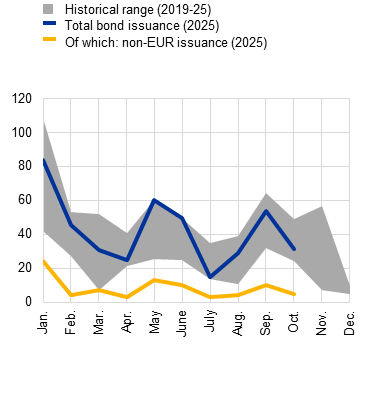 |
Sources: S&P Dow Jones Indices LLC and/or its affiliates, Dealogic and ECB calculations.
Notes: Panel a: “Current” indicates the latest observed spread. Panel b: “Historical range” indicates minimum and maximum of the total bond issuance in a given month, from 2019 to 2025.
Deposit rates have declined further, as banks maintain deposit franchise value which supports their net interest income. Following the first ECB interest rate cut in June 2024, banks started lowering deposit rates (Chart 3.6, panel a). The decline was stronger for term deposits, which have reacted in line with previous monetary policy cycles and shown greater sensitivity to rate cuts than rate hikes. By contrast, changes to overnight deposit rates have been sluggish in either direction, and household deposit rates offered by many banks are still just marginally above zero.[37] Although the pass-through is slowly increasing over time, overall deposit rate sensitivity has been weaker during this cycle than in previous ones (Chart 3.6, panel b).[38] With the rise in interest rates, the deposit franchise has again become an important source of income, especially during the hiking phase of the cycle. Even now, with policy rates at half their peak levels, banks’ deposit funding substantially supports their income and is likely to remain a source of profit as long as interest rates remain moderately positive (Chart 3.6, panel c).[39]
Chart 3.6
Deposit rates have fallen, supporting banks’ net interest income
|
a) Average deposit rates offered by euro area banks |
b) Deposit betas across past cycles |
c) Contribution of deposit spread to euro area bank net interest income |
|---|---|---|
|
(Jan. 2022-Sep. 2025, percentages) |
(Jan. 1999-Sep. 2025, coefficient) |
(Q1 2019-Q2 2025, € billions) |
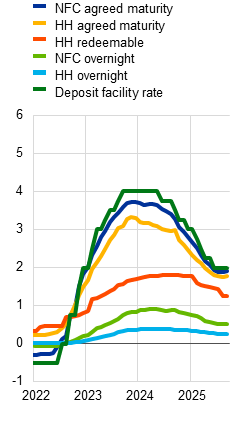 |
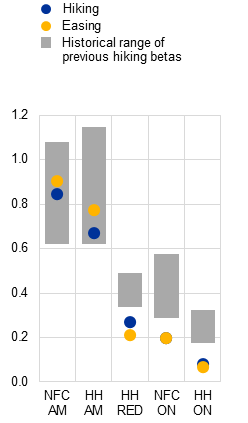 |
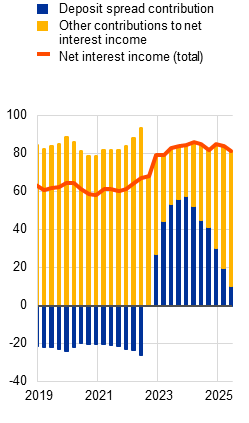 |
Sources: ECB (MIR, BSI, supervisory data) and ECB calculations
Notes: NFC stands for non-financial corporation; HH stands for household. Panel a: rates on new business. Panel b: change in rate on new business divided by change in the deposit facility rate, Deposit betas for the hiking cycle are calculated on the period from January 2022 to November 2023 for term and redeemable-at-notice deposits and from January 2022 to May 2024 for overnight deposits, reflecting the peak of different deposit rates. Easing betas for agreed maturity (AM)/redeemable-at-notice (RED) and for overnight (ON) deposits consider the period from November 2023 and May 2024 until September 2025 respectively. “Historical range of previous hiking betas” refers to the peak betas reached during previous hiking cycles in November 2000, November 2005 and September 2011. Panel c: the deposit spread contribution is the hypothetical spread that banks could earn from placing funding obtained from household and NFC deposits on the overnight money market. It is computed as the total deposit volume in a given period multiplied by the euro short-term rate (€STR) minus the actual interest expense on household and NFC deposits in that period. “Other contributions to net interest income” is net interest income minus the hypothetical deposit spread income.
Banks’ deposit volumes are increasing, with renewed inflows into retail overnight deposits. With the start of the hiking cycle, banks increased deposit term spreads and depositors reacted by reallocating funds from overnight deposits to term deposits. However, following the first rate cut, deposit flows have reversed again, leading to a further accumulation of overnight deposits. As a result, the ratio of term to overnight deposits remains low by historical standards (Chart 3.7, panel a).[40] This benefits banks as it skews their funding composition towards the cheapest source of funding. However, the renewed growth in overnight deposits likely reflects a shift in the preference of the non-financial private sector for more liquid assets resulting from the increase in economic uncertainty. While competition for deposits is currently limited by the abundance of cheap overnight deposits, which reduces the risk of a of a sudden increase in the cost of deposit funding, economic uncertainty could create volatility in deposits and revive competition for deposits.
Chart 3.7
Banks’ funding structures have shifted towards overnight deposits and market-based funding
|
a) Deposit term spread and term/overnight deposit ratio |
b) Year-on-year change in bank funding composition |
|---|---|
|
(Jan. 2003-Sep. 2025; percentages, ratio) |
(Q2 2024-Q2 2025, percentages of total liabilities) |
 |
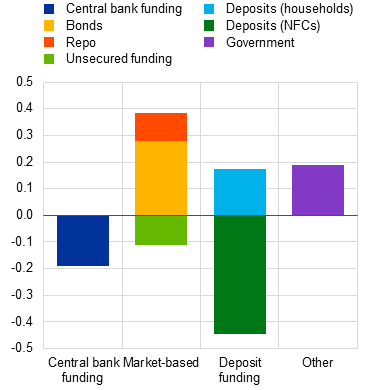 |
Sources: ECB (MIR, BSI, supervisory data) and ECB calculations.
Notes: Panel a: the term spread is the difference between the average term and overnight deposit rate. The term/overnight deposit ratio is the total stock of retail term deposits divided by overnight deposits. Panel b: total liabilities exclude equity financing, and government deposits with euro area banks are regional government and agency deposits.
A growing reliance on funding from non-bank financial intermediaries could become a vulnerability in times of market stress. Over the past year, banks have seen a strong increase in their market-based funding (Chart 3.7, panel b). This funding is usually provided by non-bank financial intermediaries which invest in bank bonds, deposit their funds in bank accounts and lend to banks in the repo market. This growing interlinkage leaves banks at higher risk of funding disruptions, should these counterparties be forced to deleverage in times of market stress (see Special Feature B). Moreover, repo market intermediation by euro area banks has also increased, more than doubling over the last four years. A substantial portion of these transactions is denominated in foreign currency and has a very short maturity, with limited substitutability of funding providers. This increases banks’ reliance on their own foreign currency liquid asset holdings to manage potential funding disruptions and may amplify asset price gyrations (see Box 3).
Box 3
US dollar activities of European banks: business models and financial stability implications
The US dollar assets and liabilities of euro area banks arise mainly from their capital market activities. Capital market activities are often characterised by short maturities and require daily marking to market and margining. These features may pose a liquidity risk to banks in the event of abrupt market movements. US dollar funding and hedging instruments provided by banks are also important for euro area corporates and non-bank financial institutions, especially when exchange rates move rapidly. This box presents the business rationale for euro area banks’ US dollar activities and aims to assess the associated financial stability risks.
3.3 Asset quality remains sound in aggregate, but some sectors and countries have seen a slight deterioration
Despite a challenging macroeconomic environment, bank asset quality remains sound, with the aggregate non-performing loan (NPL) ratio close to historical lows. The aggregate NPL ratio dropped slightly in the first half of 2025. This was caused by declines in stocks of household NPLs (Chart 3.8, panel a) driven largely by improvements in the quality of residential real estate loans. Furthermore, the aggregate Stage 2 ratio also fell slightly (by around 0.3 percentage points) over the same period, while early arrears − loans that are less than 90 days past due − have shown modest improvements since the middle of 2024.
Chart 3.8
The aggregate NPL ratio has dropped slightly due mainly to falling NPL stocks in the household sector, while there are tentative signs of improvement in CRE loan quality
|
a) Aggregate NPL ratio and quarterly net NPL flows, by sector |
b) Quarterly net NPL flows for CRE lending |
|---|---|
|
(Q1 2021-Q2 2025; percentages, € billions) |
(Q1 2021-Q2 2025, € billions) |
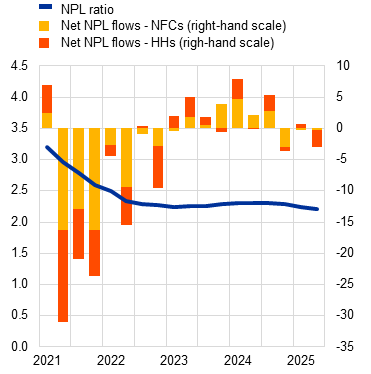 |
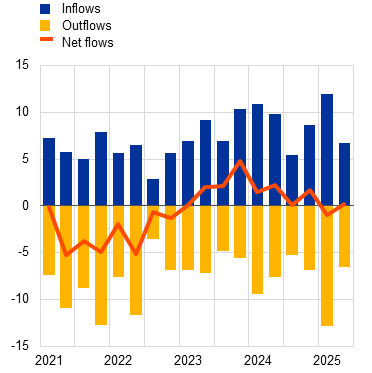 |
Sources: ECB (supervisory data) and ECB calculations.
Notes: based on full sample of significant institutions (113 banks as at Q2 2025). Panel a: NFCs stands for non-financial corporations; HHs stands for households. Panel b: excludes loans held for sale.
There have been tentative signs of improvement in the quality of commercial real estate (CRE) loans in recent quarters. After eight consecutive quarters of net NPL inflows in CRE lending, the last two quarters show net flows hovering around zero (Chart 3.8, panel b), which likely reflects a recovery in the CRE sector amid easing financial conditions (see Section 1.5). However, weakness in CRE portfolios persists in some countries where CRE NPL ratios have seen substantial increases year on year. Persistent vulnerabilities in the non-prime and office markets, which continue to face a challenging outlook, may lead to a reversal in this improvement.
Chart 3.9
SME and consumer loans continue to show signs of a mild deterioration in asset quality
|
a) SME NPL ratio, by country group and SME default rate |
b) NPL ratio for consumer loans, by region |
|---|---|
|
(Q1 2022-Q2 2025, percentages) |
(Q1 2023-Q2 2025, percentages) |
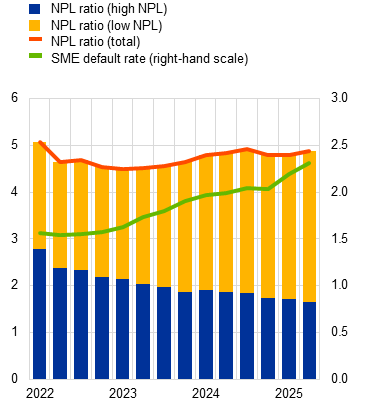 |
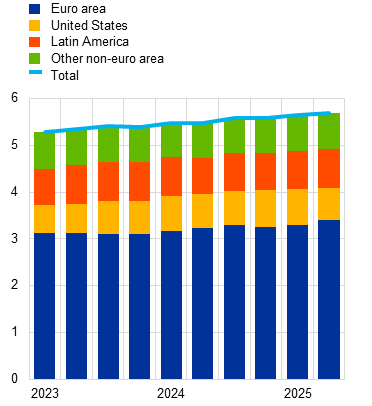 |
Sources: ECB (supervisory data) and ECB calculations.
Notes: Panel a: based on a sample of 87 significant institutions for NPL ratios and 56 IRB-reporting significant institutions for default rates. Country groups are based on whether a country’s SME NPL ratio was above/below the median value of country-level SME NPL ratios in Q4 2021. “NPL ratio (high NPL)” and “NPL ratio (low NPL)” show the contributions to the total SME NPL ratio of countries with high and low initial NPL ratios. Panel b: based on a sample of 65 significant institutions which report a geographical breakdown of their loan portfolios.
At the same time, SME loan portfolios continue to experience some limited deterioration. Default rates for lending to small and medium-sized enterprises (SMEs) have been increasing consistently for the past three years (Chart 3.9, panel a) in line with rising corporate insolvencies (see Overview). In aggregate, they now stand above pre-pandemic levels. However, these overall trends conceal significant cross-country differences. SMEs in Germany, Italy and the Netherlands have experienced rising default rates in recent years, in contrast with declines in several other countries. Similarly, while the aggregate NPL ratio for SME loans has only edged up slightly since late 2023, developments in NPL ratios have varied greatly across countries. In particular, increases in NPL stocks in countries with low NPL ratios at the end of 2021 have been almost fully offset by declines in countries with high initial NPL ratios (Chart 3.9, panel a), due for instance to disposals or write-offs. Going forward, banks in those countries which have recently experienced rising NPLs and also have a weaker macroeconomic outlook face a risk of further deterioration in SME loan quality.
In the household sector, consumer lending has shown signs of a mild deterioration in asset quality in recent quarters. This is evidenced by a gradual, albeit contained, rise in aggregate NPL ratios for consumer loans since late 2023. By borrower location, the composition of consumer loan NPLs has shifted slightly towards euro area exposures since late 2023 (Chart 3.9, panel b). While aggregate unemployment remains low, these developments, along with the recent slowdown of real wage growth, suggest that a subset of consumers with lower incomes could become financially constrained. This is particularly the case if economic conditions were to weaken more than currently expected, possibly leading to a further deterioration of asset quality in this loan portfolio.
Corporate credit risk may yet materialise in the context of rising trade fragmentation, a still weak macroeconomic environment and elevated debt service costs. In particular, banks with higher exposures to firms operating in sectors more reliant on US export markets face greater credit risk. As of April 2025, 8% of euro area banks’ NFC lending was directed towards sectors with a high reliance on the US market, but the share of lending at risk varied materially across sectors and countries. Banks with higher exposures to these sectors could face a deterioration in asset quality through both direct credit losses and second-round effects, such as knock-on impacts on suppliers, and a broader macroeconomic slowdown.[41] Furthermore, euro area corporates continue to face elevated, albeit somewhat declining, debt service costs. This may add to credit risk (see Section 1.3), in particular if coupled with weaker corporate profitability due to lower external demand.
Provisioning coverage levels remain broadly stable, but an upward adjustment of provisions may be needed if credit risk deteriorates. The share of NPLs covered by provisions has shown signs of stabilisation in recent quarters, although both the provisioning and total coverage of NPLs (also including collateral and financial guarantees) remain below the levels seen at the end of 2021 (Chart 3.10, panel a). Banks’ aggregate cost of risk dropped slightly in the second quarter of 2025, driven by lower Stage 3 provisions in line with a slight moderation of realised credit losses. At the same time, early-stage provisions − i.e. those for Stage 1 and Stage 2 loans − have edged up in recent quarters (Chart 3.10, panel b). This may be a sign that banks are taking account of the evolving macro-financial environment, which is characterised by heightened geopolitical risk and trade uncertainty. However, the volume of Stage 1 and Stage 2 provisions remains very low, indicating that banks are not expecting a substantial increase in credit losses over the medium term. Cost-of-risk trends have also diverged somewhat across sectors since late 2023, with a gradual rise for NFC loans up to the first quarter of 2025 contrasting with a slight decline for household loans. Looking ahead, banks could see their provisioning costs rise, in particular in countries where the macroeconomic outlook is weaker.
Chart 3.10
NPL coverage ratios have remained broadly unchanged in recent quarters, while stable cost-of-risk trends for total loans hide some divergence across sectors since late 2023
|
a) Coverage of NPLs by provisions, collateral and financial guarantees (for total loans) |
b) Banks’ cost of risk, by stage and sector |
|---|---|
|
(Q1 2021-Q2 2025, percentages) |
(Q1 2020-Q2 2025, percentages of total loans) |
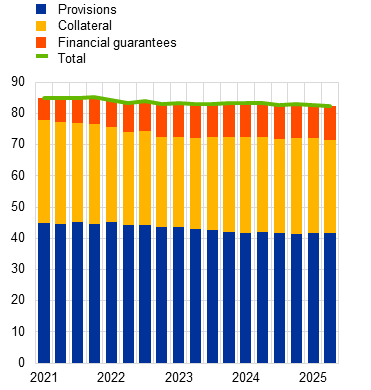 |
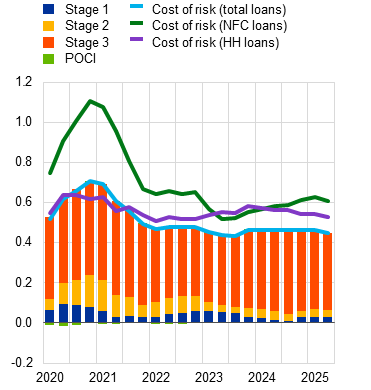 |
Sources: ECB (supervisory data) and ECB calculations.
Notes: Panel a: based on a sample of 87 significant institutions. Panel b: based on a sample of 80 IFRS-reporting significant institutions. Four-quarter trailing figures. POCI stands for purchased or originated credit-impaired financial assets; NFC stands for non-financial corporation; HH stands for household.
3.4 Liquidity and capital buffers remain ample
Sovereign bonds are replacing central bank reserves in banks’ liquidity buffers. Banks have purchased larger amounts of bonds issued by EU sovereigns amid the normalisation of the ECB’s balance sheet and the concomitant decline in excess reserves (Chart 3.11, panel a). As a result, banks’ aggregate liquidity coverage ratios have remained largely stable of late. Notwithstanding their recent declines, holdings of excess reserves remain higher than pre-pandemic levels and are relatively evenly distributed across banks (Chart 3.11, panel b). From a repricing risk perspective, even a large and widespread increase in credit spreads on banks’ sovereign bond portfolios would have a limited impact on their solvency, liquidity and profit metrics (Chart 3.11, panel c). But the effects could become more meaningful significant as banks absorb further sovereign bond issuance and their excess reserve buffers shrink.
Chart 3.11
Banks continue to absorb sovereign bonds, while excess liquidity remains ample
|
a) Unencumbered sovereign bond holdings of euro area banks |
b) Excess reserve distribution and LCR |
c) Estimated repricing risk from 200 bps shock in spreads |
|---|---|---|
|
(Q1 2019-Q2 2025, € trillions) |
(Q1 2017-Q2 2025, percentages of LCR denominator) |
(Q2 2025, percentages) |
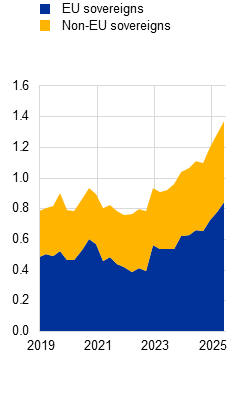 |
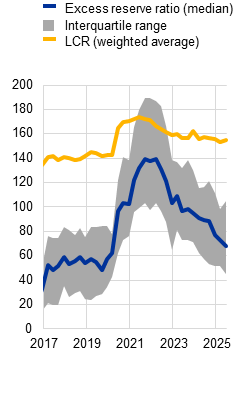 |
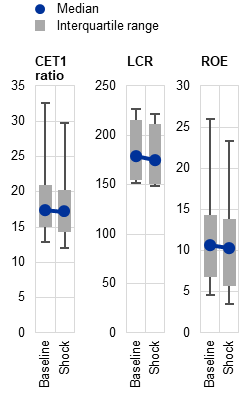 |
Sources: ECB (supervisory data, SHS) and ECB calculations.
Notes: Panel a: EU sovereigns include bonds issued by EU institutions (e.g. the European Investment Bank). Panel b: sample of 77 significant institutions. LCR stands for liquidity coverage ratio. Panel c: impact estimates represent losses in response to an interest rate shock of 200 basis points, for a sample of 87 significant institutions. LCR calculations only consider unencumbered Level 1 sovereign bonds (about 80% of total sovereign bond holdings); for CET1 ratios, only bonds accounted for at fair value (in other comprehensive income or through profit and loss) are included; for return on equity (ROE), the impact from bonds accounted for at fair value through profit and loss is included. The reported impact is gross of hedging, which means it may be overestimated.
Banks’ earnings now allow them to increase their capital while also meeting shareholder return requirements. For the first time in a decade, the return on equity of listed euro area banks has surpassed their cost of equity, driven by continually improving earnings and a decline in risk premia that has translated into lower returns required by shareholders (Chart 3.12, panel a, and Section 3.1). This allows banks to reconcile higher payouts with capital generation, as retained earnings have continued to bolster capital ratios and buffers (Chart 3.12, panel b).[42] Capital accumulation has increased the sector’s resilience and enables banks to absorb shocks in an adverse macro-financial scenario, as confirmed by the results of the 2025 EU-wide stress test coordinated by the European Banking Authority and the ECB’s macroprudential stress test extension report.[43] However, the aggregate picture masks the fact that a number of banks are still struggling to meet their cost of equity, given compressed earnings. Moreover, should the recent decline in core revenues indicate a turning point for profitability, some banks may once again face a trade-off between shareholder remuneration and the internal capital generation needed to meet credit demand.
Chart 3.12
Banks’ return on equity is now sufficient to increase capital while meeting shareholder return requirements
|
a) Return on equity and cost of equity of listed euro area banks |
b) Aggregate CET1 ratio and decomposition of changes in capital headroom |
|---|---|
|
(Jan. 2016-June 2025, percentages) |
(Q1 2015-Q2 2025, Q2 2024-Q2 2025; percentages of risk-weighted assets) |
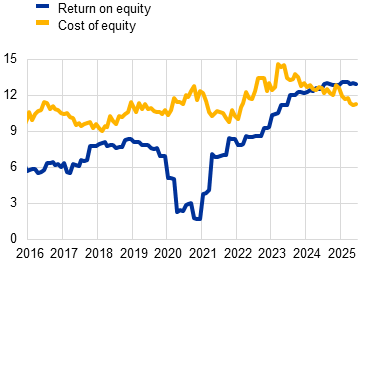 |
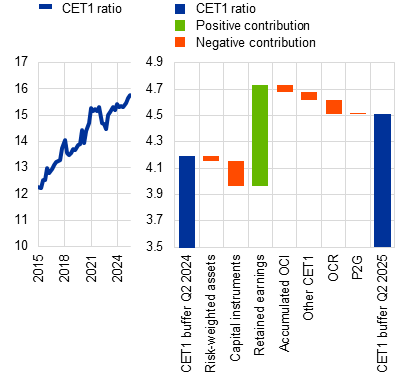 |
Sources: ECB (supervisory data), Bloomberg Finance L.P. and ECB calculations.
Notes: Panel a: for a balanced sample of 29 listed banks. Return on equity is the four-quarter trailing sum. The cost of equity of euro area banks is estimated based on Altavilla et al.* Panel b: OCI stands for other comprehensive income; OCR stands for overall capital requirement; P2G stands for Pillar 2 guidance. Capital instruments capture share buybacks, while retained earnings are calculated after dividend payouts.
*) Altavilla, C., Bochmann, P., De Ryck, J., Dumitru, A.-M., Grodzicki, M., Kick, H., Melo Fernandes, C., Mosthaf, J., O’Donnell, C. and Palligkinis, S., “Measuring the cost of equity of euro area banks”, Occasional Paper Series, No 254, ECB, 2021.
3.5 Preserving bank resilience continues to be the primary goal of macroprudential policy in an uncertain environment
The euro area banking sector is resilient to adverse shocks, on the back of strong capital positions and effective macroprudential policies. The results of the 2025 EU-wide stress test show that euro area banks are generally well capitalised and capable of withstanding adverse shocks.[44] This can be attributed in part to the macroprudential policy measures implemented in recent years, which have helped to bolster the resilience of the banking sector. Since the previous edition of the Financial Stability Review, two more countries have increased their countercyclical capital buffers, bringing the level of releasable capital buffer requirements in banking union countries to 0.84% of risk-weighted assets.[45] These macroprudential buffers enhance the authorities’ ability to strengthen banks’ capacity to provide lending via buffer releases when facing adverse shocks, including those arising from the international economic environment.
Maintaining the current level of resilience in the banking sector is essential, as geopolitical and trade uncertainty remain elevated. Current releasable capital buffer requirements should be maintained to preserve bank resilience, while targeted increases in buffer rates could still be considered in countries with low releasable buffers, provided that the risk of procyclicality remains low.[46] At the same time, it is important to ensure that borrower-based measures are properly calibrated to maintain sound lending standards, particularly in countries experiencing strong increases in residential real estate prices. Finally, given the high degree of uncertainty, macroprudential policy must remain agile and adaptable to changing conditions.
Macroprudential policy should remain firmly focused on safeguarding financial stability, thereby benefiting the economy without compromising the banking sector’s competitiveness as measured by profit efficiency.[47] While it has been argued that higher capital requirements restrict credit supply and weaken banks’ competitiveness,[48] recent empirical evidence is not in line with this view. For example, post-pandemic studies suggest that increases in capital requirements have only modest effects on lending when banks are profitable and well capitalised.[49] Furthermore, empirical analyses have been conducted to estimate whether the overall capital requirement (OCR) and the CET1 capital ratio affect bank competitiveness, measured by how efficiently they generate profits. A bank is considered more profit efficient than its European peers if it earns higher profits using a similar mix of inputs. The evidence shows that the OCR does not have a significant impact on profit efficiency (Chart 3.13, panel a).[50] Moreover, higher CET1 capital ratios improve profit efficiency for banks that are not as well capitalised, as they benefit from lower funding costs and reduced earnings volatility (Chart 3.13, panel b).[51] By strengthening resilience and credit provision throughout the cycle and by limiting risk taking, macroprudential buffers help to ensure financial stability and thus boost banks’ long-term competitiveness. Importantly, research also shows that appropriate macroprudential policy reduces the probability and impact of a banking crisis and attenuates real estate booms, both of which are harmful to economic productivity.[52] These findings underline the fact that effective macroprudential policy can help to enhance, rather than jeopardise, the euro area’s competitiveness and productivity in the economy.
Chart 3.13
Bank competitiveness, as measured by profit efficiency, is unrelated to overall capital requirements, but higher CET1 ratios enhance competitiveness up to a certain point
|
a) Estimated association between banks’ overall capital requirement ratios and profit efficiency |
b) Estimated non-linear association between banks’ CET1 ratios and profit efficiency |
|---|---|
|
(percentiles, index scores) |
(percentages, index scores) |
 |
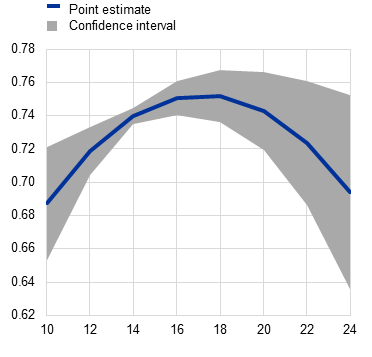 |
Sources: ECB and ECB calculations.
Notes: Profit efficiency is defined as a bank’s ability to produce the maximum output (profit) feasible given its inputs (costs). It is computed using data envelopment analysis. The methodology employs inputs (cost of equity, interest expenses, administrative expenses, provisioning costs and staff expenses) and outputs (interest and non-interest income) to compute profit efficiency scores. Profit efficiency scores range between zero and one. A higher score indicates a higher level of profit efficiency. The profit efficiency scores are then employed to study the relationship between profit efficiency, as a measure of competitiveness, and both overall capital requirements (OCR) and the CET1 ratio. Panel a) shows the estimated profit efficiency scores at various levels of banks’ OCR ratios. These levels correspond to the descriptive statistics of the OCR ratio: 8%, 8.5%, 9.5%, 10% and 10.5%, which represent the 10th percentile, 25th percentile, median, 75th percentile and 90th percentile of the OCR distribution respectively. The confidence intervals are reported at the 95% level. The dependent variable is the profit score, and the regression controls for a large set of bank and country-specific characteristics, including the logarithm of total bank assets, the non-performing loans ratio, the cash and cash at the central bank/total assets ratio, the deposits/total assets ratio, the loan/total assets ratio, the industrial production index, the inflation rate, the slope of the yield curve and the total assets Herfindahl-Hirschman Index. Bank and quarter fixed effects are included in all regressions. The estimation sample is for Q4 2019-Q4 2024. Panel b) plots the estimated profit efficiency scores (blue line) along with a 95% confidence interval (grey shaded area) at various levels of bank CET1 ratios. The inverted U-shaped relationship is modelled using a quadratic interaction term for the CET1 ratio variable in the econometric specification. The regressions control for the same set of bank and country-specific characteristics as those described above.
Notable progress has been made regarding the Fundamental Review of the Trading Book and the review of the Crisis Management and Deposit Insurance (CMDI) framework. In June 2025 the European Commission adopted a new delegated act[53] postponing the application of the Fundamental Review of the Trading Book by one additional year, until 1 January 2027.[54] This decision was taken with a view to preserving an international level playing field, given that some major global jurisdictions have delayed the implementation of Basel III still further. At the same time, the European Parliament and the Council have reached agreement on the review of the CMDI framework. This marks a significant milestone on the path to completing the banking union and represents a step forward in strengthening the EU’s bank resolution framework. The revised framework could significantly contribute to safeguarding financial stability and protecting depositors, while preventing the burden falling on taxpayers when banks fail. It will make it easier for the authorities to manage bank crises by improving access to resolution funding for smaller and medium-sized banks. The ECB has called for the revised framework to be adopted swiftly. Looking ahead, the conclusion of the CMDI review should allow further progress to be made towards completing the banking union (including the European deposit insurance scheme) and establishing an EU-level framework for liquidity in resolution.
The ECB is committed to reducing unwarranted complexities in regulation, supervision and reporting while maintaining resilience and compliance with international standards. The resilience of the EU banking sector has been demonstrated by its stability during recent crises like the COVID-19 pandemic and the banking turmoil of March 2023. This resilience is largely the result of the global regulatory reforms implemented in the wake of the global financial crisis. These reforms have strengthened both the quality and the quantity of banks’ capital and enhanced their liquidity positions.[55] However, they have also increased the complexity of the regulatory framework and added to the compliance burden faced by banks. While the regulatory framework reflects the inherent intricacy of bank business models, undue regulatory complexity needs to be minimised. Recognising this, the ECB has set up the High-Level Task Force on Simplification, comprising the ECB’s Vice-President and five governors of euro area national central banks as well as an ECB representative to the ECB’s Supervisory Board. The Task Force is working on ways to simplify the regulatory framework and streamline reporting requirements and supervisory processes. The goal is to eliminate overlaps and inefficiencies while maintaining the current level of resilience in the banking sector, ensuring that prudential objectives continue to be met effectively, and adhering to international standards. The Task Force aims to conclude its work by the end of 2025. At that point, any final proposals will be presented to the European Commission.
The ECB emphasises the need for progress on the review of the EU macroprudential framework by the European Commission, incorporating any proposals set out by the Task Force. The review should focus on promoting the consistent use of macroprudential tools across Member States, making implementation procedures more effective and enhancing information sharing among authorities. The ECB supports any revisions that enable the authorities to build up releasable capital buffers in a timely manner to strengthen banks’ resilience in an uncertain macro-financial environment. At the same time, the ECB acknowledges that overlaps between risk-weighting, leverage-ratio and resolution requirements could limit the usability of some capital buffers in scenarios where materialised losses are large and widespread. In this context, the forthcoming proposals should take a holistic approach to prudential and resolution requirements, ensuring that capital buffers can be used and released more easily.[56]
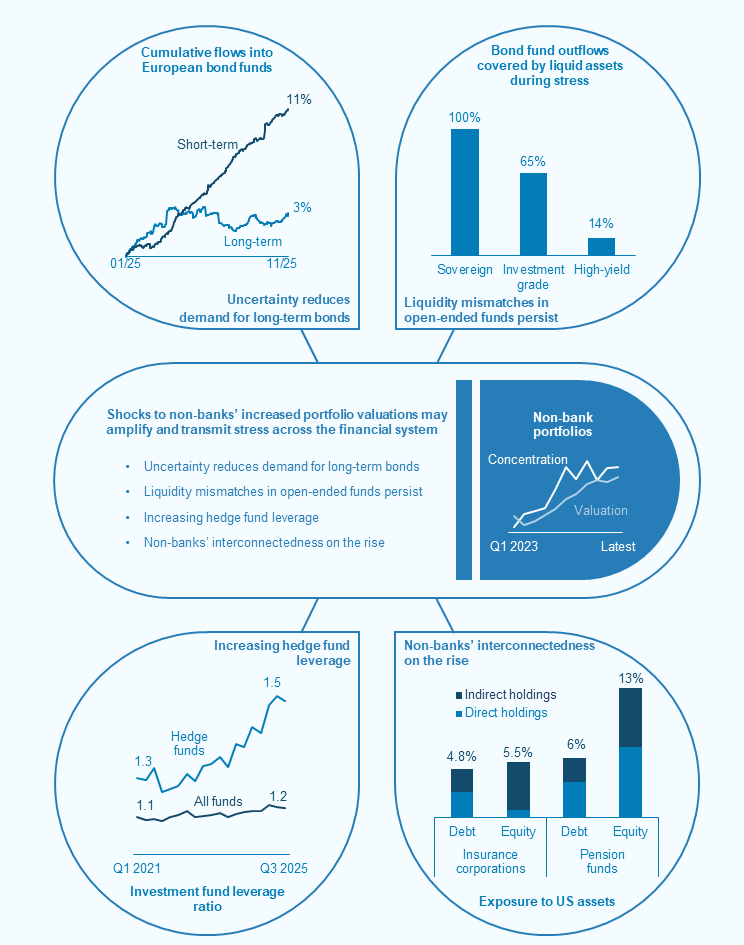
4.1 The non-bank financial sector remains vulnerable to valuation shocks
The non-bank financial intermediation (NBFI) sector is an important provider of funding to the euro area real economy and its governments. The financing of non-financial corporations (NFCs) by non-banks has expanded steadily over the past decade and now accounts for an estimated share of up to 37% of euro area NFC credit, depending on the measure used.[57] Ten years ago the figure was around 33%, while twenty years ago it was only 20%. Although business models and investment portfolios vary across the diverse NBFI ecosystem, the sector as a whole remains a stable source of funding for euro area governments, holding about 27% of euro area sovereign debt. Non-banks are particularly important for long-term government financing. The NBFI sector holds about 40% of outstanding euro area government debt securities with residual maturities of between ten and 30 years, and 60% of those with maturities of 30 years or more (Chart 4.1, panel a). Insurance corporations and pension funds represent the largest euro area institutional investors in long-term sovereign bonds, typically holding such securities until maturity.
Chart 4.1
Non-banks have recently increased the absorption of short-maturity bonds while reducing their net intake at the long end of the yield curve, indicating a portfolio shift
|
a) Investor base of long-term sovereign debt, by residual maturity |
b) Cumulative net change in total outstanding versus total non-bank holdings of sovereign debt, by NBFI segment and maturity |
|---|---|
|
(Q2 2025; percentages, € trillions) |
(Q1 2024-Q2 2025, € billions) |
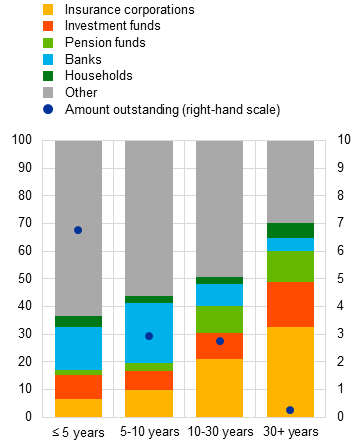 |
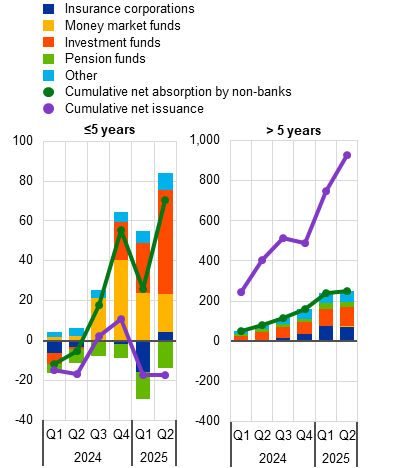 |
Sources: ECB (CSDB, CSEC, SHS) and ECB calculations.
Notes: Panel a: the referenced sectors refer to euro area holders, while “Other” includes other non-specified euro area holders, non-euro area holders and the Eurosystem. Insurance corporations, investment funds and pension funds constitute the NBFI sector. Panel b: net issuance is defined as cumulative quarter-on-quarter net changes in issued securities, while non-bank absorption refers to cumulative quarter-over-quarter net changes in the holdings of the euro area NBFI sector. “Other” includes all other euro area holders besides those listed in the chart.
The recent steepening of the yield curve has been associated with a shift in the composition of non-banks’ bond portfolios, with weight moving slowly towards the shorter end. Several structural demand and supply shifts have been driving the recent increase in long-term sovereign bond yields in the euro area and are currently having an impact on the important role played by non-banks in bond markets (see Chapter 2). Non-banks, especially insurance corporations and pension funds, have long been and still are a stable funding base for sovereign and corporate debt. However, the composition of their portfolios continues to shift slowly from longer to shorter maturities, despite increasing sovereign bond issuance at the long end (Chart 4.1, panel b). The reform of the Dutch pension system may result in a sell-off of bonds and interest rate swaps with long maturities as the individual pension funds move from defined benefit to defined contribution schemes.[58] With traditional hold-to-maturity investors reducing their absorption of long-maturity bonds, the funding base of sovereigns at the long end may shift towards more “flighty” investors, increasing the risks to government financing posed by bond market volatility.[59]
Chart 4.2
Non-bank portfolios remain vulnerable to shocks given holdings of risky assets, high equity valuations and tight credit spreads in their securities portfolios
|
a) Weighted average equity PE ratios in non-bank portfolios |
b) Weighted average bond spreads in non-bank portfolios |
|---|---|
|
(Q1 2015-Q2 2025, percentages) |
(Q1 2015-Q2 2025, percentage points) |
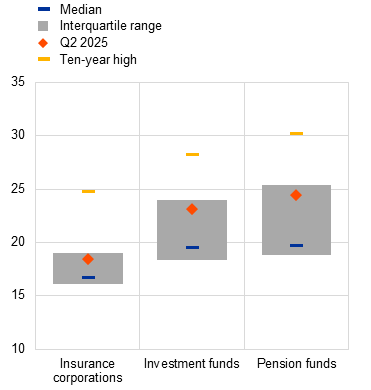 |
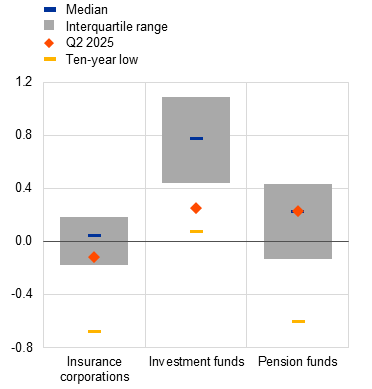 |
Sources: ECB (SHS), LSEG and ECB calculations.
Notes: Panel a: the price/earnings (PE) ratio calculation is limited to non-bank holdings within the S&P 500, EURO STOXX 600, Nikkei 225 and FTSE 100 indices, accounting for their changing compositions over time. The metric used is the 12-month forward PE ratio. The PE ratios are weighted by the market value of each equity holding relative to the total market value of the portfolio. Panel b: the spreads are calculated as the difference between an individual security’s yield to maturity and a corresponding benchmark rate. Euro-denominated holdings are benchmarked against the euro area ten-year government benchmark bond yield while US dollar and all other currency holdings are benchmarked against the ten-year US Treasury yield. Each security’s yield is compared with the respective common ten-year benchmark, regardless of its individual maturity. In a standard, upward-sloping yield curve environment, yields on shorter-maturity bonds can be lower than the ten-year benchmark rate. The spreads are weighted by the market value of each individual debt security.
Non-banks’ portfolios show signs of elevated valuations, exposing the sector to credit risk and the risk of sudden price adjustments. Current market valuations reflect significant market optimism driven, among other things, by high expectations of future earnings growth or a fear of missing out on gains from a continued rally (see Chapter 2). High valuations are also mirrored in non-banks’ holdings, with equity portfolio valuations now standing close to the 75th percentile observed in the past decade (Chart 4.2, panel a). These high valuations leave the sector exposed to broad, abrupt price adjustments, should investor sentiment shift or fall short of expectations. Furthermore, heavy concentration in highly valued US and (especially) tech stocks increases the sector’s vulnerability to both market-wide valuation adjustments and idiosyncratic shocks. The picture is more nuanced with regard to bond holdings. Weighted average spreads of investment funds’ bond portfolios are close to their ten-year low (Chart 4.2, panel b), reflecting elevated bond valuations, for example in the high-yield segment, but also a portfolio composition with a higher share of riskier bond types. In the high-yield segment in particular, overly benign valuations may mask significant credit risks. Insurance corporations hold bond portfolios with less extreme but still elevated valuations, while the valuation of pension funds’ bond portfolios is at the historical median, likely mirroring the relatively high share of longer-dated government debt securities that both sectors hold. Insurance corporations maintain portfolios with a significantly lower share of equities than do investment funds and pension funds, even though the proportion has been increasing slowly over time for all three types of entity.
Highly valued assets expose non-banks to sudden price shocks, with potentially adverse knock-on effects on financial markets. The combination of highly valued and concentrated portfolios with low liquidity buffers in some non-bank types exposes the sector as a whole to financial stability risks from market shocks (see Section 4.2). When highly valued assets correct quickly, non-banks can face valuation losses, margin calls and fund share redemptions. This would result in forced asset sales and reduce the ability of non-banks to make markets, potentially further exacerbating price declines. Risks for sudden valuation shocks may be especially pronounced in private equity and credit markets due to the opaqueness of valuations, the illiquid nature of investments and pockets of elevated credit risk in these markets.
Interconnectedness within and between the non-bank and banking sectors results in potentially systemic financial stability risks. Borrowing by non-banks accounts for 10% of euro area banks’ total assets, but 17% of banks’ liabilities are attributable to non-bank funding, meaning that non-banks are net lenders to euro area banks (see Special Feature B). Non-bank funding tends to be short term and can be “flighty” in times of market stress, exposing banks to rollover and redemption risks. Additionally, banks’ provision of leverage to non-banks exposes the banking sector to credit risk and could amplify market swings should banks cut lending to non-banks in times of stress. Finally, increasing interconnectedness within the NBFI sector means that risks from liquidity mismatches and high valuations in investment funds and private markets may spill over to insurance corporations and pension funds (see Section 4.2). Insurance corporations and pension funds increasingly manage their investments in listed equities and bonds through fund shares instead of direct asset holdings.
4.2 Flows into investment funds recover, while hedge funds’ footprint and leverage continue to grow
Investment fund flows have recovered from the April turmoil, especially in high-yield and shorter-maturity bond funds. Euro area investors’ demand for European equities has continued in 2025, while flows into funds holding US equities have remained subdued since the April turmoil, despite a slight pick-up of late (Chart 4.3, panel a). A breakdown of more recent flows into US-equity ETFs shows that investors are increasingly looking to hedge US dollar currency risks (Chart 4.3, panel b), while flows into high-yield bond funds have recovered strongly amid record spread compression (see Chapter 2). In a context of elevated macroeconomic uncertainty, investors have been showing a preference for short-term rather than long-term bond funds (Chart 4.3, panel c). This is also reflected in the recent steepening of the yield curve. The stalling of long-term bond fund flows mirrors the recent shift in bond absorption in the wider non-bank financial intermediation sector towards the shorter end (see Section 4.1). A less stable investor base and lower demand for long-term sovereign bonds could contribute to vulnerabilities in bond markets and increase the risk of market volatility, particularly if fiscal positions in some euro area countries were to deteriorate further.
Chart 4.3
Investment fund flows into risky assets recover from the April trade shock amid increasing demand for currency-hedged US equities and shorter-maturity bonds
|
a) Cumulative flows into euro area-domiciled investment funds, by fund focus |
b) Monthly flows into euro area ETFs investing in US equities, by currency hedging |
c) Cumulative flows into funds investing in European bonds, by maturity |
|---|---|---|
|
(2 Jan.-18 Nov. 2025, percentages of total net assets) |
(Jan. 2023-Oct. 2025, € billions) |
(2 Jan.-18 Nov. 2025, percentages of total net assets) |
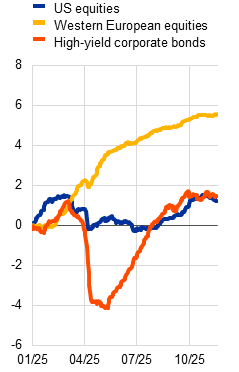 |
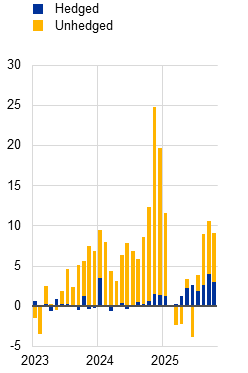 |
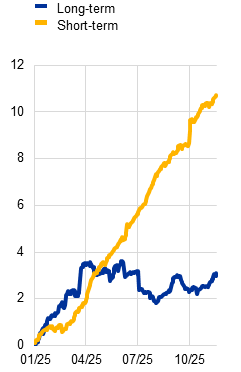 |
Sources: EPFR Global, Bloomberg Finance L.P. and ECB calculations.
Notes: Panel b: ETFs stands for exchange-traded funds. Data are at monthly frequency and refer to month-end values. The latest observations are for 31 October 2025. Panel c: short-term bond funds invest in bonds with durations of between zero and four years. Long-term bond funds invest in bonds with durations of six years or more. A bond fund with duration of five years is classified as intermediate term.
Concentrated exposures to US assets and liquidity mismatches make investment funds vulnerable to procyclical asset sales. After years of strong inflows and valuation gains in US equities, euro area equity funds now maintain large positions in US stocks with high concentration risk and valuation risk. While the recent depreciation of the US dollar against the euro has increased demand for hedged products, most funds remain additionally exposed to exchange rate risk. These portfolios are therefore highly susceptible to valuation risk arising from both adverse exchange rate movements and sudden stock price adjustments. Previous episodes of shocks to financial markets have illustrated how open-ended investment funds may amplify price declines via procyclical asset sales. Spikes in share redemptions, like those that followed the market turmoil in April this year, can force funds to sell less-liquid assets at unfavourable market conditions. This risk is particularly pronounced in fund types with high liquidity mismatches, such as real estate funds and high-yield corporate bond funds (Chart 4.4, panel a). Procyclical investor behaviour can further amplify market downturns, as investors in funds focusing on riskier assets tend to redeem their shares when returns are negative (Chart 4.4, panel b). The composition of a fund’s investor base can play an important role in determining how procyclical open-ended fund flows are. While institutional investors’ leverage and short-term investment strategies may lead to higher redemption shocks in periods of stress, a broad household investor base can reduce procyclicality (see Box 2).
Chart 4.4
Liquidity mismatches in open-ended funds and procyclical asset sales continue to pose a significant financial stability risk
|
a) Redemption coverage ratios across different types of euro area-domiciled open-ended bond fund |
b) Average monthly flows into euro area investment funds, by negative return level |
|---|---|
|
(Q3 2025, ratios) |
(Jan. 2008-Oct. 2025; x-axis: negative return level as a share of total net assets, y-axis: percentages) |
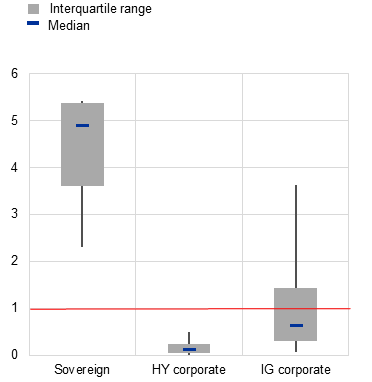 |
 |
Sources: Bloomberg Finance L.P., EPFR Global, LSEG Lipper and ECB calculations.
Notes: Panel a: HY stands for high-yield; IG stands for investment-grade. The redemption coverage ratio (RCR) measures investment funds’ resilience to redemption shocks, following the methodology set out in the November 2023 edition of the Financial Stability Review*. The RCR is obtained by dividing the value of fund-level high-quality liquid assets according to Commission Delegated Regulation (EU) 2015/61 by net outflows experienced in a severe but plausible scenario lasting 30 days. An RCR above 1 indicates that high-quality liquid assets are sufficient to cover outflows, while an RCR below 1 indicates insufficient coverage. The boxplots display the distribution per fund group of the resulting fund-level RCRs. The whiskers refer to the 5th and 95th percentiles.
*) See the box entitled “Assessing liquidity vulnerabilities in open-ended bond funds: a fund-level redemption coverage ratio approach”, Financial Stability Review, ECB, November 2023.
European and global hedge funds have levered up considerably since late 2022 and expanded their footprint in euro area sovereign bond markets. Over the past two years, financial leverage has risen by 30 percentage points on average in euro area-domiciled hedge funds that are not subject to the Undertakings for Collective Investment in Transferable Securities (UCITS) Directive, to around 165% of total assets as at the first quarter of 2025 (Chart 4.5, panel a). However, these aggregate figures mask the concentration of hedge funds with significantly higher leverage ratios in the tail of the distribution. Both UCITS and non-UCITS hedge funds make extensive use of synthetic leverage and may be exposed to simultaneous liquidity risk from margin calls and procyclical redemption requests in periods of stress (see Box 4). While the presence of hedge funds in bond markets does not in itself increase bond market volatility, it may significantly amplify financial shocks when leveraged positions have to be unwound.[60] US hedge funds, which are often domiciled in the Cayman Islands, have ramped up their overall exposure to international sovereign debt by around USD 1 trillion and their net repo borrowing by more than USD 1.3 trillion since late 2022. Since mid-2024, they have also been net repo borrowers, using euro area sovereign bonds as collateral (Chart 4.5, panel b), likely reflecting basis trade activity in euro area markets. Basis trades commonly use extensive repo borrowing to fund long positions in sovereign bonds while shorting corresponding futures. This type of activity can pose significant risks in the event of sudden yield changes: liquidity-constrained funds facing margin and collateral calls may be forced to unwind their positions, thereby amplifying declining prices through additional sovereign bond sell-offs.[61]
Chart 4.5
Hedge funds have increased leverage and activity in euro area sovereign bond markets
|
a) Euro area and US hedge funds’ exposures and financial leverage |
b) Outstanding repo borrowing by Cayman Islands-domiciled non-banks with European sovereign bonds as collateral |
|---|---|
|
(Q1 2021-Q3 2025; USD trillions, ratio of total assets to shares) |
(1 Jan. 2021-4 Nov. 2025, € billions) |
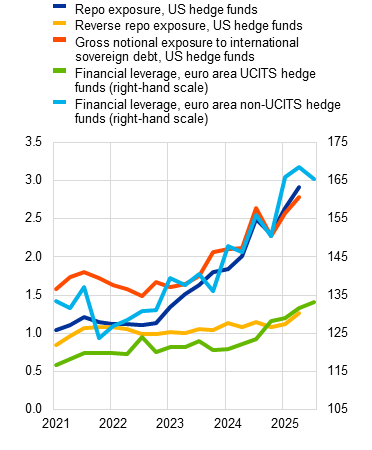 |
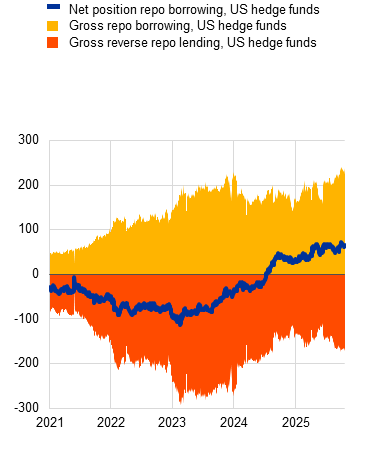 |
Sources: Office of Financial Research (OFR), ECB (IVF, SFTDS) and ECB calculations.
Notes: Panel a: financial leverage is defined as the ratio of total assets to outstanding fund shares. US hedge funds include all investment advisers registered with the U.S. Securities and Exchange Commission (SEC) with at least USD 150 million in private fund assets under management. Euro area hedge funds are the entire universe of funds reported in the ECB’s Investment Funds Balance Sheet Statistics (IVF) dataset. Financial leverage series end in Q3 2025, while the other series end in Q1 2025. Panel b: the chart includes all non-banks domiciled in the Cayman Islands that have repo or reverse repo transactions with euro area counterparts and use euro area sovereign debt as collateral in these transactions.
Box 4
Procyclicality and leverage of euro area UCITS hedge funds: an unhealthy mix
Hedge funds represent a relatively small segment of the euro area investment fund sector and comprise both AIF and UCITS hedge funds. The total assets of euro area hedge funds stood at around €660 billion in the third quarter of 2025, equivalent to roughly 3% of the investment fund sector’s total assets. In the EU, hedge funds may fall either under the Alternative Investment Fund Managers Directive (AIFMD)[62] or the Undertakings for Collective Investment in Transferable Securities (UCITS) Directive.[63] AIF hedge funds are usually marketed to wealthy investors and are predominantly held by euro area investment funds. They offer limited liquidity, by allowing redemptions only quarterly or even annually (often with advance notice), for example, and by imposing lock-up periods on initial investments. By contrast, UCITS hedge funds are more accessible to retail investors and other non-bank sectors – with euro area households and insurance corporations each holding around 15% of the shares in such funds. As these funds often allow investors to redeem shares on a high-frequency basis, the sector is more exposed to fund share redemptions during market turmoil. UCITS hedge funds account for about 30% of the overall hedge fund sector in terms of shares issued (Chart A, panel a) as well as total assets.
4.3 Insurance and pension fund sectors remain resilient but face valuation and structural risks
The euro area insurance and pension fund sectors continue to demonstrate resilience overall, despite the complex and evolving risk environment. Euro area insurers have consistently maintained Solvency Capital Requirement coverage ratios well above the 100% regulatory minimum (Chart 4.6, panel a). Profitability trends, while mixed, have remained broadly stable in recent quarters.[64] Higher yields at the long end of the yield curve have helped to reinforce resilience. Although weaker economic growth could weigh on demand for new business – particularly in the life insurance segment – the insurance sector’s strengthened balance sheets and improved asset yields provide a significant buffer. Euro area pension funds also slightly improved their funding ratios – to slightly above 120% in the first two quarters of 2025 – as assets increased at a faster rate than liabilities.
Chart 4.6
Insurers’ solvency remains strong in a context of structural portfolio adjustments
|
a) Solvency coverage ratios of euro area insurance groups |
b) Share of alternative assets in total assets held by euro area ICPFs |
|---|---|
|
(Q1 2021-Q1 2025, percentages) |
(Q4 2022-Q2 2025; € trillions, percentages) |
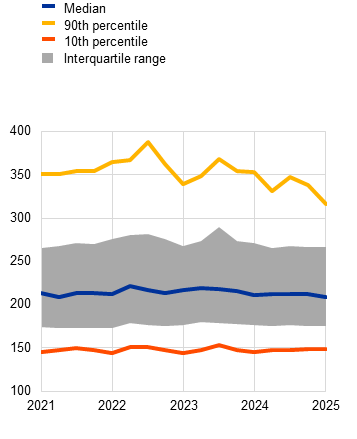 |
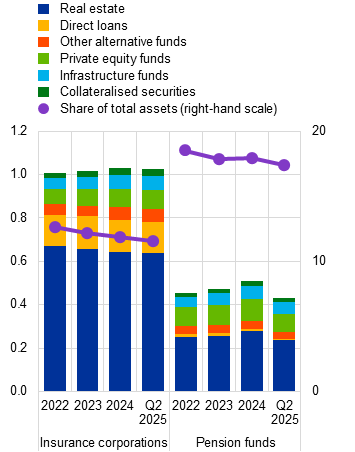 |
Sources: EIOPA and ECB calculations.
Notes: Panel a: the minimum required solvency coverage ratio is 100%. Panel b: “Pension funds” includes only occupational pension funds. “Real estate” includes direct holdings of real estate (i.e. physical property) and indirect holdings (i.e. real estate fund and company shares, securities and mortgages). “Direct loans” excludes mortgages. “Other alternative funds” covers alternative funds as categorised by EIOPA, which also includes private credit funds. The 2022-24 series refer to year-end data, while 2025 data refer to mid-year observations (Q2 2025).
Exposures to illiquid assets and the potential for derivative-related margin calls currently constitute the main vulnerabilities on the assets side of the balance sheet of insurance corporations and pension funds (ICPFs). ICPFs strategically allocate a significant portion of their portfolios to alternative assets – such as private equity, private credit, infrastructure and real estate – to enhance diversification and optimise long-term returns (Chart 4.6, panel b).[65] Alternative assets may face valuation pressure if financing conditions tighten or price discovery slows, which could reduce investment income and profitability. ICPFs employ derivatives – particularly interest rate and foreign exchange derivatives – as a strategic tool to manage market risk. However, these instruments can trigger acute liquidity pressures during periods of heightened volatility or abrupt rate movements. While recent monitoring indicates that median derivatives exposures remain modest overall, tail risks can become significant under system-wide stress scenarios.[66]
Portfolio adjustments are being driven by the higher yields at the long end of the yield curve and valuation effects, as well as long-term objectives for return optimisation and liability matching. While insurance corporations have slightly reduced the share of sovereign bonds in their balance sheets over the last two years, pension funds have slightly increased this share. They have also slightly adjusted their bond portfolios in favour of safer, higher-quality sovereign bonds (Chart 4.7, panel a). Although their overall exposure to debt securities has remained relatively stable, both sectors have increased their holdings of listed equities in the past two years, either through direct investments or via investment funds (Chart 4.7, panel b).[67] While exposures to US debt instruments have declined slightly, holdings of US equities have increased, particularly among pension funds, heightening ICPFs’ sensitivity to both global and US-specific market shocks. Although increased US equity exposures in a highly concentrated market amplify the sector’s vulnerability to abrupt market corrections, ICPFs’ greater activity in foreign exchange derivatives markets suggests more limited exposure to currency risk than is the case for the broader non-bank financial sector.[68]
Ongoing reforms, such as the transformation of the Dutch occupational pension system,[69] are driving significant changes in investment strategies, governance frameworks and geographical asset allocations for pension funds. While these reforms aim to enhance diversification and improve risk management, they also introduce new transition-related risks that could affect the asset classes traditionally favoured by pension funds. At the same time, pockets of concentration risk remain, particularly in areas like commercial real estate and certain private market segments which are sensitive to market fluctuations. During periods of market stress, these risks could materialise as margin calls or collateral demands could lead to forced procyclical asset sales. This could exacerbate market volatility and trigger ripple effects across other financial intermediaries, including investment funds and banks.
Chart 4.7
Insurance corporations and pension funds are steadily adjusting their exposure structures
|
a) Share of sovereign bond holdings in euro area ICPFs’ bond portfolios |
b) Share of debt securities, listed equity and US exposures in euro area ICPFs’ total assets |
|---|---|
|
(Q2 2023, Q2 2025; percentages) |
(Q4 2023, Q2 2025; percentages) |
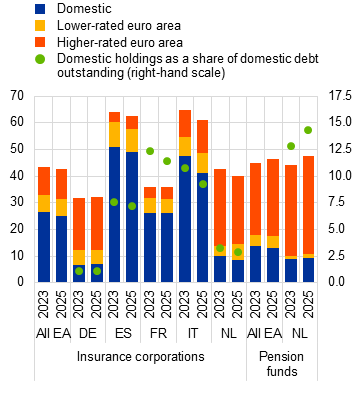 |
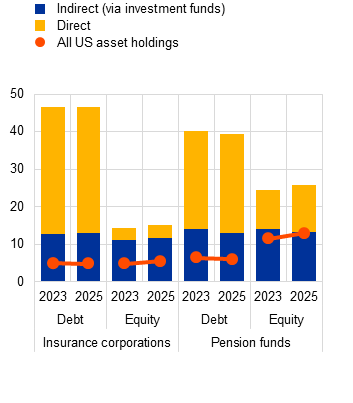 |
Sources: ECB (BSI, CSDB, ICB, IVF, PFBR, SHS) and ECB calculations.
Note: Panel a: EA stands for euro area; ICPFs stands for insurance corporations and pension funds. The green dots show the share of a country’s domestic sovereign debt held by all insurance corporations (left) and all pension funds (right) residing in that country, expressed as a percentage of the country’s total domestic sovereign debt outstanding. Lower-rated euro area sovereigns are countries with credit ratings below AA-. All series refer to mid-year data. Panel b: the 2023 series refers to end-of-year data, while the 2025 series refers to mid-year data (Q2 2025). Assets held via investment fund shares are obtained following the look-through approach outlined in Carvalho and Schmitz*.
*) Carvalho, D. and Schmitz, M., “Shifts in the portfolio holdings of euro area investors in the midst of COVID-19: looking-through investment funds”, Working Paper Series, No 2526, ECB, 2021.
Cyber risks have become a significant concern for both the insurance and the pension fund sectors, driven by geopolitical tensions and growing digital interdependencies.[70] Both sectors need to ensure operational resilience to protect their systems and data from cyber threats. That said, insurers face additional challenges as they also underwrite cyber risk − offering policies that cover losses from cyber incidents like data breaches and ransomware attacks. This exposes them to financial risks from claims. The increasing use of artificial intelligence (AI) in cyberattacks and internal operations creates a dual challenge for insurers: while AI enhances their internal efficiency in tasks like underwriting and claims, it simultaneously raises the risk of more sophisticated cyberattacks that leverage AI. This amplifies third-party dependencies as insurers rely on AI-driven platforms and data, potentially increasing their vulnerability to a system-wide failure or breach. Meanwhile, cyber criminals use AI to generate highly convincing scams and automate exploit development. To address these challenges, the EU’s Digital Operational Resilience Act,[71] which entered into force in January 2025, aims to strengthen the resilience of insurers and pension funds by enhancing oversight of critical information and communications technology (ICT) providers, mitigating the risks from cyber threats, technological failures and service disruptions.
4.4 Strengthening NBFI resilience and deepening EU capital markets
Monitoring and tackling emerging risks in the non-bank financial intermediation (NBFI) sector is becoming increasingly important as new market segments expand in size and relevance. Private market financing has grown rapidly, accompanied by rising corporate leverage, opaque valuations and lax lending standards. While the private credit fund segment remains relatively small in the domestic euro area market, concerns persist around concentration of risks and opaque bank lending exposures.[72] At the same time, the growing role of non-bank trading firms in equity and bond markets raises concerns about market functioning and the transmission of shocks through concentrated or leveraged trading strategies. Moreover, developments regarding stablecoins and other crypto-assets pose novel risks, especially where multi-issuance schemes and interlinkages with traditional finance could amplify vulnerabilities (see Box 5). Such developments underscore the need to broaden monitoring and deepen analysis to identify emerging risks at an early stage and to adapt the policy framework accordingly to prevent the build-up of systemic vulnerabilities.
Effective oversight of the NBFI sector requires timely, granular and comparable information, yet fragmented data continue to impede the assessment of systemic risks, both domestically and across borders. While substantial datasets are already being collected in the EU, the European System of Central Banks (ESCB) still has incomplete access to supervisory information under the AIFMD, the UCITS Directive, Solvency II and MiFID/MiFIR. Initiatives such as the proposal from the European Securities and Markets Authority (ESMA) to develop a more integrated reporting framework for investment fund data are welcome, to the extent that they broaden the sharing of available data and preserve the frequency and granularity of existing reporting. Limited cross-border information sharing means that the total exposures of foreign non-banks operating in the EU often remain opaque, creating significant data gaps for domestic authorities and central banks. Given the cross-border nature of NBFI activities and the sector’s interlinkages with banks and core markets, ongoing work by the Financial Stability Board (FSB) and other standard-setting bodies to improve the availability and comparability of NBFI data is critical. Removing barriers to effective cross-border data sharing and strengthening public disclosures would help close information gaps.
Timely and consistent implementation of international reforms in the EU is essential to enhance resilience and reduce the scope for regulatory arbitrage. Past stress episodes, including the March 2020 market turmoil, the 2021 collapse of Archegos and the 2022 UK gilt market stress, have shown how vulnerabilities in the NBFI sector can amplify shocks and spill over to banks. In response, international policy work has been undertaken by the FSB and the International Organization of Securities Commissions (IOSCO) has made progress in addressing liquidity mismatches in money market funds (MMFs) and open-ended funds, tackling vulnerabilities from NBFI leverage and improving liquidity preparedness for margin and collateral calls. The EU should move forward with the implementation of agreed reforms to enhance resilience in the NBFI sector and limit the scope for regulatory arbitrage. Liquidity mismatch in the MMF sector should be addressed, in particular by increasing liquidity buffer requirements and by removing threshold effects linked to the breaching of regulatory requirements, as advocated by the Eurosystem and recommended by the European Systemic Risk Board (ESRB).[73]
Addressing leverage-related risks in the NBFI sector requires a flexible yet targeted approach, resting on a broad policy toolkit. The FSB recommendations on NBFI leverage represent an important step towards building a comprehensive international framework to close existing policy gaps, given the cross-border dimension of leveraged activities.[74] These recommendations call for a combination of entity-based measures, such as leverage limits and enhanced reporting, and activity-based measures, such as margins and haircuts, while carefully balancing effectiveness and costs. In addition, enhancing private disclosures by non-banks would strengthen the ability of banks and prime brokers to manage counterparty credit risk exposures. The experience with leverage restrictions in the EU, such as those applied to alternative investment funds under the AIFMD,[75] demonstrates the value of entity-based tools, but also highlights the need to expand the toolkit to include activity-based measures in core financial markets and stronger instruments to address concentration risks. Further international work would help to support consistent and effective policy implementation, including FSB guidance on entity-based measures and risk-mitigation practices for securities financing transactions backed by sovereign bonds.
An effective macroprudential framework for non-banks requires both a broader policy toolkit and strengthened EU-wide coordination. Given the significant cross-border activities of the asset management sector, a macroprudential approach to NBFI should rest on common rules and standards, supported by coordinated supervisory action at the EU level.[76] Stronger coordination at the EU level is needed to ensure the consistent and effective application of macroprudential measures across jurisdictions. An EU framework for the reciprocation of such measures would help avoid cross-border leakages and arbitrage. Granting ESMA “top-up” powers over national measures, to be used in collaboration with national authorities[77] and after consulting with the ESRB, would strengthen its ability to address cross-border risks and mitigate the risk of national inaction bias. Beyond Article 25 AIFMD, which enables authorities to limit excessive leverage in alternative investment funds, a dedicated EU-level tool is needed to address liquidity mismatches in open-ended funds. This could be used, for example, to impose longer notice periods or other ex ante measures to limit liquidity mismatch. Regulatory gaps for hedge-fund-like activities under the UCITS[78] Directive should be closed by requiring all such entities to report leverage under the commitment approach[79] and by granting authorities discretionary powers to impose limits on highly leveraged UCITS that pose financial stability risks (see Box 4).[80] Finally, an EU system-wide stress-testing framework, covering banks and NBFI entities, would provide valuable insights into cross-sectoral vulnerabilities and strengthen the capacity of authorities to assess systemic risk.
Accelerated progress on the savings and investments union is urgently needed to strengthen Europe’s competitiveness, strategic autonomy and financial stability, while supporting the efficient financing of the real economy. Financing in the euro area remains predominantly bank-based, while equity markets are still fragmented and less developed than in other major economies. This hampers the efficient allocation of savings and increases funding costs across the corporate sector, particularly for innovative and high-productivity firms. Persistent legal and supervisory fragmentation continues to limit market depth, while long-term demographic trends, notably population ageing, underline the need to strengthen private pension and savings vehicles to complement public pensions and ensure adequate retirement income.
A broad set of measures will be needed to mobilise retail and institutional savings more effectively. This includes developing an EU-wide savings and investment product standard with coordinated tax incentives, wider use of automatic enrolment into occupational retirement schemes and a reduction of the debt-equity bias in taxation. Greater household participation in financial markets could also enhance financial stability by providing investment funds with a more stable funding base during periods of stress (see Box 2). Deepening equity markets should be a further priority, with targeted incentives for institutional investors to channel funds into long-term equity, especially venture capital and scale-ups, complementing efforts by the European Investment Bank (EIB) to expand venture financing. Structural barriers to cross-border activity should be reduced by streamlining corporate, securities and accounting law, as well as by aligning insolvency regimes to support efficient restructuring.
A more integrated supervisory framework would help ensure harmonised practices that underpin the development of capital markets in the EU. This is essential, given the growing size of capital markets and their inherent cross-border nature.[81] Enhancing the mandate, governance and resources of EU-level authorities and empowering them to coordinate macroprudential oversight would facilitate consistent policy implementation and improve crisis coordination across the EU. In addition, more integrated supervision of the asset management sector could be achieved, for example, by mandating ESMA to supervise asset managers and funds with significant European cross-border activities or by creating joint supervisory teams.[82] Such a system would strengthen rule implementation, boost market confidence and encourage cross-border investment. It would also help remove barriers within the European fund market, which is key to promoting retail investor participation.
Strengthening the macroprudential framework for non-banks and advancing the savings and investments union should be seen as complementary and mutually reinforcing objectives. While deeper and more integrated markets can enhance funding resilience by diversifying sources of finance, they can also heighten systemic vulnerabilities, particularly in segments of the NBFI sector characterised by liquidity mismatches, high leverage and cross-border interconnectedness. Only by combining stronger safeguards for NBFI entities with accelerated progress on the savings and investments union can Europe reap the benefits of deeper capital markets while safeguarding financial stability.
Box 5
Stablecoins on the rise: still small in the euro area, but spillover risks loom
Stablecoins have captured widespread attention in recent months on account of their rapid growth, raising potential concerns for financial stability.[83] Stablecoins are experiencing rapid growth, pushing their market capitalisation to new all-time highs. From a financial stability perspective, this may raise concerns arising from certain structural weaknesses inherent to stablecoins and their interconnectedness with traditional finance. This box explores the key risks and vulnerabilities associated with stablecoins, such as de-pegging and runs.[84] It explains the most important use cases for stablecoins and how risks could evolve if this market were to experience further significant growth. Finally, the box reflects on global regulatory developments and how the risks posed by cross-border regulatory arbitrage could be mitigated.
A What safe haven after the April US tariff announcement? Implications for euro area financial stability
Trade turmoil in April 2025 saw a marked change in cross-asset behaviour compared with typical patterns. Notably, the US dollar depreciated strongly while US Treasury yields rose – the opposite of what usually happens in a risk-off environment. This prompted discussions as to whether the safe-haven properties of US dollar-denominated assets might be changing. This is particularly important for euro area financial stability since euro area investors hold US dollar-denominated securities in an amount equivalent to €6 trillion, which represents a significant share of their portfolios. As policy uncertainty remains high and alternative safe assets are scarce, investors’ risk management practices may be evolving. Immediate and decisive implementation of policies associated with the savings and investments union and the capital markets union would help foster an alternative market of safe assets for euro area and global investors.
B Systemic risks in linkages between banks and the non-bank financial sector
Linkages between euro area banks and entities in the non-bank financial intermediation (NBFI) sector may lead to the emergence of systemic risk in at least two fields. First, the banking sector receives short-term deposit, repo and debt securities liabilities from NBFI entities. Such liabilities may be prone to flight risk and difficult to substitute. Second, euro area banks provide credit to NBFI entities which follow leveraged investment strategies. Hedge funds, mainly based outside of the euro area, together with non-bank lenders and real estate funds are the main groups of such leveraged NBFI entities. These interconnections are particularly important for euro area global systemically important banks (G-SIBs), which play a central role in financial intermediation and transform short-term NBFI liabilities into credit granted to other NBFI entities. While the scale of these linkages is generally contained, they could make euro area banks vulnerable to asset price shocks which, by triggering NBFI funding outflows and counterparty credit losses on exposures to NBFI entities, could lead to deleveraging by banks, reduced provision of leverage by banks to NBFI entities and asset fire sales. G-SIBs’ loss-absorbing capacity is thus essential to ensure the smooth provision of financial services in times of stress.
Acknowledgements
The Financial Stability Review assesses the sources of risks to and vulnerabilities in the euro area financial system based on regular surveillance activities, analysis and findings from discussions with market participants and academic researchers.
The preparation of the Review was coordinated by the ECB’s Directorate General Macroprudential Policy and Financial Stability. The Review has benefited from input, comments and suggestions from other business areas across the ECB. Comments from members of the ESCB Financial Stability Committee are gratefully acknowledged.
The Review was endorsed by the ECB’s Governing Council on 19 November 2025.
Its contents were prepared by Desislava Andreeva, Peter Bednarek, Katharina Cera, Daniel Dieckelmann, John Fell, Sándor Gardó, Max Lampe, Diego Moccero, Philippe Molitor, Csaba Móré, Allegra Pietsch, Manuela Storz, Gibran Watfe, Christian Weistroffer and Jonas Wendelborn.
With additional contributions from Paolo Alberto Baudino, Markus Behn, Ties Busschers, Maria Leonor Carrilho Puga, Jakub Doležal, Joachim Eule, Johanne Evrard, Ana Goulão Diogo Bandeira, Maciej Grodzicki, Paul Hiebert, Julija Jakovicka, Urtė Kalinauskaitė, Domenic Kellner, Anton Kostiushko, Chloe Larkou, Riccardo Meli, Daniele Miceli, Sarah Mochhoury, Cristian Perales, Guido Thomas Maria Pistorius, Alessio Reghezza, Ellen Ryan, Jaspal Singh, Pär Torstensson, Pucho Vendrell, Fabian Wagner, Regine Wölfinger, Stefan Wredenborg and Balázs Zsámboki.
© European Central Bank, 2025
Postal address 60640 Frankfurt am Main, Germany
Telephone +49 69 1344 0
Website www.ecb.europa.eu
All rights reserved. Reproduction for educational and non-commercial purposes is permitted provided that the source is acknowledged.
For specific terminology please refer to the ECB glossary (available in English only).
PDF ISSN 1830-2025, QB-01-25-248-EN-N
HTML ISSN 1830-2025, QB-01-25-248-EN-Q