
The “Christmas movie” may be a genre, a programming event, a family tradition, but what about the “Easter movie”? Is there such a thing?
In a literal sense, of course: “The Passion of the Christ,” “The Greatest Story Ever Told,” Zeffirelli’s series “Jesus of Nazareth” and maybe someday, “The Chosen.”
But as we all know — and even argue about (q.v. “Die Hard”), there’s more to a “Christmas movie” than the Nativity. Christmas is a cultural and social experience of weather, family harmony (and tension), peace on earth and goodwill to men, and movies reflect this. After all, the genre’s most popular entries don’t mention the Nativity or Santa Claus at all: not “A Christmas Carol” (nor Dickens’ novel), not even “It’s a Wonderful Life.”
Is there an Easter equivalent?
Sort of, yes — back in the day, when one man emerged as the face of Eastertime entertainment, and his name was Charlton Heston.
Heston appeared on our home screens every year around Passover and Easter for decades as Moses in De Mille’s “The Ten Commandments,” and then time-leapt to anno domini as the title character in William Wyler’s 1959 “Ben-Hur.” The latter’s television debut was on CBS in 1971 when — take a breath — 85 million people watched the 212-minute epic on Feb. 14. That’s obviously not Easter, but in subsequent years the movie found its place Easter weekend.
By the way, this year Fathom Entertainment is releasing “Ben-Hur” in theaters during Holy Week, so the tradition revives — and in a format much better suited to the epic than television.
Just as a wealth of Christmas themes emerge from the deceptive simplicity of the manger, so it is with the Passion and Resurrection: motifs of rebirth, conversion, redemption, self-sacrifice, spring, renewal, and even paradox, and a jolting reminder that your assumptions about what’s important and what’s even real just might be upended when the crucified criminal invites you to probe his wounds.
With those admittedly broad parameters in mind, I’ve got suggestions for an Easter Film Festival, in case anyone wants to mount one. It’s a quirky lineup, not exactly cozy family fare, but that seems right, too, in a season in which we’re called to contemplate the hardness of dying and shocking strangeness of an empty tomb.
1. “The Apostle” (1997) was the (recently) late Robert Duvall’s passion project. He wrote, directed, and starred in the film as the charismatic, definitely imperfect evangelist Sonny Dewey.
We’re used to stories of flawed, hypocritical religious figures, but “The Apostle” is unique in the genre because Sonny isn’t a lazy caricature: he actually, truly believes the stuff. All of it. He believes, but he also doesn’t pretend to be anything but a sinner, he resists repentance, he hits bottom — a few times — but rises again to follow Jesus and bring others to him. In an exaggerated, focused way — the way of art — Duvall’s Sonny walks, deeply aware of the presence of the living, risen Christ.
2. “Of Gods and Men” (2010) tells the true story of the seven Trappist monks who lived and served among Muslims in Tibhirine, Algeria, until they were kidnapped and murdered in 1996 during the Algerian Civil War. They were beatified in 2018.
We enter the monks’ lives as they consider the growing threat. We listen as they prayerfully ponder the question: do we stay or do we leave? It would be so easy to just return to France. But would it, really? Be so easy? They speak about death, intensely. They say: We have given our lives to Christ. They are already his. Another monk concludes that he is not afraid of death for in the risen Christ, “I am a free man.”
3. “Tree of Life” (2011), from Terrence Malick, whom you may love, hate, or never have bothered with, but in any case, creates meditative, impressionistic, visionary films. “Tree of Life,” on a superficial level, may be about family tensions in 1950s Texas. But of course, that’s only the beginning. It’s about nature and grace, about suffering and hope. And yes, resurrection.
A prayerful, challenging, visually gorgeous film, “Tree of Life” is particularly suited for this season as it calls us to move beyond an isolated vision of “what the Resurrection means to me” into the cosmic unveiling that all “… creation awaits with eager expectation” (Romans 8:19).
And now for some comic relief:
4. “Hail, Caesar!” (2016) from brothers Joel and Ethan Coen on one level is a satire of Hollywood’s studio system and specifically the sword-and-sandal biblical epic, as the movie-within-a-movie here is subtitled, in homage to “Ben-Hur,” “A Tale of the Christ.”
But with the Coens, rare among modern filmmakers in taking religion seriously, even as they joke, they give us more here. Eddie Mannix, the studio fixer, is a devout Catholic who rescues wayward stars from their sins. It’s a bit of a reach to call him a Christ figure, but in his character and woven throughout the film is indeed a sense that all of these crazy people are worth caring about, even, yes, worth saving.
Finally — was this entire article just an excuse to get you to give “Joe versus the Volcano” another try? No comment.
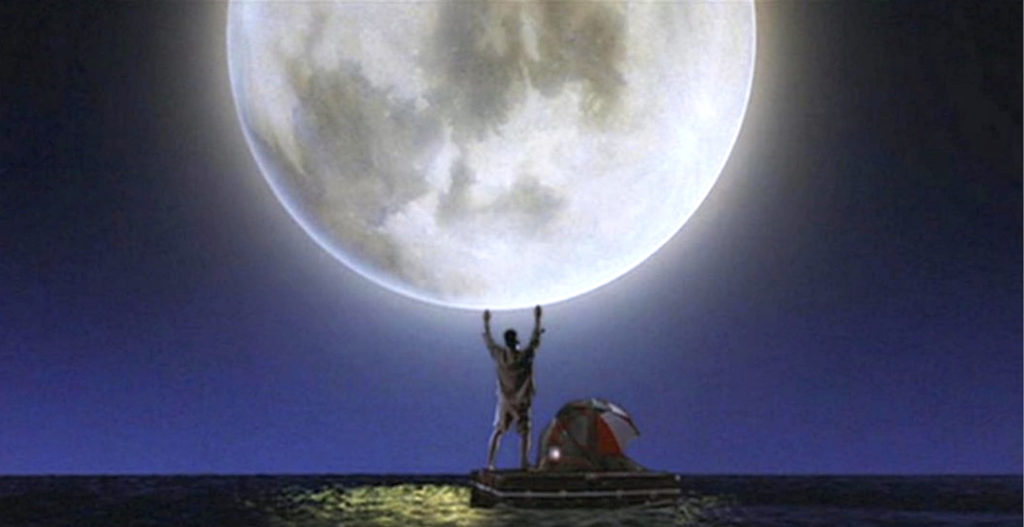
5. “Joe Versus the Volcano” was a misunderstood failure upon its 1990 release. The presence of stars Tom Hanks and Meg Ryan and the marketing led to the not unreasonable assumption that this was a frothy, zany rom-com. Reality: zany, yes, but frothy, no. Rather, this small, quirky film from John Patrick Shanley (“Moonstruck,” “Doubt”) is a surreal existential trip — a real journey — from death to life, from soul-sickness to the point where a man who thinks he’s dying, on a raft in a middle of an ocean, diverted from his task of jumping into a volcano, faces the wonder of an enormous rising moon and is moved, not to despair in the face of those circumstances, but to prayer:
Dear God, whose name I do not know — thank you for my life. I forgot how BIG … thank you. Thank you for my life.
