
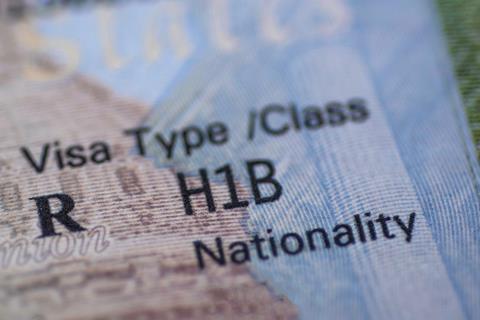
Public universities in Florida and Texas have been temporarily banned from hiring new international faculty and staff members on H-1B non-immigrant visas. There is concern that this could harm research at higher education institutions in these states and that these bans could be replicated across the country.
The Florida Board of Governors, which oversees the state’s public university system, voted on 2 March to pause the hiring of new workers on H-1B visas until 5 January 2027. There are a dozen state universities in Florida that carry out research and 10 are designated as having ‘very high’ (R1) or ‘high’ research (R2) activity. These public universities in Florida can continue their employment contracts with existing H-1B visa holders and will also be able to renew their contracts during this interim period. Florida’s public universities employ more than 1000 faculty and staff members on H-1B visas, according to public estimates.
Less than two months ago, Texas was the first state to enact a temporary freeze on new H-1B hiring for public universities in the state. On 27 January, Texas governor Greg Abbott directed the state’s public institutions of higher education to stop action on any new H-1B petitions for foreign employees until 31 May 2027. Texas is home to 23 public research universities that hold an R1 or R2 designation, and it is estimated that more than 1500 faculty and staff are working at these institutions hold an H-1B visa.
The recent changes put in place by the Trump administration have also made it easier for states and public universities to justify H-1B hiring freezes. For example, in September 2025 President Trump implemented a $100,000 (£74,000) H-1B fee that has made it prohibitively expensive for many smaller state universities to hire faculty and staff through H-1B visas.
‘State-level H-1B freezes at public universities are going to make it substantially harder on schools trying to recruit top faculty in chemistry and other scientific fields,’ states Connor O’Brien, a fellow for the Institute for Progress, a non-partisan thinktank based in Washington DC that aims to accelerate scientific and technological progress by focusing on federal policy.
When academic departments seek out new faculty, O’Brien notes, they are often looking for specialists in very narrow subfields and many of the top researchers in these specialised areas are foreign-born. ‘Recruiting to fill these faculty positions with top scientists is already challenging without arbitrary restrictions like these new H-1B pauses,’ he continues. ‘Over time, the states that adopt these pauses will produce less cutting-edge research, to the benefit of competing states.’
Fears visa bans will spread
Suresh Venkatasubramanian, a data science and computer scientist at Brown University, US, is also concerned. He came to the US from India on an F-1 student visa in 1994 and completed a PhD in computer science at Stanford University before moving to an H-1B visa in 1999 to work as a researcher at AT&T Labs in New Jersey. He eventually got a green card in 2006 and became a US citizen in 2019.
‘In the past year there has been a series of attacks on the research enterprise and universities in this country are already worried about how many students to admit into their graduate research programmes,’ Venkatasubramanian tells Chemistry World. ‘And now there is this uncertainty about H-1B visas, which means foreign PhD researchers really can’t apply for jobs at public universities in those two states.’
There is also a broader concern about weakening R&D investment in the US, he says, noting that many foreign scholars who intend to pursue PhDs have told him they now plan to apply to graduate schools in Canada, Europe and other regions outside the US. ‘These actions in Florida and Texas have caused a level of uncertainty and stress and this is being discussed at universities across the county, and they are adding stress in that part of the pipeline,’ Venkatasubramanian continues. He expresses hope that this trend that won’t spread to other states.
Robert Cassanello, president of United Faculty of Florida that represents 5000 faculty members at Florida’s public universities, says this decision will have a ‘devastating impact’ on research in Florida, especially in the hard sciences and engineering. It is possible, Cassanello says, that such initiatives will spread. ‘In places like Florida and Texas that are deep red states the politicians could follow suit,’ he states.
Similar measures have not yet been implemented elsewhere in the US, but there is momentum building in Republican-led states such as Oklahoma and South Carolina.