
Everyone likes a nice, affordable t-shirt or a baby Pikachu costume, but while fast fashion may look cheap on the price tag, a recent Greenpeace Germany investigation shows the real cost is shouldered by the workers, the environment and future generations. And it does not spare the buyers. Let’s unwrap this.

© Cristobal Olivares / Greenpeace
What is fast fashion?
The term ‘Fast fashion’ describes the rapid mass production of cheap, low-quality clothing that often mimics popular catwalk styles. In simpler terms, it refers to clothes that are made and sold cheaply, so that people buy new clothes often. It’s ‘fast’ in so many ways. Its production, the customer’s decision to buy it, its delivery, its usage and its disposal are all fast.
Brands most often associated with fast fashion include giants like Zara and H&M, as well as online retailers such as ASOS and Fashion Nova, which churn out huge volumes of trend-based clothing at low prices as often as one microseason a week. Newer ultra fast fashion platforms like Shein and Temu take this even further, adding thousands of new styles at rock-bottom prices every day and helping to normalise disposable clothing culture worldwide.
What are the environmental and health costs of fast fashion?
The ever-growing piles of discarded clothing reflect extreme resource use, severe pollution, microplastic contamination and exploitative working conditions. But fast fashion’s harm goes beyond the supply chain.
In fact, it’s also present in the clothes themselves. The products can contain hazardous chemicals that are linked to cancer, hormonal and immune system disruption, allergic reactions, as well as toxic effects on fish, plants and other organisms in rivers, lakes and seas.
People in producing countries are particularly affected, as these substances are often used and disposed of with little or no oversight, contaminating waterways and soils. Because much fast fashion is made from synthetic fibres like polyester, every wash releases microplastic fibres into rivers and oceans, where they accumulate in marine food webs and even end up in our bodies.

© Andri Tambunan / Greenpeace
What percentage of global carbon emissions comes from the fashion industry?
The fashion industry as a whole is responsible for up to 10 % of global carbon emissions annually. That’s more than the emissions of international flights and maritime shipping combined. The carbon emissions of fashion comes not only from fast fashion but it is worth noting that the carbon footprint of fast fashion consumption is 11 times higher than that of traditional fashion.
But the emissions are only part of the story. Fast fashion garments often end up in the Global South.
How does fast fashion impact the Global South?

© Kevin McElvaney / Greenpeace
A 2025 Unearthed and Greenpeace Africa investigation revealed that clothes discarded by UK consumers and shipped to Ghana have been found in protected wetlands, which are a critical biodiversity area. Reporters found garments from Next, George at Asda, and Marks & Spencer.
The clothes were in, or close to, two recently-established dump sites filled with used clothing inside an internationally recognised wetland an hour outside Ghana’s capital city, Accra. Locals complain that their fishing nets, waterways and beaches are clogged with synthetic fast fashion exported to Ghana from the UK and Europe.
In 2024, a report by Greenpeace Africa and Greenpeace Germany revealed the alarming scale of environmental and public health damage caused by the global second-hand clothing trade in Ghana. It exposed the devastating impact of discarded clothing from the Global North, much of it fast fashion, on the environment, communities, and ecosystems in Ghana.
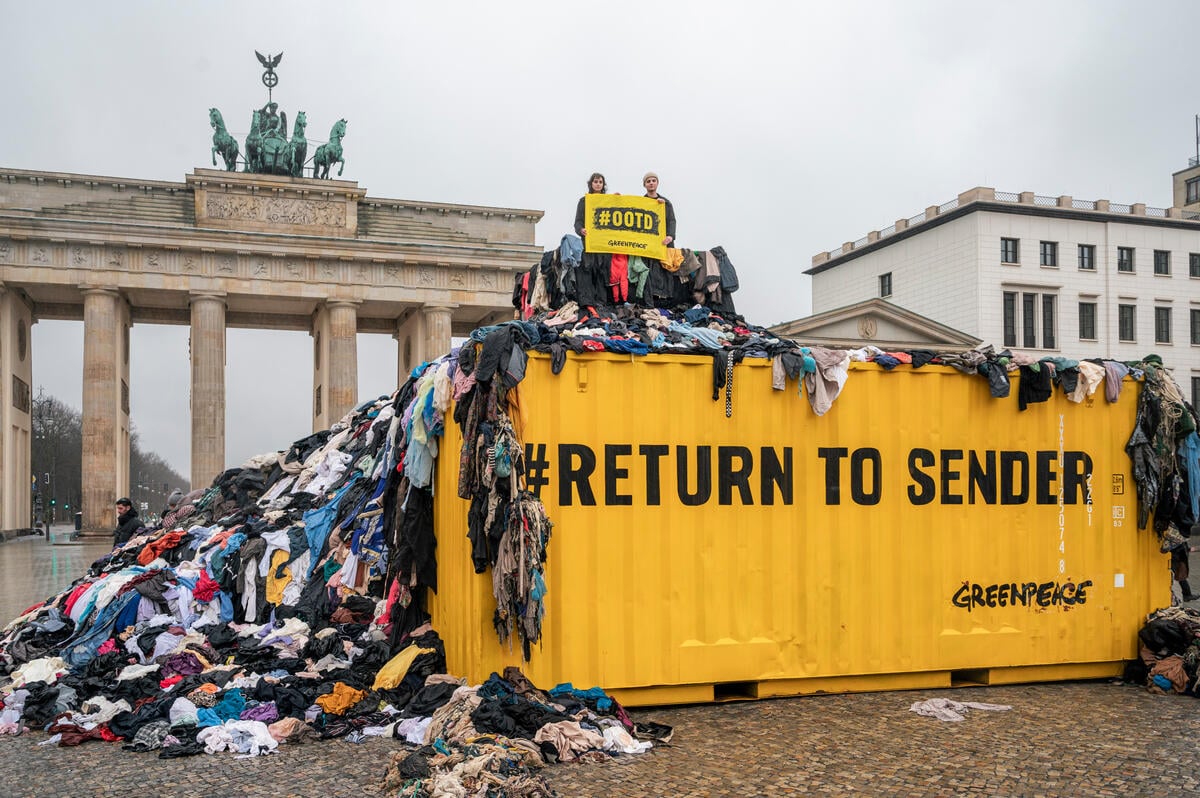
The exploitation, therefore, happens at both ends of the garment’s life, the people who make it and the people who live amongst its waste after its disposal.
© Paul Lovis Wagner / Greenpeace
Fast fashion and exploitative labour practices: the human cost
Sustainability is not just about environmental impact. It is also about social justice. Fast fashion needs a skilled operator of many different machines. They are mostly women working for low wages in a punishing global system.
Fast fashion brands exploit low-wage labour in countries with weak environmental and labour protections. Factories in Bangladesh, Vietnam, China and many other countries are notorious for unsafe working conditions, poverty wages, and pollution that devastates local communities.
Thirteen years ago, the Rana Plaza factory building in Bangladesh collapsed in a preventable tragedy. We still remember the more than 1,100 garment workers who lost their lives and the thousands who were injured. But Rana Plaza was neither the first garment factory disaster nor will it be the last, unless we change course.

© Kevin McElvaney / Greenpeace
Can fast fashion be green?
Fast fashion brands like to jump on the sustainability wagon, monetising what was once an opposition to their practices. If you have an issue with how this garment was made, maybe this ‘eco friendly’ label will reassure you and make you feel better about it. Incentivising you to buy it.
The truth is, fast fashion will never be green. Its business model is inherently incompatible with true sustainability.
For one, it fuels and thrives on overproduction which leads to millions of garments in landfills or incinerated each year with dire environmental consequences especially in the Global South.

© Kevin McElvaney / Greenpeace
Its supply chain is resource-intensive. The industry is the second-largest consumer of water worldwide, with textile production consuming vast quantities of this precious resource. As revealed by Greenpeace’s DetoxMyFashion campaign, the textiles and clothing industries are a major source of water pollution, and a significant source of hazardous chemicals and pollution of waterways in key production regions in the Global South.
Fast fashion encourages disposable consumption. It survives by convincing consumers to buy more than they need. While brands attempt to improve their image with ‘eco-friendly’ collections, their fundamental business model remains unchanged.
SHEIN – The epitome of what’s wrong with fast fashion

© Florian Manz / Greenpeace
Shein ticks every fast fashion box and more. The company’s model is driven by digital, real-time monitoring of trends, stolen and AI-generated designs, and a dense network of supplier factories in China operating under intense pressure. Thousands of new products go online every day, more than 10,000 on peak days.
A recent Greenpeace Germany investigation revealed that among other chemicals, the plasticizers phthalates and the water- and dirt-repellent “forever chemical” PFAS were detected in Shein products. These are hazardous chemicals that have been linked to various diseases, including cancer, reproductive disorders, and growth disorders in children, as well as a weakened immune system. This likely particularly affects workers and the environment in the production countries but it also reaches into consumers worldwide as they are exposed to these chemicals through skin contact, sweat, or inhaled fibres, and when garments are washed or discarded, the substances enter rivers, soil, and the food chain.
The use of hazardous chemicals in fast fashion is not a fringe mistake but a deliberate feature of the business model. They are cheaper than safer alternatives and enable rapid, high-volume production.
Is fast fashion worth it?
The simple answer is: No. While it might be tempting and accessible to many, fast fashion is harmful to consumers, workers, and the environment. Its devastating impact transcends geographical and social boundaries. Affecting people’s health and environment for the sake of more profit.
True sustainability demands a shift away from overproduction and overconsumption, yet fast fashion brands refuse to adopt this model because it threatens their profits and instead invest in greenwashing campaigns.
Everyone wants to look good without going broke. It’s understandable. Most people who buy fast fashion do so because it’s accessible, size-inclusive, or simply because it’s what they can afford in a cost-of-living crisis. There is no shame in needing clothes but while a fast fashion garment is disposable by design, our planet and the people who make those clothes are not.
Consider sharing, exchanging and repairing clothes. Find a local second-hand shop and the next time you see a new ‘must-have’ trend at an ‘impossible’ price, please remember that someone, somewhere, is paying the difference.