
Blog | Feature
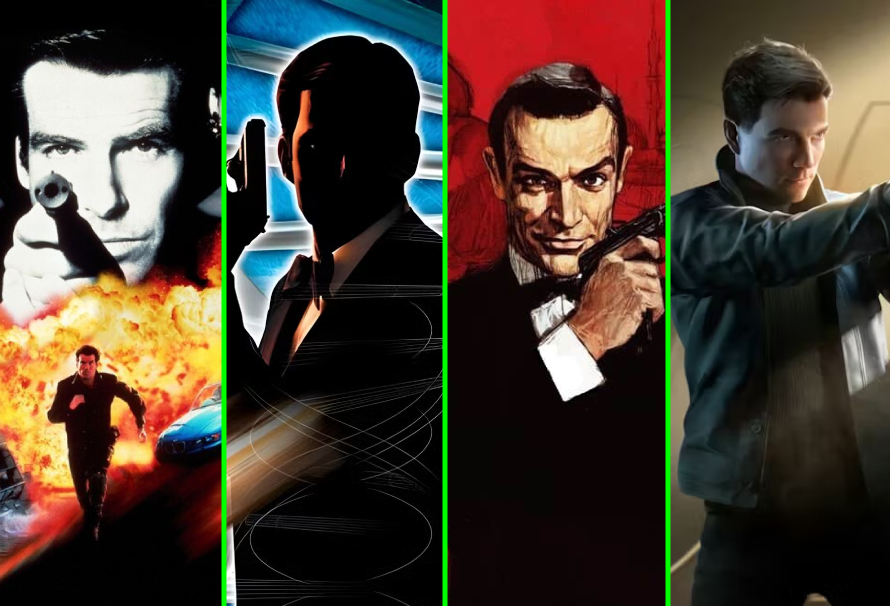
In a fashion not entirely dissimilar to the iconic films that inspired them, it’s fair to say the many video games based on the adventures of James Bond have had a rather uneven batting average over the years. With that in mind, and as we approach the release of what looks to be the most ambitious 007 game in years – 007 First Light – it’s worth revisiting the major digital adaptations of Britain’s most famous spy.
GoldenEye 007 (1997)
Before GoldenEye 007 arrived in 1997, there had been a handful of Bond titles across the 8-bit and 16-bit eras, but none came remotely close to the standard set by Rare’s Nintendo 64 classic. A bona fide masterpiece, GoldenEye 007 followed the plot of the 1995 film while whisking players across the globe in a slick, action-packed adventure. Its legendary multiplayer modes set a towering benchmark not just for Bond games, but for licensed movie adaptations in general. Sadly, 007 wouldn’t see another game of this calibre for decades. And yes, picking Oddjob is still cheating.
Tomorrow Never Dies (1999)
The qualitative whiplash between GoldenEye 007 and Tomorrow Never Dies could probably be measured in g-forces. Released exclusively for the original PlayStation, Tomorrow Never Dies shifted to a third-person perspective and delivered a relentlessly dull, by-the-numbers shooter that clung to the film’s events without adding much spark. Repetitive, visually underwhelming, and riddled with frustrating bugs (collision detection fans, look away), it wasn’t just a stumble – it was a minefield that threatened to undo Rare’s earlier triumph.
The World Is Not Enough (2000)
Abandoning the third-person approach of its predecessor, The World Is Not Enough returned to the first-person perspective that had powered GoldenEye’s success. While it was comfortably better than Tomorrow Never Dies – not a high bar, admittedly – it still proved to be a fairly lacklustre affair. Gadgets, weapons and spy toys were all present and correct, but the experience felt pedestrian overall, doing little to restore Bond to gaming greatness.
James Bond 007: Agent Under Fire (2001)
Marking Bond’s debut on the PlayStation 2, Agent Under Fire stuck with the first-person viewpoint and layered in stealth elements reminiscent of GoldenEye. Featuring a completely original storyline about a shadowy organisation deploying cloned operatives, it wasn’t a classic, but it was the strongest outing since 1997. Built on an early iteration of the id Tech 3 engine, it also impressed on a technical level for its time.
James Bond 007: Nightfire (2002)
Continuing the trend of original stories, Nightfire featured Pierce Brosnan’s likeness (unlike the more generic Bond of Agent Under Fire) and was widely hailed as the best Bond game since GoldenEye. Blending first-person shooting, stealth, driving missions and a hugely entertaining multiplayer suite – complete with Oddjob, Jaws and other iconic characters – Nightfire suggested that 007’s gaming fortunes were firmly on the rise.
James Bond 007: Everything Or Nothing (2004)
Pierce Brosnan returned once more for Everything Or Nothing, just a year before Daniel Craig would reinvent Bond on the big screen. Switching back to a third-person perspective, the game delivered another original story, bolstered by a star-studded cast including Dame Judi Dench, Willem Dafoe and Heidi Klum. With high production values, globe-trotting set pieces, cover shooting, driving segments and gadget-driven puzzles, Everything Or Nothing felt like a confident and refreshing entry in the Bond gaming canon.
From Russia With Love (2005)
From Russia With Love stands out for one key reason: it features both the likeness and voice of Sean Connery in his final outing as 007 – and he delivers a solid performance. Retaining the third-person style of Everything Or Nothing, the game offered a cinematic, if slightly simplistic, retelling of the classic film. Jet packs, Q-branch gadgets and an arsenal of weaponry kept things lively. It wasn’t exceptional, but neither was it the disaster some made it out to be.
007: Quantum Of Solace (2008)
The first Bond game to star Daniel Craig (with no Casino Royale adaptation in sight), Quantum Of Solace felt like a step backwards. Clearly influenced by Call of Duty, it focused heavily on straightforward gunplay and wave after wave of dim-witted enemies. While From Russia With Love at least offered variety, Quantum Of Solace often resembled a thinly skinned Call of Duty campaign – and not one developed by Infinity Ward or Treyarch.
007: Blood Stone (2010)
On paper, Blood Stone had plenty going for it. Though another third-person effort, it featured solid cover-based shooting, satisfyingly brutal takedowns and some excellent driving sequences – unsurprising given that developer Bizarre Creations was responsible for Project Gotham Racing. Criticised for its short length and uninspired story, Blood Stone nonetheless delivered a polished and entertaining slice of Bond-flavoured action.
GoldenEye 007: Reloaded (2011)
Fourteen years after the N64 original, it felt slightly odd to see GoldenEye revisited. Reloaded (following a Wii version released the year prior) retold the 1995 film’s story with modernised mechanics and Daniel Craig in the lead role. The multiplayer was well received and the shooting solid, but despite its competence, there was an undeniable sense of cynicism hanging over the project.
007 Legends (2012)
Easily the weakest Bond game in years – and perhaps a key reason for the long hiatus that followed – 007 Legends belongs firmly in the bargain bin. A clunky first-person shooter spanning several classic Bond films, it was hampered by dreadful AI, uninspired level design and a complete lack of innovation. In short, it secured its place as the low point of Bond video games.
007 First Light Looks Set To Deliver The Ultimate Bond Fantasy
Now, however, 007 First Light appears poised to change the narrative. Developed by Hitman studio IO Interactive, it clearly shares DNA with that acclaimed franchise while aiming to deliver the most comprehensive realisation of the Bond fantasy yet. Presented in third-person, the game follows a younger, less seasoned 007 as he hunts the leader of a shadowy organisation.
While First Light incorporates cover shooting and slick takedowns, it also leans into IO’s signature strengths: disguises, social stealth and open-ended level design that encourages creative, non-linear solutions. Crucially, it understands that charm is one of Bond’s deadliest weapons. Extended dialogue sequences and more fully realised story beats help the game feel like it has leapt from the silver screen rather than merely borrowed from it. At the same time, it hasn’t forgotten the series’ bombastic flair, promising cinematic chases and driving sequences that might even make Naughty Dog blush.
Moneypenny would approve.
