
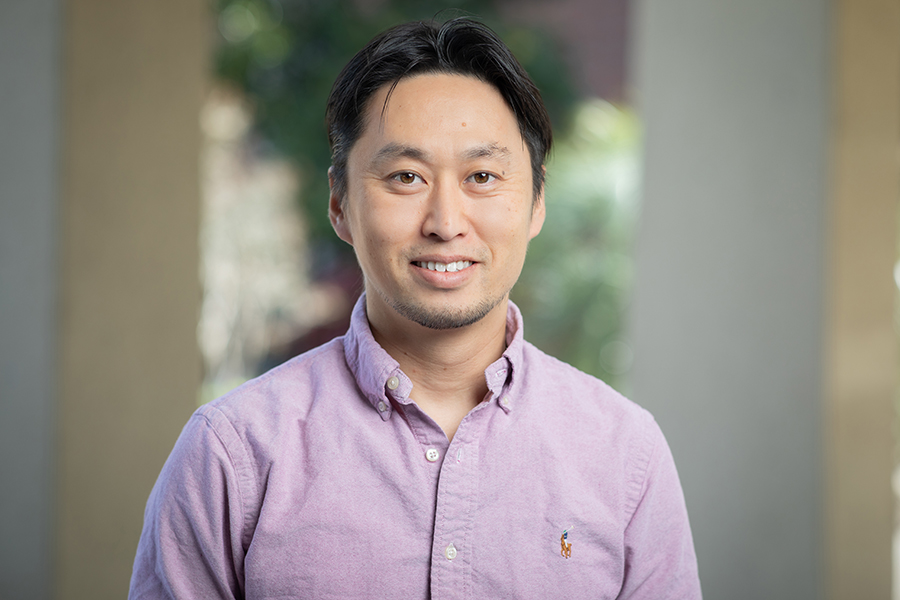
A Florida State University particle physicist has been awarded a fellowship to support his research into the Higgs boson, a fundamental building block of our universe, and dark matter.
Kohsaku Tobioka, an associate professor in the Department of Physics, is the first FSU faculty member to receive an Invitational Fellowship for Research in Japan from the Japan Society for the Promotion of Science, or JSPS. The fellowship will support his research in Japan from April to July.
“We’re looking to learn more about the origins of the universe, and conducting research across institutions and nations is essential to do so,” Tobioka said. “We need international collaboration to make real progress; it can’t be done with just one laboratory or nation.”
JSPS strengthens international research networks and fosters the next generation of scientists who pursue the creation of new avenues of knowledge in all areas of science. The specific fellowship Tobioka earned invites physics researchers with exceptional records of achievement to collaborate with colleagues at the Yukawa Institute for Theoretical Physics at Kyoto University in Japan, a world-renowned institute for theoretical physics research.
“In the four months of my fellowship, I hope to begin two projects and continue working with Kyoto University researchers after returning to FSU,” Tobioka said.
In collaboration with Ryuichiro Kitano, a professor at the Yukawa Institute for Theoretical Physics, Tobioka will focus on two research avenues: the presence of dark matter — an invisible, mysterious substance that makes up most of the mass in the observable universe — as well as properties of the Higgs boson, a fundamental particle that interacts with other particles, which receive their mass through interactions with the Higgs field.
For 60 years, the existence of the Higgs boson was considered the final missing piece of the Standard Model of particle physics, a theory classifying all known elementary particles. In 2012, it was produced for the first time and confirmed by the European Organization for Nuclear Research, or CERN, near Geneva. Several FSU researchers were among hundreds of scientists who served significant roles in search of the particle.
Tobioka’s work will investigate how the Higgs boson interacts with itself, helping scientists understand how the universe began.
The collaborative research will use a future muon collider to experiment with higher amounts of energy than CERN’s Large Hadron Collider, or LHC, which facilitates research of subatomic particles by firing two high-speed protons at each other and observing what is produced in the collision.
In a 2024 publication, Tobioka and his former student, physics doctoral alumna Shemeran Mahmud, presented novel techniques to observe the Higgs boson self-interaction, and these new techniques can be achieved with a muon collider, which is much smaller than the LHC. Instead of firing protons, these colliders use muons — subatomic particles similar to electrons but about 200 times heavier, yielding a higher energy.
“Using protons, like in the LHC, requires a very big tunnel and can be an infrastructure challenge,” Tobioka said. “A muon collider is a smaller, completely new technology. We all want to know where we came from and how the universe came to be, and this essential science has the potential for unpredictable breakthroughs.”
Another direction of Tobioka’s research will focus on dark matter, which makes up about 27 percent of the known universe. While dark matter is invisible, scientists can understand it by observing the way it affects the environment around it through forces such as gravity. Tobioka plans to use superconducting qubits, which are cutting-edge quantum computing materials, to detect dark matter waves and develop theoretical foundations connecting dark matter and superconductivity.
“Some people call dark matter ‘the mother of galaxies’ because it hosts stars and galaxies,” Tobioka said. “Because our solar system is constantly moving through the galaxy’s dark matter, we may experience a ‘dark matter wind’ which lets us measure that dark matter. Discovering and fully understanding dark matter is a global competition right now.”
Tobioka earned his doctorate from the Kavli Institute for the Physics and Mathematics of the Universe at the University of Tokyo’s Kashiwa campus in 2014 and received a Research Fellowship for Young Scientists from JSPS that same year. He completed postdoctoral research at the High Energy Accelerator Research Organization in Japan and held a joint appointment with Tel Aviv University and the Weizmann Institute of Science in Israel. He conducted research at Stony Brook University in New York before joining FSU’s faculty in 2018.
In addition to his research, Tobioka also regularly participates in FSU’s Saturday Morning Physics program to promote scientific engagement and outreach for children and the broader community.
“Professor Tobioka has brought brilliance and energy to both our physics department and the department’s high-energy physics group,” said Paul Cottle, Department of Physics chair. “He’s an intellectual risk-taker who is constantly challenging boundaries.”
To learn more about Tobioka’s work and other research conducted in FSU’s Department of Physics, visit physics.fsu.edu.