
Valve’s latest Steam Hardware Survey is out, and it makes bleak reading for Intel. Following the underwhelming launch of Intel’s Arrow Lake Core Ultra CPUs, which generally showed gaming performance actually decreasing compared to its previous Raptor Lake CPUs, gamers are seemingly voting with their wallets and buying AMD chips instead.
According to Valve’s new December 2025 survey, 55.58% of Steam users who took part in the latest survey use an Intel CPU, while AMD’s share has gone up to 44.42%. Intel is still the leader here, of course, but that’s a much tighter margin compared to Intel’s heyday, which wasn’t that long ago. Cast your minds back to the same time five years ago, and Intel’s share sat at a commanding 81%, while AMD’s 19% looked positively piddly. Intel’s share has dropped by 31.38%, or 25.42 percentage points, in this time – that’s huge.

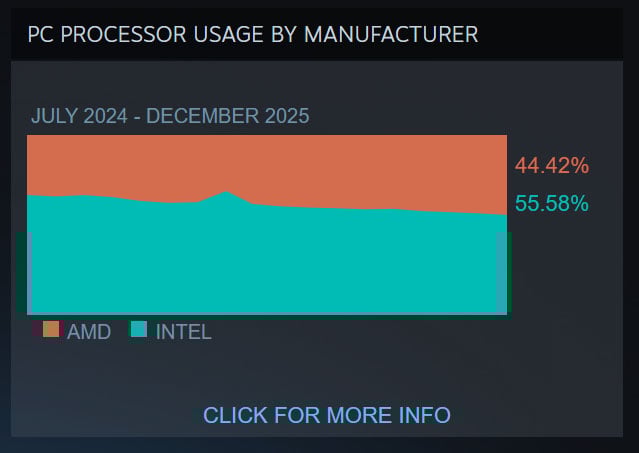
In just five years, Intel’s domination in the gaming CPU market has seemingly crumbled, and you can point to several reasons why. For one, Intel’s 14th-gen Raptor Lake CPUs were plagued by stability problems over the last couple of years, where the infamous Vmin shift issue caused large spikes of voltage to get pushed through these chips during some loads. Common results were games based on the Unreal Engine crashing and saying you didn’t have enough VRAM, when the problem was actually your CPU flaking out.
This issue didn’t just lead to game crashes, but also ended up killing CPUs in some cases, leading to accusations that Intel was making defective CPUs. A load of BIOS updates followed, reining in power settings and updating CPU microcode, requiring you to update your motherboard BIOS several times just to ensure your system would be stable. It’s been a PR disaster for Intel, which previously had a solid reputation for making rock-solid CPUs you could trust to be reliable.
Then came Arrow Lake, which, as we found in our Intel Core Ultra 9 285K review, was fine for multi-threaded content creation, while also running cooler and drawing much less power than Raptor Lake. However, gaming performance wasn’t just slower than the competition; it was actually behind Intel’s previous chips.
In the meantime, AMD has unleashed a relentless tide of new Zen CPUs, and its X3D chips with 3D V-cache have proved immensely popular, offering unparalleled performance in games. In fact, you can even buy an X3D CPU that also doubles as a multi-threaded content creation powerhouse, as we found in our Ryzen 9 9950X3D review.
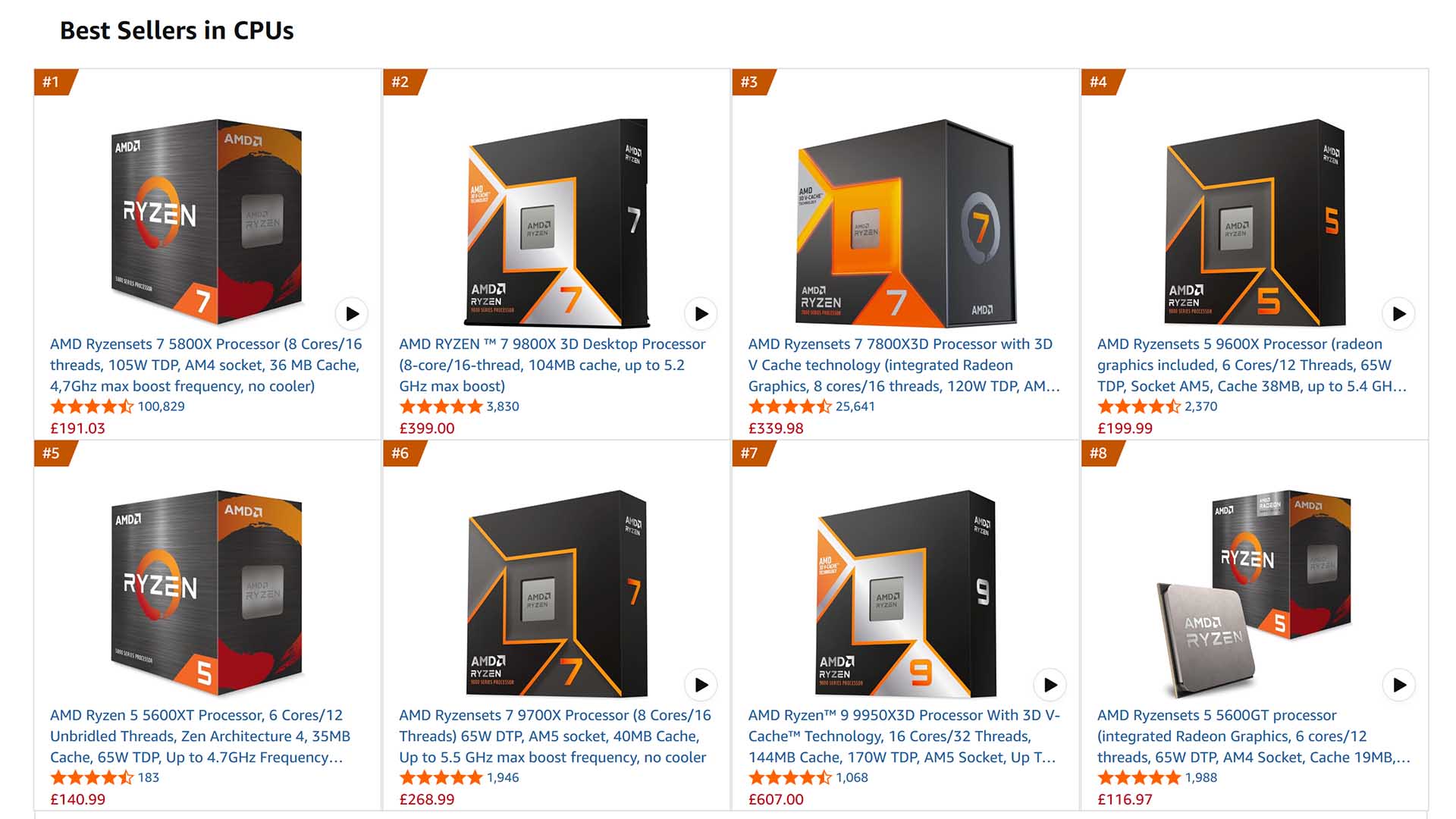
Head over to Amazon, look at the CPU best sellers, and you won’t see a single Intel CPU in the top 10. Interestingly, thanks to outlandish RAM prices lately, AMD’s ageing Ryzen 7 5800X, which supports DDR4 RAM, is the most popular CPU right now. AMD’s acclaimed Ryzen 7 9800X3D is second, followed by the 7800X3D. You have to drop to number 11 to find the first Intel CPU, a low-end Core i5-14400F, while the first Arrow Lake chip doesn’t appear until the Core Ultra 9 285K pops up at number 20.
Intel can still turn this situation around. After all, AMD was in a much worse position before it released the first Zen chips, and it’s managed to stage a massive comeback. Intel will need to hope that its forthcoming Nova Lake desktop chips, which are rumoured to have up to 52 cores and huge amounts of last-level cache, really do deliver the goods.
In the meantime, we’ll be really interested to see what Intel unveils at CES 2026. We’ll be reporting directly from the show floor, so make sure you’re following our Club386 Google News feed and have the site set up as a Google Preferred Source to keep you in the loop.