
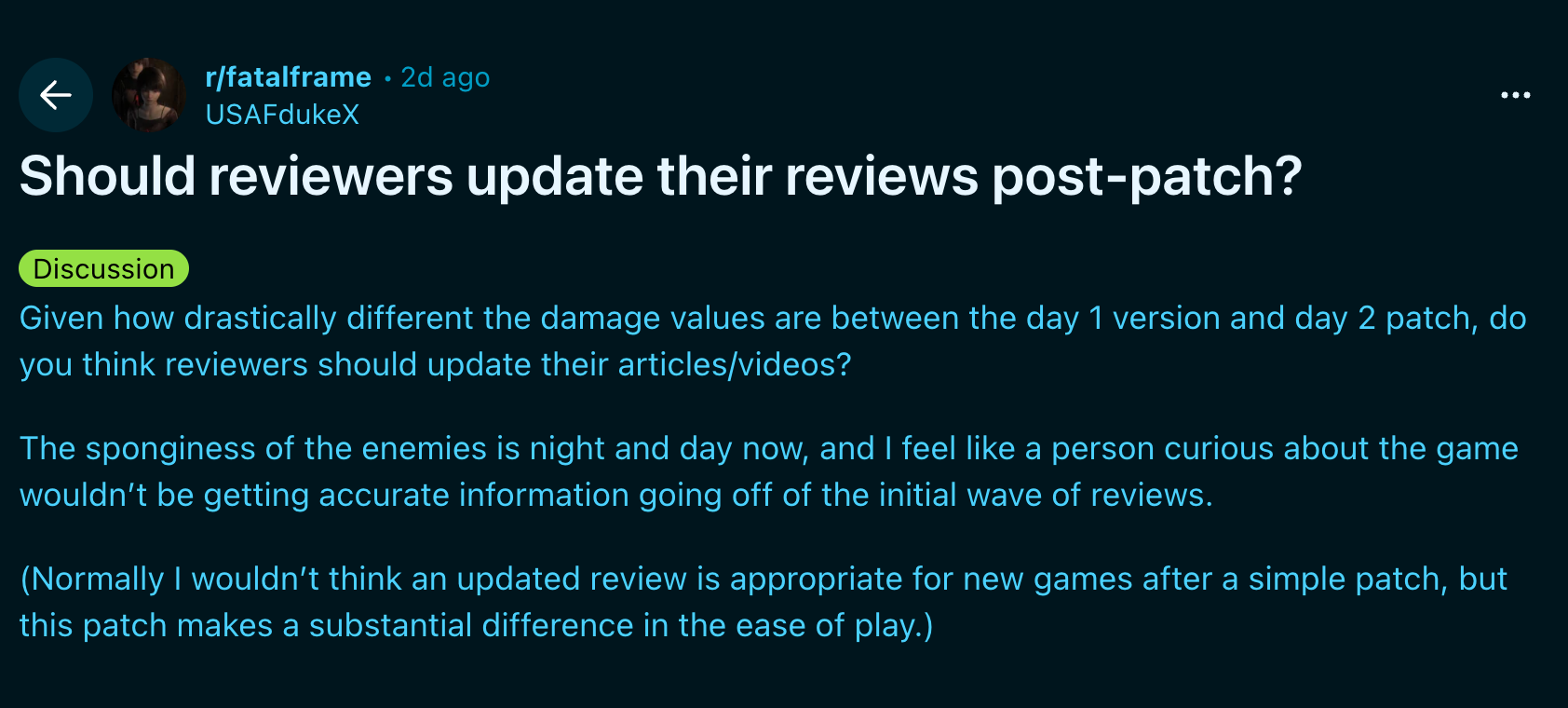
Like everyone else, I spend some time in Reddit but this weekend a post popped up on /FatalFrame which caught my attention, asking if reviewers should update their reviews in the wake of post-release patches (of which Fatal Frame II: Crimson Butterfly Remake has had a few, including the Grain Toggle, enemy balancing and more film/healing items).
I argued no. We review what we’re sent because that’s what we were asked to review. Yes, in an ideal world, the game devs will then use this as a basis for what needs tweaking or fixing, either short-term like Day One patches or longer term like things to add into their next game or instalment in a beloved franchise.
As an example, also relating to Crimson Butterfly Remake, the demo launched on the 4/5th March… and the biggest comment after how short the demo was, concerned a film grain-like effect on the PS5 version of the game. As someone who had played the game on both the Steam Deck and the PS5, I can tell you this effect made me physically nauseous and worried for anyone who suffers from epilepsy or other visual triggers. This stuff never normally bothers me but I was having to take breaks to reset my twitching brain.
This comment below appeared on 10th May, two daya before the game’s official launch. The update was then issued as a Day One patch, along with several more over launch week which focused on calming down the pissed off wraiths (I had one minor wraith Aggravate THREE TIMES in one fight prior to this patch). Koei Tecmo/Team Ninja also adjusted film, making more available, as well as other adjustments.
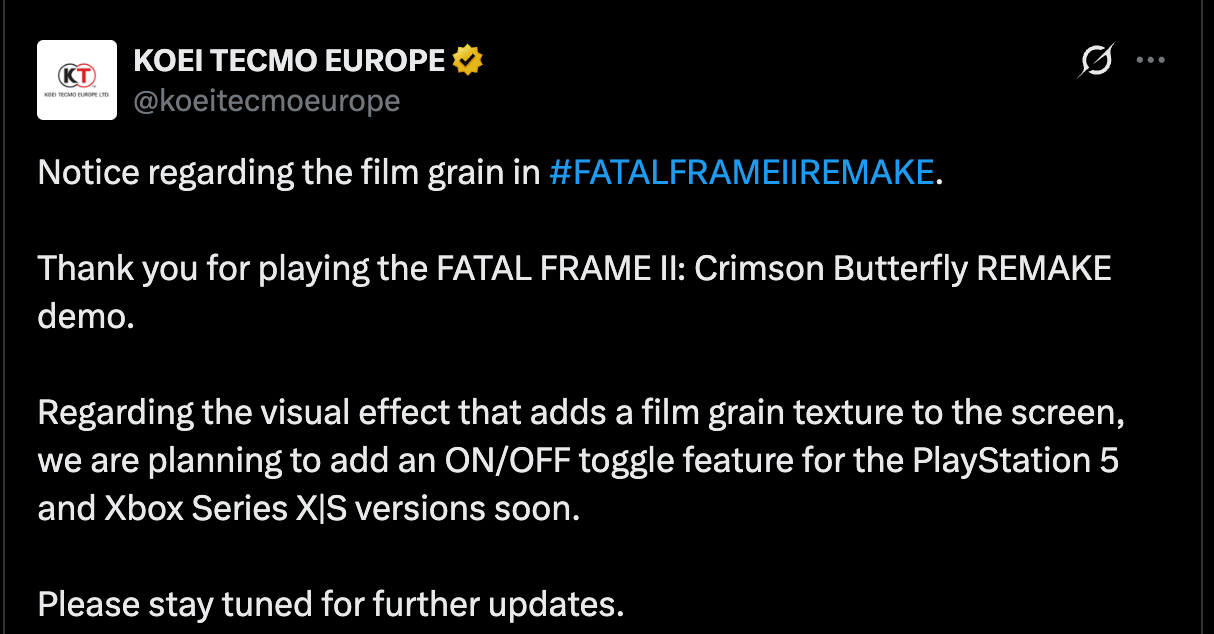
I still don’t know for certain that this particular effect was specific to the PlayStation 5, but I couldn’t see it on my Steam Deck (which does have specific settings when it comes to graphics). But I know can feel in my bones that Koei Tecmo wasn’t expecting such a loud and vocal backlash. I am, however, very glad they fixed it, along with the nice QoL stuff like more film…
The point is, the key part of reviewing a game—even a remake—is reviewing it as you’re given it. Just because a dev team could add in later patches, it doesn’t mean they will. When you get review code, even if it patches while in a pre-release state, you must review what you have in front of you…
The thing is you need to understand that the ability to do this is verty much a feature of modern gaming, thanks to the internet. Back when I started in games journalism, code came on CD, you needed to put in a dev kit and then play the game. You couldn’t take screenshots and there was no internet, so Gold meant done. No additions, no revisions, just sending the CDs to Sony’s specialist printers and then packaging them before shipping them to stores.
There was no way to do this back in the 2000s, when this game originally came out. I think, in part, that’s why they were so hard. It wss just you and your controller, or a friend if you could get them to come over and help you. I still remember booting my up PlayStation 2 on the floor of my room at uni and playing on Sunday afternoons. No guides, no help, no way to solve puzzles except for the game gave you…
I do this with every game that lands on my desk. I try to play it (I STILL suck at Soulslikes), I take notes, I review the story, the gameplay, the voice acting and music, the graphics, the flow of the game… All that good stuff. I
So, as I said in the Reddit post above:
As a journalist no, we’re reviewing what we were sent in the state we were sent it. But I will often mention post-review patches if they happen, especially if it’s something as important as the film grain toggle.
If you review a game as you think it might be, you’re not being honest. Yes PRs want 5/5 or x% Metacritic score, but without honestly there’s absolutely no point in booting up your console. Ig you don’t focus on the current state, rather than how it might change if feedback is offered and accepted, then you are ultimately misleading the millions of people about to open their wallets and pay actual fiat currency for the next big AAA game.
Asha Bardon is a twenty-year veteran of the games industry, having worked since the early 2000s covering everything from console games for Official magazines, to MMOs and gaming-focused websites like AOL.com and CBR.com. They are currently writing their first non-fiction book and also run The Gaming Lorist Substack.