
It was a classic case of too many games, too little time.
I downloaded The Drifter at the end of October. I could only play it on my Steam Deck — a less frequented device for me — so the game was already at a disadvantage. I booted it up, played 10 minutes to get the gist ahead of a developer interview with co-creator Dave Lloyd from Powerhoof for another story.
I remember saying the game was a unique commentary on homelessness on the call. Lloyd played a straight bat at the time, agreeing with my point. In retrospect, he must have eye-rolled on the other end of the line — another games journalist who has no bloody idea. This game is as much about homelessness as Stranger Things is about the ‘80s. It’s a present theme, it’s interesting, sure, but it’s so far from the core story.
As a result, I was intrigued, but it didn’t grab me. In that month I’d bought six other games and expansions. I was midway through The Outer Worlds 2, with other games I was really looking forward to on the horizon.
The Drifter was on my list, but ironically, began to drift.
It wasn’t until the classic January lull — where time on hand and number of exciting new releases started to balance out — that I revisited the game, booting up my Steam Deck after a long sleep inside its case and plugging it into my TV. I picked up where I left off, exploring the game’s initial area: a rundown causeway near a body of water, talking to a few characters.
My mission: find a power source to charge my smartphone. Pretty low stakes as far as games go, coming right off the action of being shot at in a train carriage. I could see why I’d bounced off it.
But then, almost as soon as I sorted that one trivial objective, the game kicked into gear, presenting a much more interesting broader narrative and a really unique take on the genre.
More than meets the eye
Following this, it clicked. I could see why this point-and-click adventure game swept the Australian Game Developer Awards last year. Far from a commentary on homelessness, The Drifter is more or less a horror sci-fi conspiracy story, where you play as Mick as he navigates coming home to Mawson for his mother’s funeral — a town he left behind after an earlier tragedy. Though nothing is as it seems.
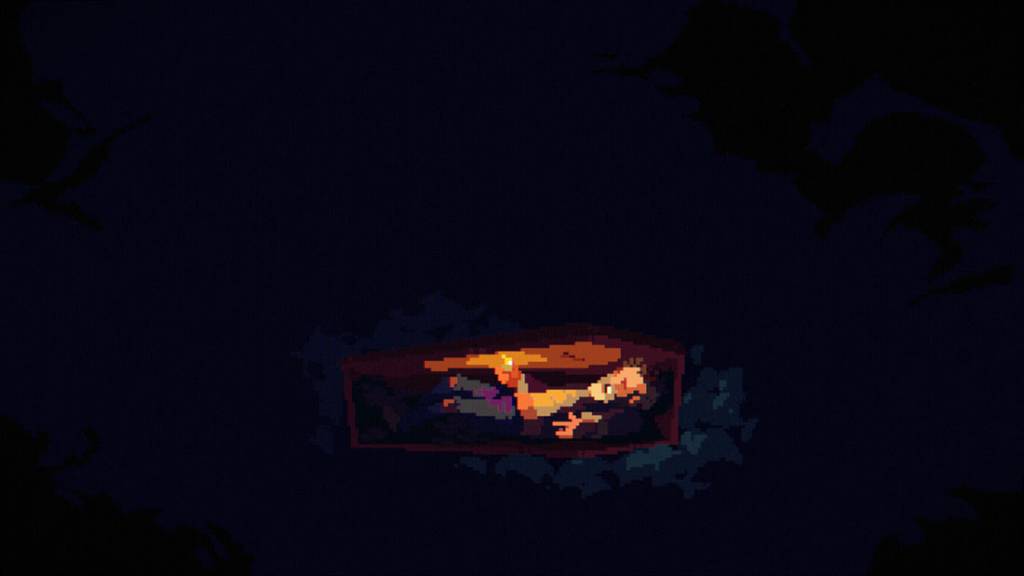
There are two distinct modes that alternate across the game’s chapters. The slower segments are your classic point-and-click gameplay — gathering items, travelling to certain areas, thinking laterally about what you have on hand, and at times combining items to create a solution.
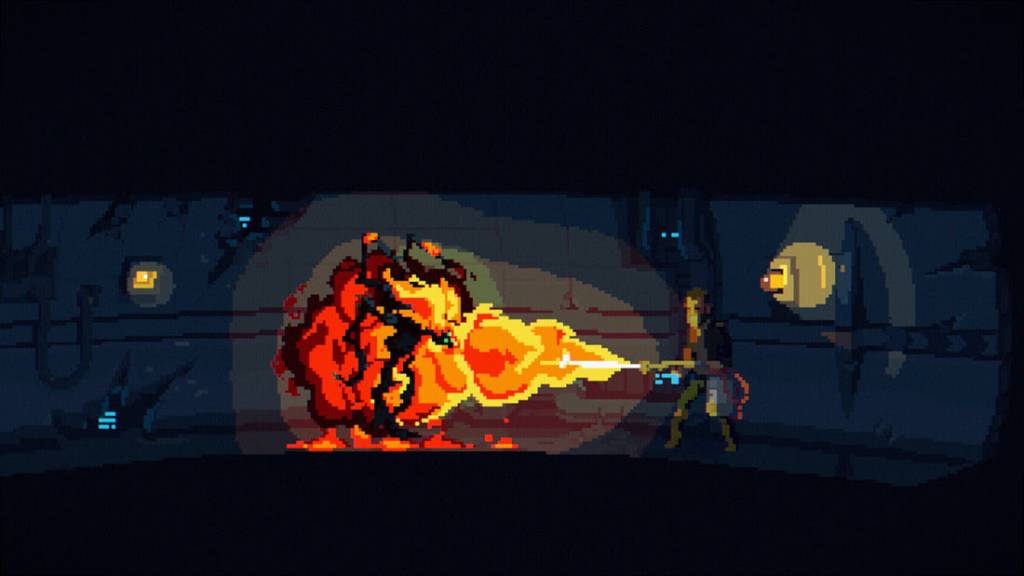
Other parts, however, are significantly more intense. The Drifter throws time-sensitivity into the mix and is not afraid to let you make mistakes that kill Mick in some rather graphic and explicit ways. The catch: Mick dies, but is somehow painfully hurled back in time to moments before his demise each time. This is the core premise of the game, and if I’d stuck with it for ten more minutes, I’d have gotten it.
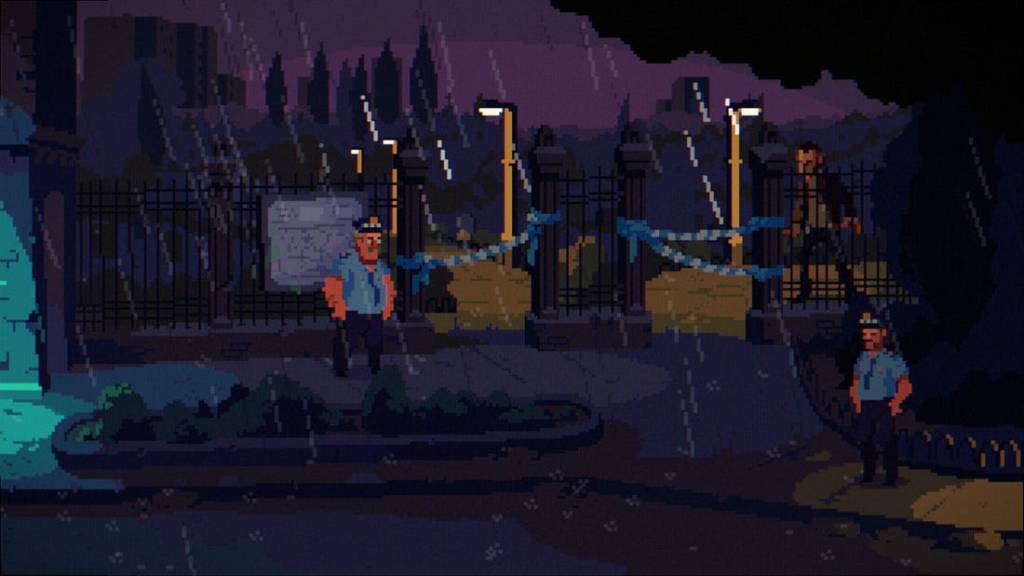
Aside from the beautifully rendered pixel art — which holds up surprisingly well ported from a Steam Deck to a larger screen — the other artistic standout is the voice acting. Adrian Vaughan, who plays half a dozen characters including Mick, works some serious magic here. The game is entirely voiced, and for much of it Vaughan is narrating Mick’s state of mind as he tries to solve the game’s various puzzles. It never grates, despite projecting a thick Australian accent when playing Mick.
Perhaps that’s the other perk for me personally. This is quintessentially an Australian game, but it doesn’t scream it. And as an Australian, I kind of appreciated that. Aside from the accents, there are only a few nods that Mawson could be an Australian city, like police in short-sleeve shirts and ties. It’s something Australians would clock immediately, but not jarring enough to alienate anyone playing abroad. Though where you sit on this is interesting, given Clair Obscur: Expedition 33 and its expression of French culture really opened the door to games as a form of cultural expression. The same could be said for Black Myth: Wukong with China, and Japanese role-playing games since the ‘90s.
Think fast and smart
While The Drifter is easy to pick up, it’s by no means an easy game. Playing without a guide will rack your brain. The more intense, time-sensitive sections are balanced to help; other characters provide hints or context Mick may have missed with each death. But outside of these, you’re largely on your own, with Mick’s narration nudging at best. That can leave certain sections requiring some broader knowledge and perhaps a bit of guesswork to pass without assistance.
For instance: one later section asks you to sanitise a needle for stitching a wound. I went looking for alcohol, which seemed the obvious solution. What the game actually wanted was for me to use steam from a nearby coffee machine. As someone with family in infection control, I know this is genuinely a thing — steam sterilisation is used on surgical equipment at scale. But my video game brain defaulted to a familiar fix and I missed it entirely.
Some will call this clever design; others will absolutely curse at their screen. It presents an interesting question about difficulty: when it’s not about skill, but creative thinking and general knowledge, where does that leave players determined to go guide-free?
Another point of friction perhaps lies in the game’s settings for playing with a controller. The solution here, a ring around Mick indicating all nearby interactive items, was intuitive enough. But it did lead to occasional frustration: accidentally clicking the same object twice, or struggling to distinguish between icons. It led to situations where I couldn’t quite get Mick to do what I wanted him to, and in time-sensitive moments that led to some avoidable deaths. In other instances, I could see the solution, but with a controller I wasn’t quite sure how to interact with it.
This is a non-issue on PC with a mouse and keyboard, but with a Switch release expected later this year, it’s worth noting. It’s by no means a deal-breaker, but a small piece of unwanted frustration.
At $30 AUD on Steam, The Drifter is well worth it. It’s a compelling mystery with a surprisingly complex, multi-layered story for a ten-hour game. Point-and-click aficionados will lap it up, but I’d also recommend it to fans of the classic Resident Evil games — Resident Evil Remake or Resident Evil 0 in particular. Those titles put as much emphasis on puzzle solving and player ingenuity as they do on combat. While there’s no combat here, there’s a similar gameplay loop, and the tension of certain sections — along with the late-game story twists — makes it a closer comparison than you’d initially expect. The game markets itself as a mystery title, but so does Stranger Things, and anyone past the first season knows it’s a lot more sci-fi than Cluedo.
Just whatever you do, don’t make the same mistake as me. If any of this is piquing your interest, play the game longer for 10 minutes. The Drifter is well worth finding that time.
- Reviewed on: Steam Deck OLED
- Worth playing if you like: Disco Elysium, Resident Evil Remake, Return To Monkey Island (but this is absolutely not a kids game!)
- Available on: Steam, Windows and coming to Nintendo Switch.