
Sports arenas across the United States could soon have a new, jiggly way to measure the excitement of a game. Jell-O, the company most known for its physics-defying gelatin dessert, is introducing a device it says can calculate fan intensity in a stadium and then visually represent that data in real time as a jiggling mass of Jell-O. The rowdier the crowd gets, the more the Jell-O jiggles. The company is calling its bizarre invention the JELL-OMETER. It’s already been used at a professional hockey game in New York and is expected to be on its way to other stadiums soon.
Anyone who has been to a sporting event has likely seen messages on the jumbotron urging fans to “Get Loud” and cheer. Those systems typically use decibel readers to measure sound.
The JELL-OMETER takes a different approach and tries to measure fan energy instead. The company claims the device uses “proprietary plate-sensing” technology to capture sound pressure from the crowd’s cheers. That sound pressure is then converted into mechanical motion and presented as a shaking mold of Jell-O.
The energy is measured in “jiggles”on a scale of one to 10. One jiggle is roughly equivalent to a microwave, while 10 is supposedly the same as a small earthquake rumble. No word yet on how many the small earthquakes generated at Taylor Swift concerts would be.

JELL-O Introduces: JELL-OMETER
Related: [What a Jell-O brain tells us about the future of human-machine interaction]
The company says that their goal is to create an “interactive way to experience crowd intensity.” Priming fans to get up and buy a packet of the jiggly substance probably doesn’t hurt either.
“As the inventors of the jiggle more than 125 years ago, we knew we had a unique opportunity to visually measure sound in a way no one else could,” Kathryn O’Brien, the Kraft Heinz Company’s head of marketing for desserts, said in a statement.
“With the JELL-OMETER, we’re bringing the iconic Jell-O jiggle to sports to give the fans something they’ve long waited for—the opportunity to secure bragging rights on who has the most passionate fanbase.”
The JELL-OMETER has already seen some action. On Friday, the device was trialed at a professional hockey game between the New York Islanders and the Philadelphia Flyers. This clip posted on Instagram shows the device registering “5.8” jiggles.
Loud crowds can win games
Sports fans aren’t shy about getting loud. In 2014, Kansas City Chiefs fans broke the Guinness World Record for loudest crowd roar at a sports stadium, belting out an ear-blistering 142.2 decibels—roughly equivalent to the sound of a jet taking off. That record beat the one set by Chiefs fans in 2013.
And while the rowdy fans certainly played a role, the stadium has also earned a reputation for being particularly loud, something reportedly attributed to a pair of canopies that cover a large portion of the seats. That coverage protects fans from rain, but it also serves a secondary purpose of amplifying sound.
Some particularly crafty sports teams have also been known to use a stadium’s loudness to their advantage. The Houston Astros famously opted to keep their roof closed during the 2017 World Series, even when the weather was fine, in a deliberate attempt to amplify the crowd noise bouncing back down from the roof. They ended up winning that series four to three.
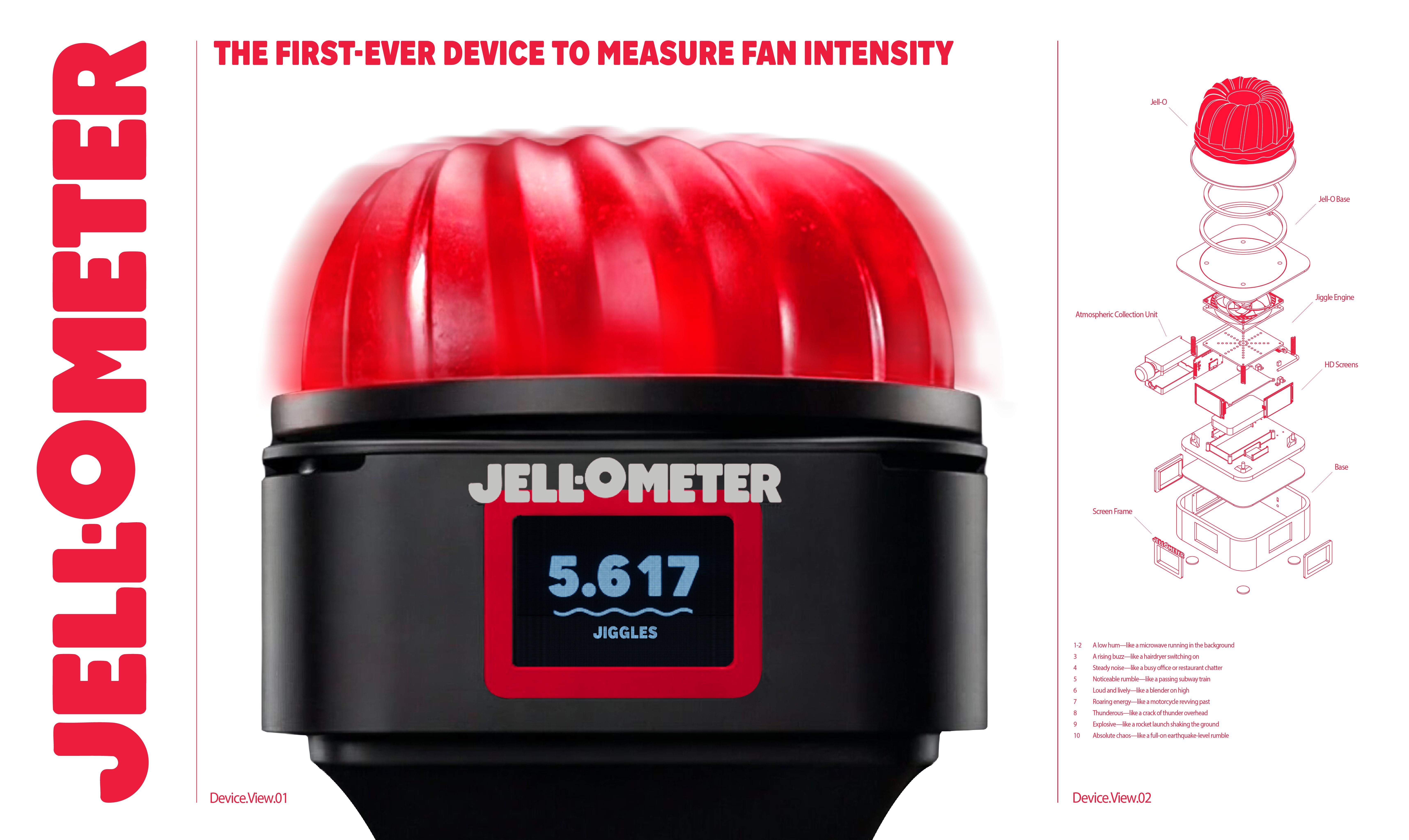
Jell-O makes it clear they aren’t pulling for any one team in particular. The company said it is looking to introduce its device to more stadiums and is gathering feedback from fans to see which cities might be prime candidates.
“The JELL-OMETER doesn’t take sides,” O’Brien said. “It just measures the madness.”

2025 PopSci Best of What’s New