
When the most recent (10th ) trilateral summit between Greek Prime Minister Kyriakos Mitsotakis, Israeli Prime Minister Benjamin Netanyahu, and Cyprus’s President Nikos Christodoulides was held in Jerusalem in late December, the three leaders stressed the multi-faceted nature of their 3+1 partnership (the US is the +1) and their determination to further deepen and expand a relationship which has clearly remained entirely unaffected by the bloodshed of the Gaza war.
The strategic partnership, which developed under the auspices of the United States, is clearly intended in part to curb Turkey’s hegemonic aspirations in the Mediterranean, though the parties are careful to underline that is not directed against any third country.
Its expansive strategic ties include close defense cooperation—Hellenic Air Force pilot training, joint military exercises annually, and major Greek procurement of advanced Israeli weaponry (in December, parliament approved the purchase of 36 Elbit Systems PULS (Precise & Universal Launching System) multiple rocket launchers with a 650mn euro price tag)—, rapidly growing trade and commercial ties, critical energy sector cooperation, massive purchases of Greek real estate by Israeli investors, and cooperation in the technology and R&D sectors.
Strategic defense partnership front-and-center
For most observers, the defense aspect of the Greece-Israel-Cyprus strategic collaboration is the most critical, and its potential impact on geostrategic balances in the Mediterranean, where Ankara is forcefully disputing the rights of Greece and Cyprus under international law, is an area of particular focus.
“I believe that this military cooperation seeks to raise the level of two partner countries in a specific area, and cooperative projects can be upgraded. Most importantly, the two militaries [Greek and Israeli] become acquainted with one another, so that when they want to serve common interests, there will be no barriers to mutual military understanding,” retired Air Force Lieutenant General and honorary training commander Evangelos Georgousis tells TO BHMA International Edition.
“It leads to sharing knowledge of particular military dogmas in various operations, and especially in the area of naval and air force operations, in which the two countries are particularly interested.”
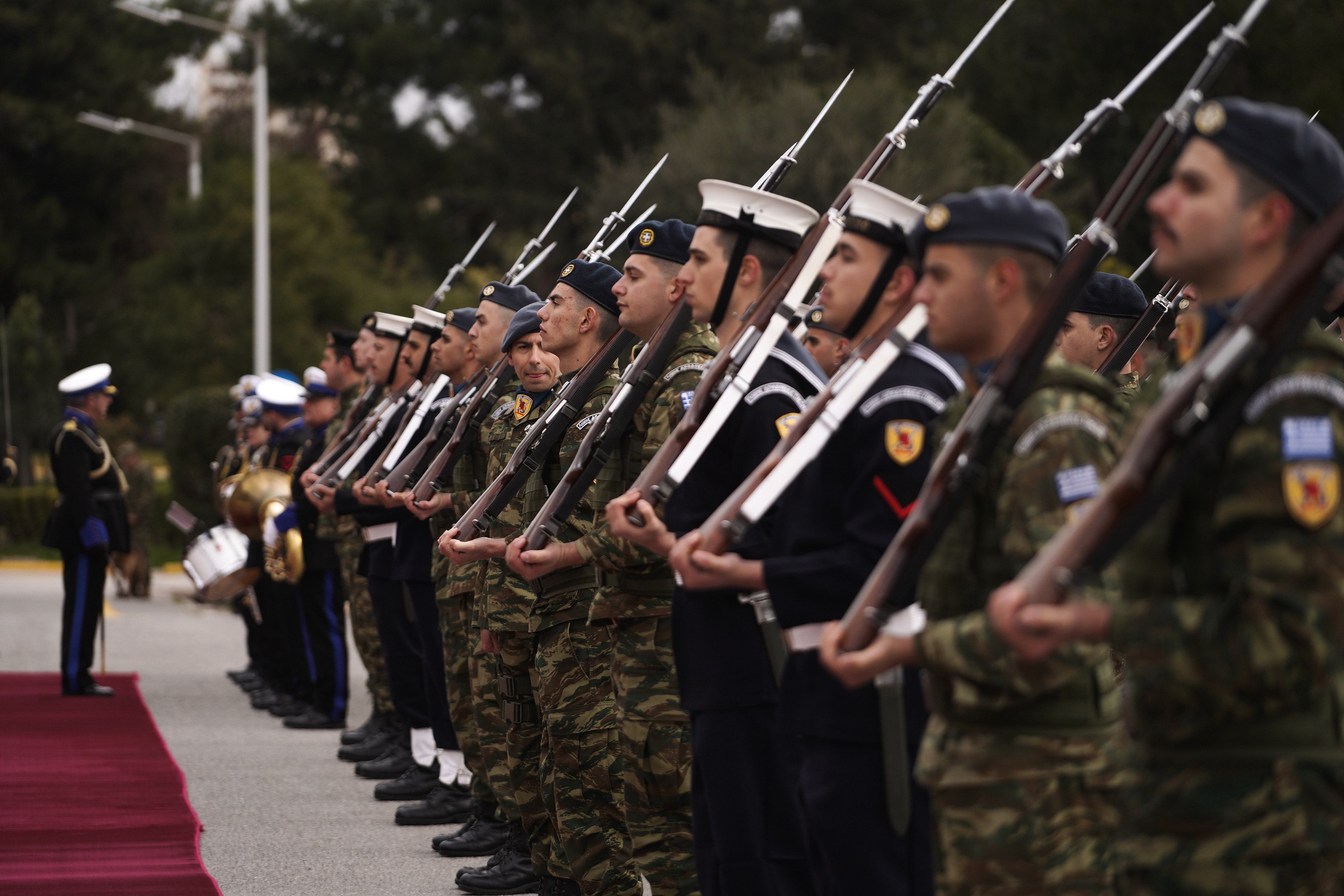
Soldiers stand in line at the Ministry of National Defense in Athens, Greece, January 20, 2026.
Kalamata Air Force Training Center
A crucial element of the strategic partnership has been the creation of an Air Force training school in Kalamata. Established with the core participation of the Israeli defense contractor Elbit Systems, the school utilizes the M-346 Leonardo aircraft to bridge the gap for Greek pilots transitioning to advanced fighters like the F-16, Mirage 2000-5, and the French Rafale.
Moreover, the training center is already being used by military pilots from Italy, Germany and elsewhere, which pay by flight training hours. Other countries have also shown an interest.
“This is an advanced course, the final stage in our pilots’ training. The aim of this training school is in the first instance commercial. Israel’s Elbit must recoup the money that it invests.”
“From the standpoint of operational performance, the [Leonardo] aircraft is very good. In the past I had cooperated with the company and am familiar with it. Within the framework of its capabilities, Greek pilots and others who may receive training can only gain from the experience,” Georgousis says.
Critically, they will require less training time in fighter jets, because they will have gained a good knowledge of switch technology and other areas from the M-346s. “The pilots can carry out many exercises with this plane, and it is the initial stage for starting flights in fighters with better performance and efficiency,” he adds.
Trilateral partnership as an obstacle to Turkish revisionism
Turkey expressed consternation over the last trilateral Greece-Israel-Cyprus summit, which the pro-government Turkish press viewed as evidence of an Israeli military threat to Ankara.
“Let’s not kid ourselves. Turkey has convinced itself that it is a regional power. It does not want other countries to impede its revisionist [geopolitical] plans in any way,” Georgousis notes.
“The tighter the Israel-Cyprus-Greece relationship is, not only in defense, but also in the areas of commerce and energy, the more difficult it will be for Ankara to implement its revisionist plans. Turkey has clearly stated that it wants to craft its own Law of the Sea based on its [expansionist] vision of a “Blue Homeland” (Mavi Vatan),” he underlines, referring to Turkey’s claims in the Aegean, Eastern Mediterranean and Black Sea.
“Neither Greece, nor Cyprus, nor Israel by extension are willing to tolerate such designs.”
Greece defends its own interests in the Mediterranean
Greece does not expect direct assistance from Israel in the event of a Turkish-Greek clash in the Mediterranean, as their partnership is not that sort of alliance, and Greece is fully prepared to defend its own interests.
“There could conceivably be ancillary assistance, however, what we call ‘indirect strategy’,” Georgousis notes, which includes sharing intelligence, know-how, and various other systems in which Israel has expertise.
What’s in it for Israel?
Participation in bilateral and multilateral military exercises on terrain different from its own, and including mountain ranges, are a key benefit for Israel.
In particular, the annual multi-national “Iniochos” (Charioteer) exercises centered on the Andravida Hellenic Air Force base stress complex air operations and interoperability. Fighter jets, transport planes and helicopters participate in the maneuvers in a coordinated manner.
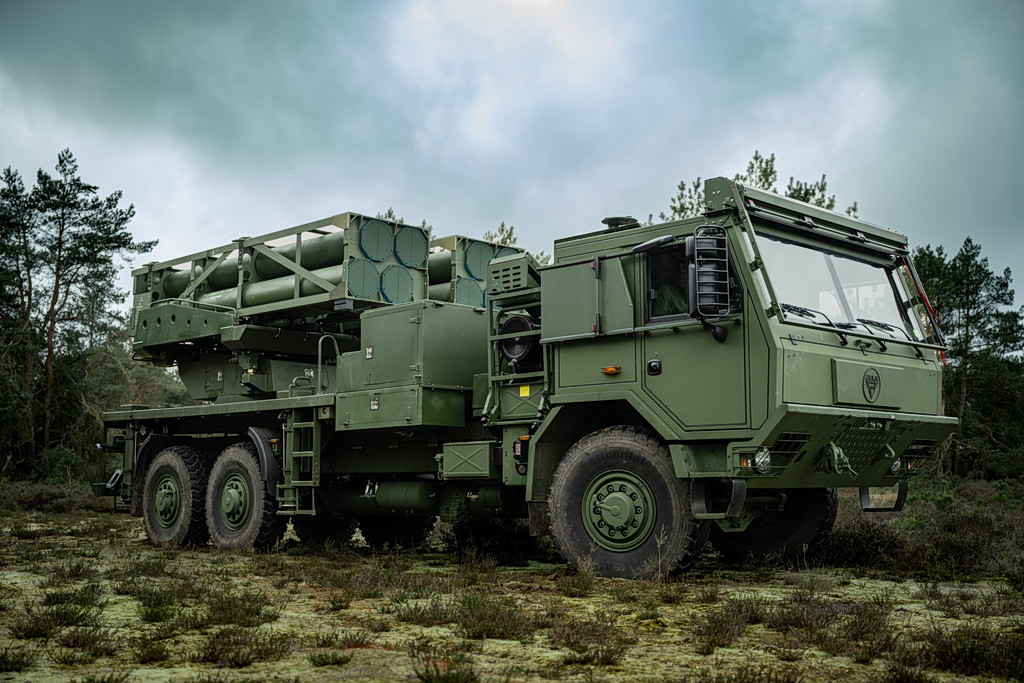
A PULS rocket launcher.
Greece-Israel Air Force exercises south of Crete
There are also more frequent bilateral air-to-air refueling exercises in the Mediterranean, south of Crete. Crucial for long-distance operations, they help build inter-operability for prospective future missions, while also underlining the two countries’ presence in the area.
“There is a benefit, because their [Israeli Air Force] extensive experience in air operations mainly involves bombing missions. Their opponents to date have not had great experience in air battles and their performance reflects this. Greece, on the other hand, has faced a strong Turkish Air Force which has staged provocations in the Aegean over the last 50 years, and developed considerable sophistication in confronting such situations,” Georgousis says.
Israeli experts say it is of substantial benefit to the Israeli Air Force to become acquainted with, and to adopt elements from, the experience of the Greek Air Force.
Cooperation between defense industries
The bilateral cooperation that has developed between the Hellenic defense industry and its Israeli counterpart alongside the collaboration between the respective defense ministries is also considered positive.
“Defense industry research in Israel is at a very high level, and the Greek defense industry needs that. Many Greek firms collaborate in joint programs in modern technologies in various sectors. The Israeli defense industry has made investments in Greece. Intracom Defense (IDE) was bought out by Israel Aerospace Industries (IAI)],” Georgousis notes.
IDE continues to operate as a Greek defense company specializing in missile launchers, missile subsystems, tactical land and sea communications, and hybrid power systems.
The objective now is to develop more joint defense programs.
Trilateral cooperation not hostile toward Turkey
“One should note here that the trilateral strategic defense collaboration, as well as the related cooperation with Egypt, does not aim to diminish the power of any other regional country. These democracies seek to defend their interests in the framework of their rights under international law and the Law of the Sea [UNCLOS]. For example, both Israel and Cyprus reached an agreement with Lebanon through joint acceptance of the principles of international law. The country that is projecting a different stance is Turkey, which must adjust so that we can have good neighborly relations, which all three countries are seeking in energy and other sectors,” Georgousis says.
Mutual geostrategic benefits for Greece, Israel
The Greece-Israel strategic partnership entails geopolitical benefits for both countries, but also requires caution, according to Ioannis Grigoriadis, Associate Professor of Political Science at Ankara’s Bilkent University.
“Following the sharp deterioration of Israeli-Turkish relations, Israel has found in Greece a strategic alternative offering substantial security and economic benefits. For its part, Greece has managed to reassert itself in the Middle East and strengthen its position in the Eastern Mediterranean through deepening its relations with Israel,” he told TO BHMA International Edition in a statement.
Ankara’s concerns over ‘Anti-Turkish’ parameter
As for Turkey’s reaction to the December meeting of the Israeli, Greek and Cypriot leaders in Jerusalem, Grigoriadis notes that Ankara has longstanding concerns, which he considers grounded at times.
“Encirclement concerns have been a recurrent theme in Turkish foreign and security policy. Some trilateral initiatives over the last decade have made such normally exaggerated interpretations look plausible, as an “anti-Turkish” element could be traced,” he says.
“Trilateral or multilateral partnerships could be open-ended, as long as they serve the regional interests of all littoral states and promote regional dialogue and conflict resolution,” he asserts.
Grigoriadis discerns that the Greece-Cyprus-Israel strategic partnership is already affecting balances in the Eastern Mediterranean, but notes that the duration of any shift is unclear.
“While this partnership has already helped shift the strategic balance in the Mediterranean, its medium- and long-term prospects will hinge upon Turkey’s position in the Western security architecture as well as on whether Israeli-Turkish rapprochement is possible in a post-Erdogan and post-Netanyahu era,” he says.
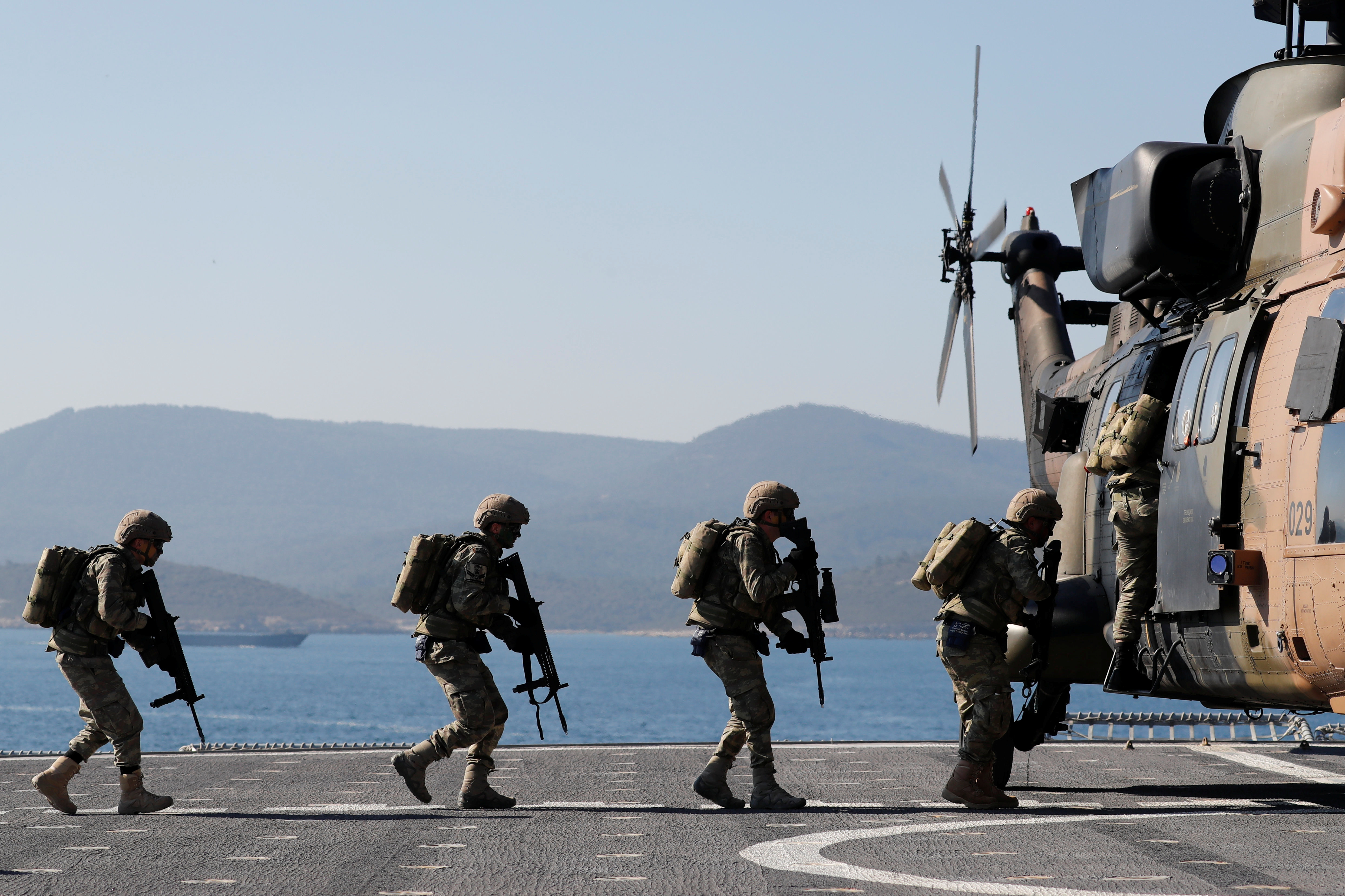
Turkish marines on board the TCG Bayraktar (L-402) take part in a landing drill during the Blue Homeland naval exercise off the Aegean coastal town of Foca in Izmir Bay, Turkey March 5, 2019. REUTERS/Murad Sezer
US factor in Greece-Israel Ties: relations with Turkey paramount
Pavlos Apostolidis, a prominent retired ambassador who has served as Counselor at the Greek embassy in Ankara, General Secretary of the Hellenic Foreign Ministry, and later Director-General of Greece’s National Intelligence Service (1999-2004), views the Greece-Israel strategic partnership as relating to Greece’s relations with both the United States and Turkey.
“We seek good relations with the US, and Israel is related to that framework. By maintaining good relations with Israel, we improve our ties with the US. Beyond that, good relations with Israel help us handle the difficulties we have with Turkey, especially at sea, in the Aegean and the Mediterranean,” Apostolidis tells TO BHMA International Edition.
Caution over impact on Greek-Turkish relations
“I’m not certain that until now this has helped us vis a vis Turkey in particular. If it regards Greece-Cyprus-Israel mutual assistance, that automatically creates a greater opposition with Turkey. It indicates that we are taking a clear stance against them,” he asserts.
Apostolidis says that Turkey’s annoyance over last December’s Greece-Cyprus-Israel summit was because “it was obvious that an alliance against them was being exhibited.”
“It’s quite simple. I understand why they reacted. Having worked for many years either in Turkey or in foreign ministry directorates related to Cyprus, I believe firstly we should be pursuing a good relationship with Turkey.”
Growth of Greece-Israel trade, economic ties
One area of Greece-Israel relations that is undoubtedly a win-win situation is the expansion and deepening of trade ties, as Konstantinos Kostopoulos, the legal counsel of the Greek-Israeli Chamber of Commerce and Technology, explains.
“Trade relations between Greece and Israel today cover a wide range of sectors, reflecting the overall deepening of bilateral economic ties. Trade in goods continues to play a central role, with particular emphasis on energy products and petroleum derivatives, industrial and chemical products, as well as food and beverages,” says Kostopoulos.
There has also been a notable increase in Israeli investments in Greece, mainly in tourism real estate, infrastructure, and technology.
Over the past five years, the overall volume of bilateral trade has increased, with steady growth in both Greek exports and imports from Israel.
“Cooperation has gradually shifted from traditional sectors of lower added value toward more complex and specialized goods and services,” Kostopoulos notes, adding that ties in the defense sector have developed at all levels through mutual agreements, positively affecting growth through companies operating in both states.
Future vistas for economic ties
He also sees many future opportunities for collaboration with Israel’s strong research and startup ecosystem, dovetailing with Greece’s position within the European Union and its highly skilled human capital.
“This creates conditions for cooperation in areas such as cybersecurity, artificial intelligence, digital health, financial technologies, and agrotechnology. At the same time, there is strong growth potential in energy, the green transition, and sustainable agriculture,” the Greek-Israeli Chamber counsel concludes.