

In a pivotal move to preserve a lesser-known chapter of the Holocaust in Greece, the Hellenic Ministry of Culture has assumed control of the railway station and surrounding grounds of Karia (also spelled as Karya) in Fthiotida, Central Greece.
The area has been officially ceded to the Greek Ministry of Culture by GAIOSE, the public utility company that manages the Greek railway system’s massive real estate portfolio and rolling stock (trains and carriages). This move marks the critical first step toward restoring the site.
This decision, following the positive opinion of the Central Council of Modern Monuments, recognizes Karia not merely as a railway infrastructure but as a stark monument to the brutality of Nazism and a vital component of collective historical memory, both Greek and global.
The Ministry of Culture has already initiated the necessary studies to transform the building complex into a visitable historical landmark. The goal is to create a ‘documented space of memory,’ ensuring that the site serves as a testament to historical truth and human dignity for future generations.
Karia Railway Station: A site of “extermination through forced labor”
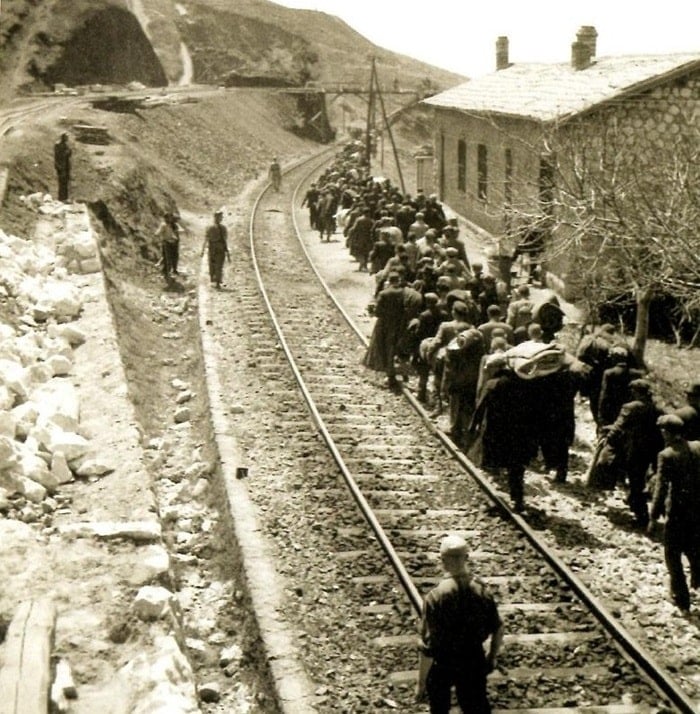
During World War II, the Karia Railway Station became a site of horrific forced labor under the command of the German Organization Todt. Despite being in the Italian occupation zone, Germany held full control of the railway network, and Karia’s strategic location near Lianokladi, a crucial sorting station on the Athens-Thessaloniki route, made it invaluable for Nazi logistical operations.
In 1943, between 300 and 500 Jewish men from the Thessaloniki ghetto were transported to Karia. These individuals, already suffering from extreme deprivation, were forced to undertake the arduous task of carving a bypass railway section—a daunting 100-meter-long, 20-meter-deep cut into a rocky mountainside—to facilitate the transport of raw materials and military forces for the German army.
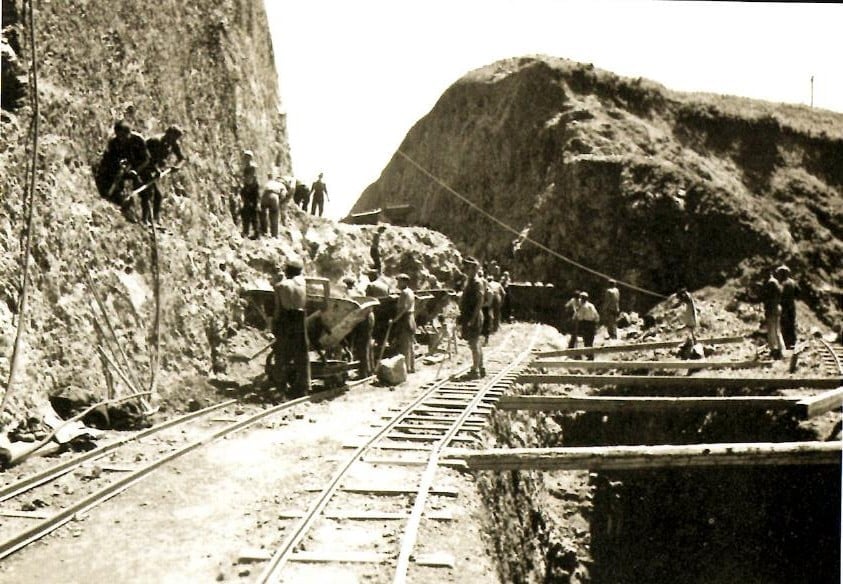
The construction site was closed and fenced off. The Jewish forced laborers were obligated to work all day in two grueling twelve-hour shifts. They lived in two cramped wooden dormitories, received minimal food, and almost no water. Lacking proper tools, most of the digging was done with picks, shovels, and bare hands, as compressors were scarce. Guards and foremen mercilessly beat or even killed in cold blood anyone who failed to work fast enough.
Minister of Culture Lina Mendoni emphasized the site’s grim significance: “Karia is a place of forced labor and a testimony to the Holocaust in Greece. It is one of the places where the Nazis implemented the policy of ‘extermination of Jews through forced labor.’” Most of the survivors who were taken back to Thessaloniki and from there deported to Auschwitz in August 1943 were already exhausted, emaciated, and sick.
The sheer brutality of the guards combined with the extreme difficulty of the task—literally cutting down an entire mountain—makes Karia an exemplary, chilling case of the Nazi doctrine of “extermination through labor” by both Greek and European standards.
The Rössler photographic archive
The designation of Karia as a historical site relies heavily on compelling evidence from an international research project, “Deadly Forced Labor in Karia—German Occupation and the Holocaust in Greece.” This project, a collaboration between the University of Osnabrück, the Documentation Center for Nazi Forced Labor, and the Memorial for the Murdered Jews of Europe, was instrumental in bringing this largely unknown history to light.
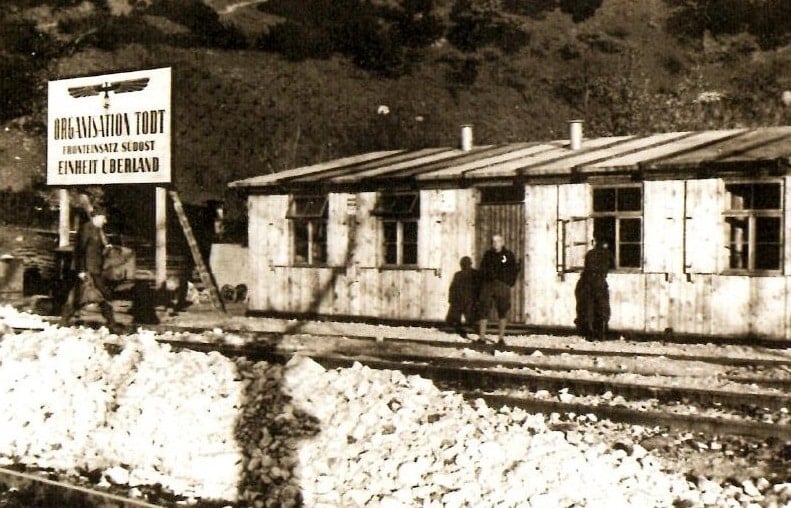
Central to their findings is the extraordinary photographic archive of German engineer Hans Hermann Rössler. Rescued in 2002 by Andreas Assael, the son of a Holocaust survivor, this rare collection provides irrefutable visual documentation of the atrocious conditions endured by hundreds of Greek Jews at the Karia construction site in 1943.
The research program further identified material remains and other tangible traces of the construction site and the living conditions of the Jewish forced laborers. An on-site autopsy by the Hellenic Ministry of Culture’s competent service confirmed the historical authenticity of the Karia Railway Station area.
Preserving memory at Karia Railway Station
“The Ministry of Culture, with this decision, as well as with the support of the joint exhibition organized in Athens and Berlin a year ago, dedicated to the forced labor of Greek Jews during the German occupation, recognizes the events in Karia and pays tribute to the victims of Nazi forced labor in Greece,” stated Minister Mendoni.
Today, only a stone building and a well survive from the original construction site; the wooden barracks used by the Nazis were removed by guerrillas after the works’ completion and the site’s abandonment. However, the prominent rocky cut itself stands as a “timeless testimony to the ‘extermination through labor’ implemented by the Nazis in Karia.”
This space will serve to “preserve and highlight the memory of those who were victims of the hatred and atrocities of the Nazis,” ensuring that this painful but important chapter of history is never forgotten, Mendoni said.