

Greece is entering a new era of political turbulence. Scandals, governance failures, and voter frustration are shaking established leaders like Kyriakos Mitsotakis, while speculation grows over Alexis Tsipras’ potential return. The latest Interview poll, published on August 26, shows New Democracy plunging to 21.4 percent, Syriza languishing at 3.7 percent, and a staggering 43 percent of voters responding “none of the above” when asked who is most suitable for prime minister.
The global financial crash of the late 2010s redefined party dynamics, eroding the once-dominant PASOK and weakening New Democracy, while propelling the left-wing Syriza from a marginal force to government. Today, however, Greece appears headed into a new kind of political turbulence—one rooted less in economic collapse and more in governance scandals, which are eroding trust and reshaping leadership dynamics.
The first signs of this new wave emerged in the 2023 national elections, when New Democracy secured a decisive 41 percent victory, granting Mitsotakis a strong mandate. The opposition, meanwhile, floundered, with Syriza collapsing to just 17 percent. Yet within a year, the political balance began shifting dramatically. By the June 2024 European elections, New Democracy had already lost significant ground, and the decline continued into the summer of 2025.
Scandals eroding New Democracy’s credibility
The credibility of Mitsotakis’ government has been shaken by successive controversies, each adding to a growing sense of distrust. These include the:
-
OPEKEPE farm subsidy scandal
One of the most damaging scandals emerged within OPEKEPE (Payment and Control Agency for Guidance and Guarantee of Agricultural Payments), Greece’s farm subsidy agency.
Investigations by the European Public Prosecutor’s Office (EPPO) revealed fraudulent EU fund disbursements tied to fictitious land leases and nonexistent livestock. High-ranking figures in New Democracy, including former Agriculture Ministers Makis Voridis and Lefteris Avgenakis, were implicated.
Under mounting pressure, Voridis resigned as Migration and Asylum Minister in June 2025, a position he had held since June 2023. Mitsotakis admitted systemic failure, dissolved OPEKEPE, and promised institutional reforms, but the damage to his party’s credibility was severe.
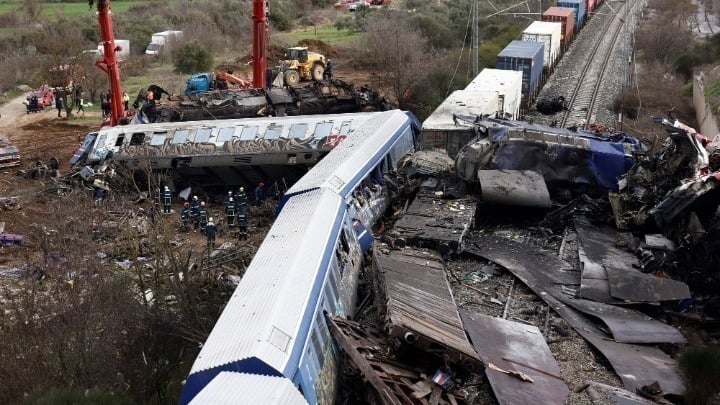
The February 2023 Tempi train crash remains a political wound that refuses to heal. Public anger was intensified not only by the tragedy itself but also by accusations of negligence, delayed safety measures, and suspicions of a government cover-up.
Protests and calls for accountability have kept the issue alive, symbolizing what critics call the state’s systemic failure to prioritize public safety.
-
Surveillance scandal, or “Predatorgate”
Perhaps most damaging to the perception of democratic integrity was the 2022 spyware scandal. Known as Predatorgate, it exposed illegal surveillance by Greece’s intelligence service (EYP) targeting politicians, journalists, and public figures.
The scandal triggered international condemnation and continues to undermine confidence in government transparency and respect for democratic freedoms.
The polls: Collapse of support for Mitsotakis
The latest Interview poll, published on August 26, 2025, illustrates the severity of New Democracy’s slump. The governing party fell to 21.4 percent, down nearly five points from June’s 25.9 percent.
Other parties have yet to capitalize decisively: PASOK polls at 12.2 percent, Elliniki Lysi at 8.4 percent, Plefsi Eleftherias at 8.3 percent, and the Communist Party (KKE) at 6.5 percent. Syriza, once Greece’s main opposition, languishes at just 3.7 percent.
More telling is the poll’s projection of electoral outcomes, with New Democracy at 25.9 percent, PASOK at 14.8 percent, Plefsi Eleftherias at 10 percent, Elliniki Lysi at 10.1 percent, and Syriza at 4.5 percent.
Perhaps the most striking finding concerns leadership. When asked who is more suitable for prime minister, Kyriakos Mitsotakis scored 31 percent and Alexis Tsipras (currently not active in politics) 26 percent, while a staggering 43 percent responded “none of the above.”
This data signals widespread disillusionment—not just with the current government but with Greece’s political class as a whole.
The possible return of Alexis Tsipras, with polls showing him nearly tied with Mitsotakis
Although Alexis Tsipras stepped away from active politics after Syriza’s crushing defeat in 2023, speculation of a comeback has intensified. The latest polling shows him nearly neck-and-neck with Mitsotakis in leadership preference.
While his overall party remains weak, Tsipras’ personal brand still resonates with segments of the electorate, particularly those seeking an alternative to the current government but disillusioned with fragmented opposition parties.
For Tsipras, reentering the political arena could transform the landscape. His return would not only consolidate Syriza’s base but also potentially unify a fractured left. However, skeptics argue that his leadership could revive old divisions and challenges, especially after his turbulent governance during the bailout years.
Still, in the absence of a strong opposition figure, Tsipras remains the most viable contender capable of destabilizing Mitsotakis’ dominance.
The Thessaloniki International Fair: Mitsotakis’ “checkmate” moment
Despite the downturn, Mitsotakis retains a potential lifeline: the Thessaloniki International Fair (TIF). Traditionally a platform for economic promises and policy resets, the event could become a pivotal stage for the Prime Minister to regain momentum—or risk further political decline.
According to government insiders, Mitsotakis’ speech will focus on the middle class, a demographic feeling the squeeze of inflation and stagnation. The key measures under preparation include:
- Tax relief: Adjustments to income tax brackets to ease the burden on middle-income households, particularly between €10,000 ($11,590) and €20,000 ($23,180) and above €40,000 ($46,350).
- Family support: Higher tax-free thresholds for families with children, alongside increased allowances for voluntary employer benefits.
- Fairer taxation for freelancers: New criteria for more equitable imputed taxation of self-employed workers.
- Pensions: Elimination of the remaining “personal difference” for 600,000 pre-2016 retirees, plus expansion of the €250 (around $285) annual support bonus.
- Wage increases for armed forces and police: Salary hikes of up to 20 percent for military personnel and security services.
If delivered convincingly, these measures could help Mitsotakis lift New Democracy closer to 30 percent in the polls, stabilizing his leadership. Yet the stakes are high, and failure to persuade could embolden both Tsipras and other contenders, deepening the crisis.
A political chessboard in flux
Greece is entering a period of heightened political uncertainty. New Democracy’s credibility has been shaken by scandals and governance failures. Tsipras, despite past defeats, is reemerging as a credible contender, his proximity to Mitsotakis in leadership polls underscoring widespread voter disillusionment.
The Thessaloniki International Fair now looms as a potential “checkmate” moment—either Mitsotakis reasserts control through bold economic promises, or the opposition gains space to reshape the country’s political trajectory.
In this fragile climate, the real question is not simply who will govern next but whether Greek politics can restore trust in a system where the majority of citizens currently see no suitable leader at all.