
I’ve spent the past few days writing about the EU’s 20th sanctions package, which makes an important break from the past by moving to ban Western oil tankers from transporting Russian oil. This is a break because the EU has up until now been trying to shut down the shadow fleet, an effort that failed because the Trump administration refused to join in sanctioning shadow fleet ships.
Prohibiting Western oil tankers from transporting Russian oil will certainly cause headaches in Moscow. In the Baltic, these ships are up to 30 percent of capacity and are almost entirely Greek-owned. Bloomberg yesterday reported that Greece is now opposing the 20th sanctions package because of its ban on Western oil tankers. This continues a pattern whereby Greece has opposed any effort to control Russia’s access to global energy markets, starting with negotiations to agree the G7 price cap in 2022.
This post details this pattern of obstruction by Greece. It so happens that a few Greek shipping oligarchs control a huge number of oil tankers. These oligarchs exert a lot of power in Greece and de facto control the government. Its current efforts to block the 20th sanctions package are just a continuation of obstruction at the behest of these oligarchs. Needless to say, this highlights a deep governance crisis inside the EU. You can’t hope to counter external threats like Russia if foreign policy decisions require unanimity, which gives Greece and its shipping oligarchs a de facto veto.
Greece has acted on behalf of its shipping oligarchs and to the detriment of the rest of Europe and Ukraine on two occasions. First, the key variable in the G7 price cap is the level of the cap. Countries like Poland and the Baltics wanted to set this cap low – say around $30 per barrel – which would have hurt Russia a great deal. However, when the cap was officially announced in December 2022, it was set at $60 per barrel, the result of Greek lobbying on behalf of its shipping oligarchs who feared a low cap would disrupt their ability to transport Russian oil.
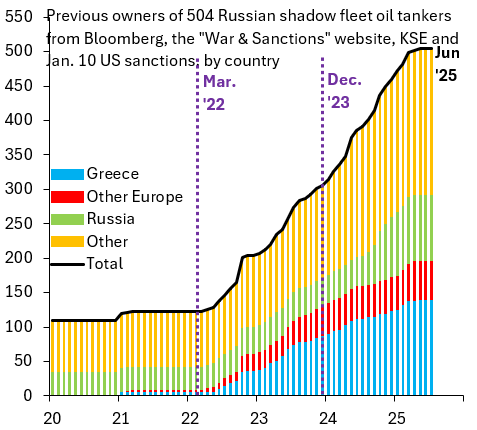
Second, Greek shipping oligarchs sold lots of oil tankers to Putin for his shadow fleet. The chart above is from a blog post I did last year with Ben Harris, which shows that many oil tankers were sold to the shadow fleet by Greece’s oligarchs, even after the 12th sanctions package in December 2023 tried to clamp down on such sales to the shadow fleet. So not only did Greece help Russia by pushing for a high and thus ineffective cap. It also fatally undermined the cap by providing Russia with shipping capacity to operate outside the G7 cap.
Greece’s opposition to the 20th sanctions package is therefore no surprise. It continues a pattern of obstruction that goes back to right after the invasion. The only question really is for how long the rest of the EU decides to go along with this. It just can’t be appropriate for Greek shipping oligarchs to have a de facto veto in Brussels. That must end if the EU wants to become a credible foreign policy actor.