
Gringo Custum
Gallery / 19 images
At the heart of Gringo Custum is two friends: Neguin and Yan. The pair founded the brand in 2022 shortly after arriving in Senegal from Gabon. Neguin is the designer, a jack-of-all-trades always on the lookout for anything slightly quirky, who basically just wanted to dress differently. Yan’s his safe guy, a more discreet type, in charge of management alongside the coordinator, Harry, the brand’s third figure, who introduced us.
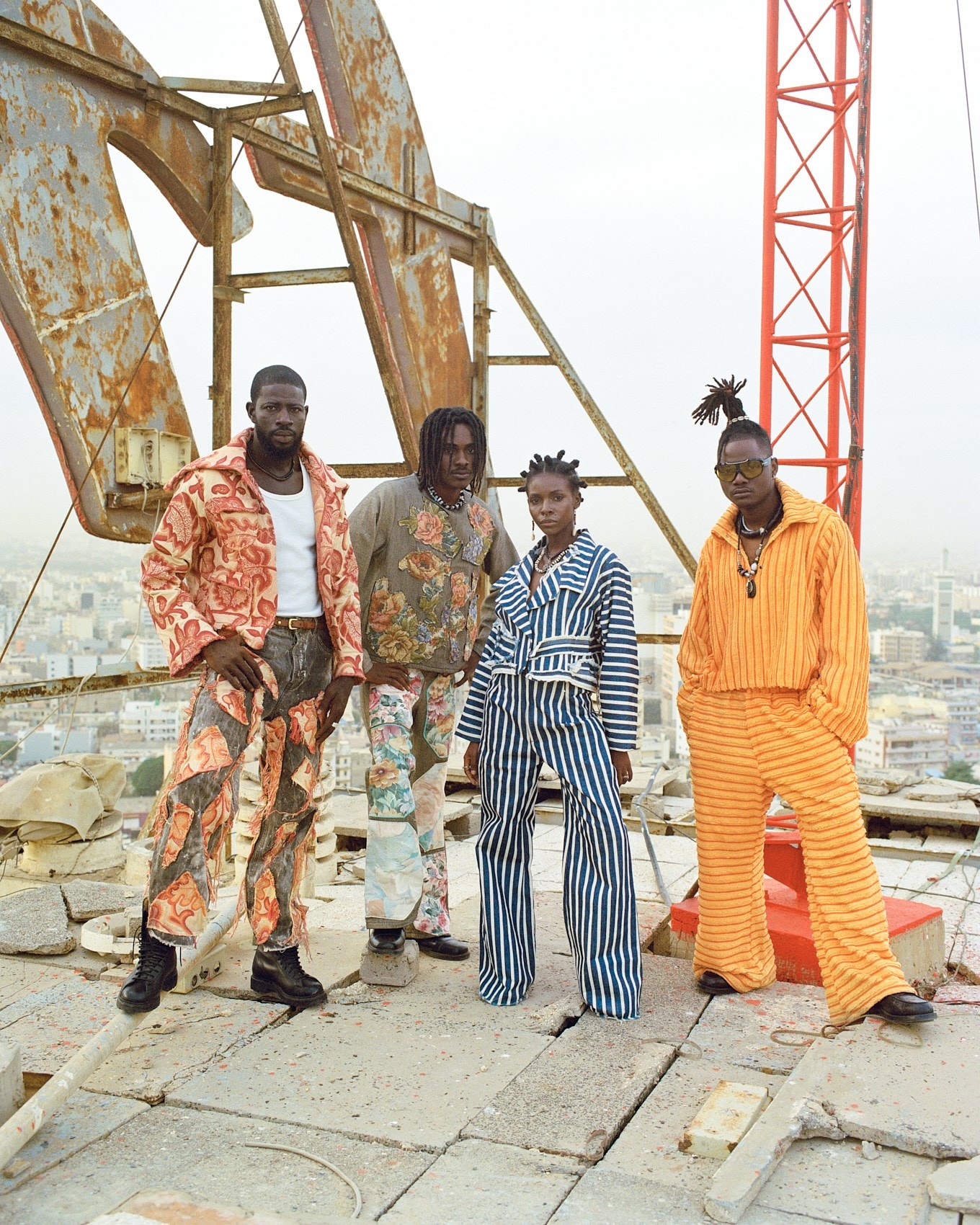
Gringo is a very specific creative process. Using patching and upcycling techniques that make each piece a unique product, Neguin checks, cuts and reconstructs. No patterns, no sketching. Everything’s conceived and assembled on the spot before being handed over to Moussa, the couturier. It’s a very intuitive process, closer to that of a visual artist than a fashion designer – as Neguin says, clothing is a medium of artistic expression he practices like painting, or video, which makes his designs almost performative statement pieces, whether day or evening wear. They border on costume; they need to be lived and incarnated with attitude, like a fictional character or a punk.
Gringo is definitely a punk state of mind – not just in its DIY approach but also in its relationship to marginality. Neguin’s vision depicts the gringo as an outsider who is one with his world, yet fails to go unnoticed. It’s all eye-catching colours, pattern games, textile collages, an instantly recognisable yet paradoxically isolated look – all the while firmly occupying the centre of attention. Neguin diverts the trope of the stranger and reclaims it with an exaggerated eccentricity, wanting to make the gringo ever more visible, ever more audacious. That’s the brand’s essence: the need to be together, and yet apart. In the end, when you wear Gringo, you’re in the crew. You belong – and wherever you are, you aren’t alone.

Can you tell us a bit about your background, and how you got to where you are today?
Neguin Yembas: What started it all for me was just wanting to be myself. When I arrived in Senegal in 2019 to study, I didn’t necessarily set out to start a brand, but I wanted to dress differently. That’s what really pushed me to create my own designs. And in 2022, seeing people start to appreciate it here and there, I started to make it for profit. I said to myself, ‘Why not really focus on it? It could lead somewhere.’
So where does your interest in fashion come from?
Neguin Yembas: I don’t think I have a particular interest in fashion, as I’m not just into clothes. It’s more art that interests me, in a general sense. In the end, it’s cultural. I don’t necessarily go around saying this, but I have Congolese origins and I think for a lot of people the Congo is a very cultural country, geared towards everything – that’s garms, vintage culture. So I always got a kick out of seeing my dad dressed up in suits and stuff like that, and I started to dig style from a very early age.
That’s what led you to create Gringo, to share this world, because people were into it?
Neguin Yembas: Gringo is really an intergenerational identity that speaks to everyone. Old people who wear the brand, young people, and some kids appreciate the work. Not everyone can access the garment or wear it, given Senegal’s locality and climate, but seeing older people appreciate the garments speaks to me – that’s the most important thing.
“Gringo was a way of defining my personality. If you look at the meaning, a gringo is a foreigner and when I arrived in Senegal I really felt like a foreigner in everything I did”
Can you expand on the Gringo identity – why did you choose the name and what do you mean by it?
Neguin Yembas: Gringo, in a nutshell, was a way of defining my personality. If you look at the meaning, a gringo is a foreigner, and when I arrived in Senegal, I really felt like a foreigner in everything I did. So it’s more a state of mind I’ve adapted to what I’m wearing. You really recognise Gringo by the fabrics, the cuts, the extravagance, its avant-gardism. Which makes it easy to get attached to the look. And I think that’s what gave me the strength to really be different and really assert that identity.
As an outsider who’s also Gabonese, how do people in Dakar perceive your creations – this sense of marginality won’t necessarily please everyone?
Neguin Yembas: We see the work is well-received. We’ve got all kinds of clients: artists, public figures, fathers, businessmen. It’s more the prejudices that people have in the street, actually. I’ve sometimes been the victim of stuff, of harassment, where I’d get somewhat homophobic insults about my style. For them, such and such fabric is feminine, such and such textile is pretty weird.
We need to remember Senegalese culture’s relationship to religion, which can also limit artistic opinion. When I started working on my brand, I motivated people and inspired them to be themselves. A lot of people have contacted me on the down low to find out where I buy and who makes my pieces. That means they’re interested. You can see the results of the brand – you can see that we’re evolving, we’re being appreciated!

You’re very much into the patchwork and upcycling aesthetic. Is there a premise behind this way of conceiving clothing?
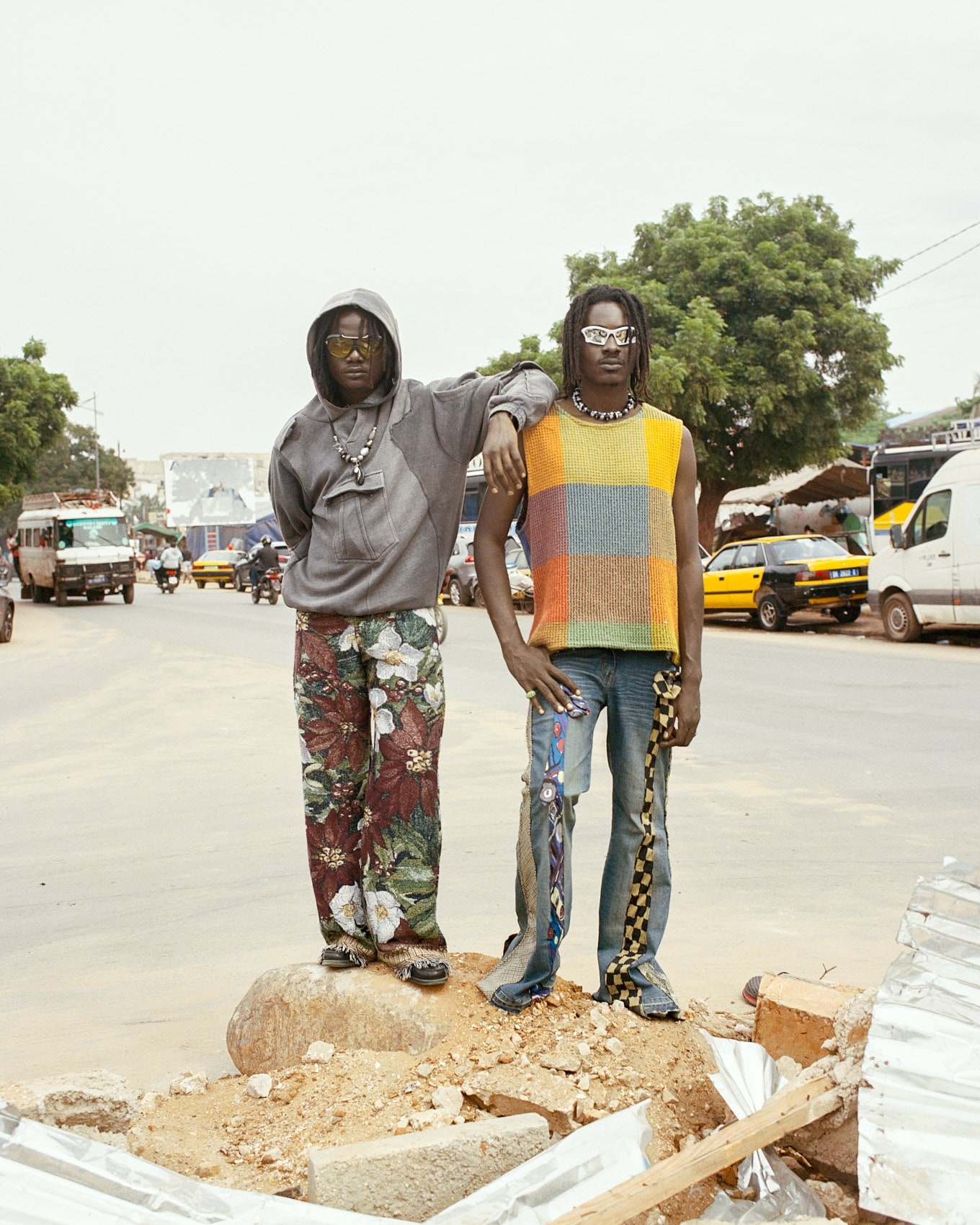
Neguin Yembas: For me, it all starts when I walk down the street. It’s not any particular place – I tell myself that anything can bring me something. I might find something with a street vendor and put the fabric aside. I might find a piece and put it aside. Then, when I see the fabric, I sit with it, it speaks to me. And the thing to emphasise is that I don’t draw my pieces. I make them on the spot. That’s also what makes the brand so special: we’ve never made any sketches.
As opposed to designers of a previous generation who are still pretty focused on the “Grand Boubou” [the best-known traditional African garment] or other archetypes, you make clothes that are warm, that aren’t necessarily adapted to the climate here. How do your clothes maintain an international influence, while still claiming a certain African-ness?
Neguin Yembas: The super afro side, it’s really the environment. Because in my campaigns, I share a lot of the African ecosystem – this kind of ghetto, urban side. I’m not really into luxury, even if I can do luxury pieces. I don’t really want to show myself in a world that isn’t mine. I’m not going to sell something that I don’t live. I sell my pieces in an environment that I know, that I master and which I inhabit.
Even the fabrics I use aren’t all imported. Some of them have been made here by hand. We’re an avant-garde, Afrofuturist brand. That’s to say that we go beyond cultural codes, which is why people from elsewhere, people like you, are interested. Whether you’re African, European or Asian, you can find yourself in the pieces. It means you’re showcasing something that doesn’t necessarily come from your community, but that makes you feel good. That’s the aim of the brand, that’s the aim of the work. And it’s paying off.
“I’m not really into luxury, even if I can do luxury pieces. I don’t really want to show myself in a world that isn’t mine. I’m not going to sell something that I don’t live”
When I first came here, I did some initial curatorial research into West African thought on art and its philosophy. And I really understood textile as a means for the transmission of ancient memories.
Neguin Yembas: What people don’t know is that I’m someone who has been very much affected by life. I’ve been sick, paralysed. My brand isn’t just clothes that people come and buy just to wear. It’s first and foremost a story. I have been very alone, and it’s these things that allow me to express my feelings, my experiences, my sadness.
Because already, you’re alone as a student at home in Senegal. Not many of us will have a business or get to go to Europe for a fashion show. Not many of us will have interviews, do editorials and make clothes. They can sell or send pieces to their parents, they do a bit of business, but for me, it’s not the same.
Our final theme is Afrofuturism. Where do you stand in terms of everything we’ve discussed?
Neguin Yembas: I think Afrofuturism is actually just a way of showing Westerners that Black people can evolve in their way of doing things. What they want us to do is use Afrofuturism to link the existing idea of the future to what is African. But that’s saying that ‘futurism’ already belongs to what’s white and that ‘Afro’ is a name for us. I just define it as a way of doing things. We say Afrofuturism in an exaggerated way to describe the fact that we’re going beyond what’s being done locally. Because in terms of design, we don’t necessarily have the same means as elsewhere. As Afrofuturists, we’re obliged to show a heightened, exacerbated creativity.
Styling Neguin Yembas, Harry Jardel, make-up Thaicia, models Milo Ndour, Harry Jardel, Pulzia Nolwen, Neguin Yembas, styling assistant Maxime Delvaux, creative coordinator Nathan Pietrelle, backstage photographer Alain Dramé, press and media relations Sydney Diack