
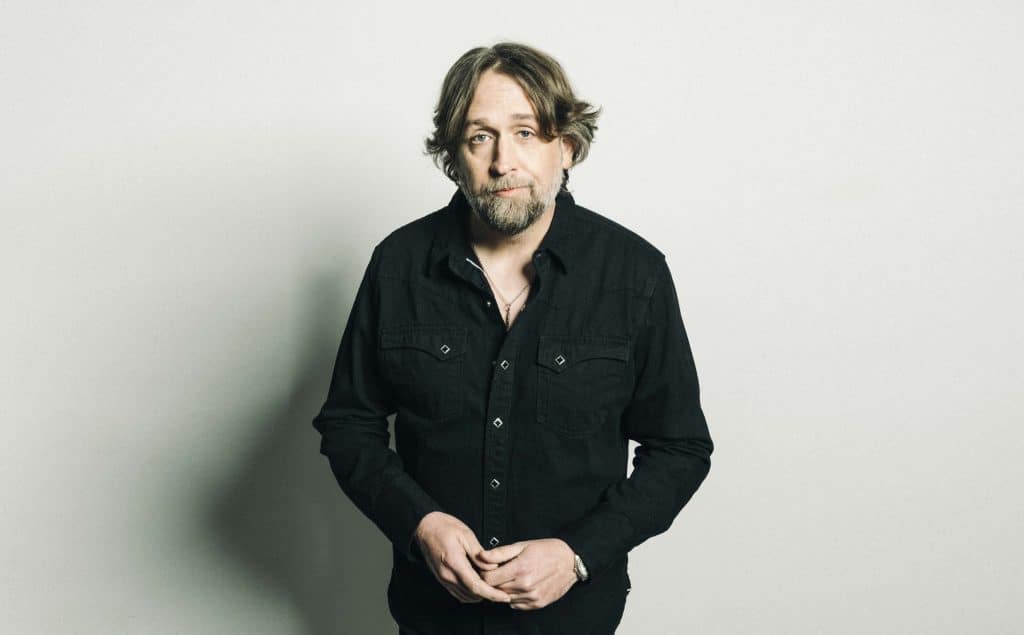
Over the past couple of years, Hayes Carll began to reflect on the discomfort that had long accompanied him on his path, leaving him feeling restless and detached even as he experienced personal and professional success.
“I have an amazing life, and it just kept hitting me that I wasn’t enjoying it or appreciating it in the way I thought I should,” the Texas-born singer and songwriter said in a late October phone interview. “And at a certain point, I realized there was nobody to blame for that but myself, because I had the ingredients to make it there. … I’m turning 50 in a couple months, my second marriage ended last year, my son’s turning 22, about to graduate from college, and it felt like I needed to face up to the things I was struggling with, I needed to do the work now. And that sort of became the most important thing in my life, trying to find some peace and happiness in the time that I have.”
Carll documents this search on We’re Only Human, from 2025, an introspective, deeply felt record that finds the musician homing in on concepts that can be in short supply in this era, such as grace, patience, and a willingness to accept that all of us are in some way a work in progress. On “Stay Here Awhile,” an acoustic country ballad, Carll sings of slowing his body to give his mind the time and space to wander (“I spent so long climbing the hill/But I only started moving when I got still”), while the loping “What I Will Be” finds him leaning into the flaws that make him human. “I’m gonna tell this old world I’m done with pretending,” he sings in a light rasp, buoyed by a lush bed of acoustic guitar, pedal steel, and piano. “From here until the end, I’m gonna be what I will be.”
Prior to beginning work on the songs that would become We’re Only Human, Carll said he focused on meditating and keeping a journal, working to slow a racing mind that he compared with “a snow globe, because it’s always shaken up.” In making a concentrated effort to finally let these thoughts settle, the musician began to view his internal world with degrees more clarity. And within that clarity, he found that he had lost his appetite for the more character-based songs with which he’d long made his trade.
“There was a quote by Todd Snider where he said something like, ‘I don’t write these songs to change anybody’s mind, I write them to ease my own,’” Carll said. “And I always loved that quote, but I also realized it was something I’d never done creatively. And I was never really working through anything in my songs. And it’s not that you need to, but for the first time in my life, I felt the desire to do so. And once I started doing that for a stretch of time, I didn’t have a desire to do anything else.”
Part of this inward turn can be traced to the early Covid months, which forced the lifelong musician off the road for an extended stretch for the first time since his early 20s. “I’d never really been home for a long enough stretch to have a dog, to know my neighbors, to build and cultivate friendships,” said Carll, whose return to the road includes a Columbus stop at A&R Music Bar on Thursday, Nov. 13. “And that time off, where my job sort of disappeared, it helped me reconnect with my love of music and gave me a real appreciation for the blessings I did have in my life. And I think, also, it made me really aware in a way I hadn’t been how quickly it’s all moving. And it had me asking, what does your life consist of? Is it career? Is it family? Is it friendships? Finances? Internal peace? And it had me reflecting in a way I hadn’t in the past, which I suppose a lot of time alone will do to you.”
Prior to the forced downtime, Carll said he’d entered into something of a rut, where the career he began to pursue out of an overriding passion for music – a form he said beginning as a teenager helped him to articulate his emotions and forge an identity – started to at times feel like a grind.
“It was still exciting and fulfilling in a lot of ways,” he said. “But it starts to become a different thing when you’re trying to entertain people and you’re thinking about perception and worrying about the business side of it and comparing yourself to other people career-wise. All of these other things come into your head.”
Release arrived unexpectedly when Carll began to livestream early in the pandemic, quickly realizing that even his own sizeable catalog wouldn’t be enough to sustain these home performances. This soon led the musician to branch out and cover songs by those artists who first inspired him to pick up a guitar, including John Prine, Kris Kristofferson, Bob Dylan, and Lyle Lovett, among countless others.
“And that helped me realize, yeah, it’s my job. But the reason I got into it is the love of it and the feelings it brought to me to write and to sing and to express myself,” said Carll, who in that time also connected with his audience in ways he hadn’t previously, exchanging stories with streamers about the songs that had helped to shape their collective existences. “And that helped remind me of the effect music can have. And it just made it feel special again, like it had a meaning and a purpose.”
The impact of these exchanges, along with the personal reckoning that helped to shape the creation of We’re Only Human, have been transformative for Carll, who allowed that he has learned to extend the same grace to others that he only recently began to grant himself.
“It made me zoom out and realize it can’t be a one-way street, and in that I find my judgmental nature is lessened a bit, where I’m able to look at people with a little more love,” said Carll, who still maintains a degree of ire for deserving targets, including “the assholes and racists” who turn up in new album track “Progress of Man,” a lacerating song rooted in the idea that plenty of us still have a ways to go. “I’m not trying to paint an everything-is-sunny-with-rainbows picture of the world. … I just choose to make my starting point as the positive, and then I can go from there and make my decisions about what I need to fight.”