
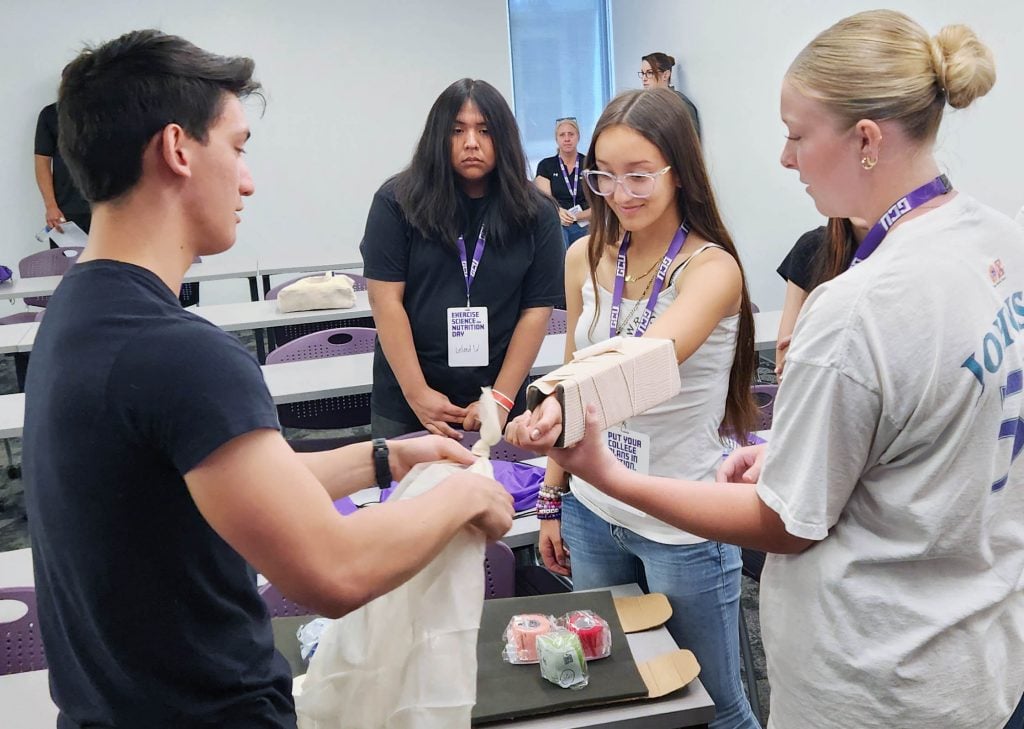
“Ahh! He’s in a lot of pain!” declares Michael McKenney, eyeing a high school student whose injured arm needs to be in a splint.
Knowing athletic trainers, he’s thinking, it’s go time. Let’s help!
But on Monday, it wasn’t the Grand Canyon University athletic training associate professor who was helping, but his students who were going in for the assist. They jumped in to show a group of high school students how to splint a volunteer patient’s simulated injury as part of the first GCU Exercise Science and Nutrition Day.
One of those students, Jerome Zito, is a pre-physical therapy major who’s headed to PT school in August.
He asked students attending the pre-athletic training skills lab, one of a dozen labs and lectures in the Catalina Building and nearby Technology Building on Exercise Science and Nutrition Day, “Can anyone tell me the key to splinting?”
The answers came fast and furious, like this one: “The splint has to be tight.”
Zito nods his head but cautions, “But you don’t want to cut off the blood flow.”
The key to splinting, if students didn’t know before the hands-on skills lab: Immobilizing the joint above and below the injury.
Then came the hands-on demonstration of taping the simulated patient’s fractured radius to a rigid device, the high schoolers in attendance watching intensely.
It was a flurry of activity repeated in every corner of the classroom as GCU athletic training students Lexi Anderson, Kaitlyn Vigil and Megan Petersen also dived right into huddled groups of aspiring athletic trainers to supervise them in splinting techniques.
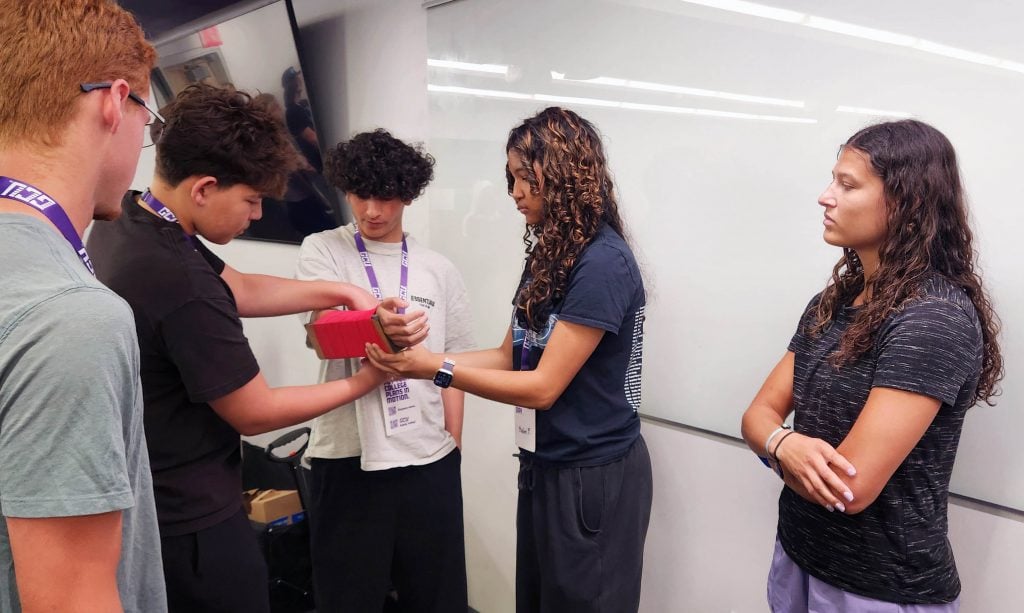
In other classrooms and labs, visitors also listened in on “Sports Nutrition 101,” made their own trail mix in the GCU Fuel Lab, or explored the occupational therapy and anatomy labs during event tours.
About 500 high school students from their schools’ sports medicine, athletic training, nutrition and similar programs were registered to attend Exercise Science and Nutrition Day, representing 14 schools and individual registrations.
College of Natural Sciences professor Dr. Cindy Seminoff, chair of the exercise, sport and nutritional sciences department, said Exercise Science and Nutrition Day is a throwback to Health Sciences Day, which the college did for many years at GCU until a little more than a decade ago.
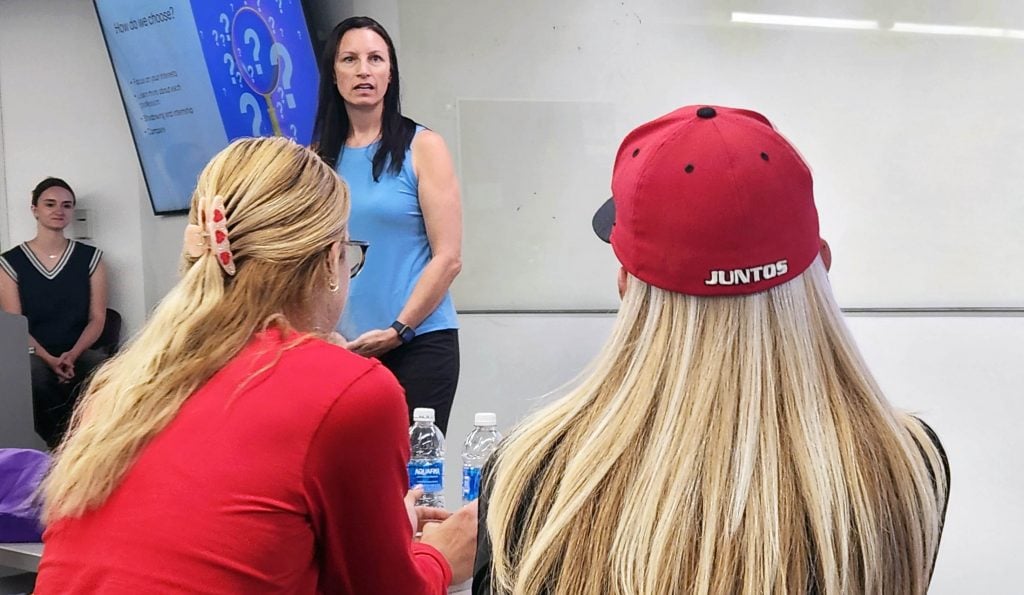
“We thought it would be a good event for local high school students to highlight our programs and the associated professions,” said Seminoff, who also led the talk “Sports Medicine Team: Who’s Who on the Health Care Team?” She fielded questions such as, “What’s the job outlook for sports psychologists?” and this one, “Can you do shadowing and internships in high school?”
Yes, absolutely you can, said Seminoff about those kinds of opportunities. Cold-calling is a good way to do that. Just start calling employers or dropping into clinics and ask if there might be an internship or shadowing opportunity for you.
“They see how interested you are. How can they turn you down?” Seminoff said.
In the classroom across the hallway, students sat in on “The Power of Food: How to Talk (and Think) About What You Eat.”
Associate professor William Kuehl asked attendees if they ate three meals a day. Not everyone’s hand shot up.
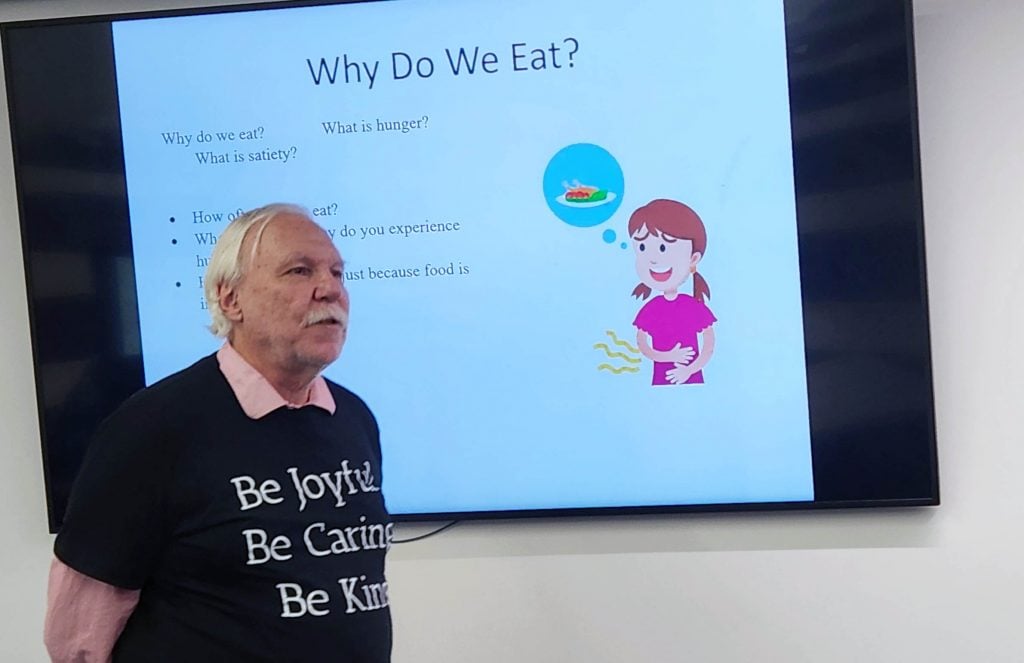
How many are snackers and graze all day? he also asked.
It’s easy to polish off a big bag of Doritos while watching TV without even realizing it.
“It’s called mindless eating,” he said.
His advice: Buy the smaller bags of chips so you don’t have access to those family-sized bags.
Another bustling area at Monday’s event was the POWER Lab, one of the campus’s slew of Lopes Live Labs, where students can get hands-on experiences in various fields of study.
The POWER Lab – it stands for Performance Optimization, Wellness and Exercise Research – is the home for CNS undergraduate research groups that focus on kinesiology, sports performance, nutrition, biomechanical analysis and wellness.
Junior Colton Reger, a POWER Lab undergraduate researcher, was one of the GCU students demonstrating the equipment in the lab.
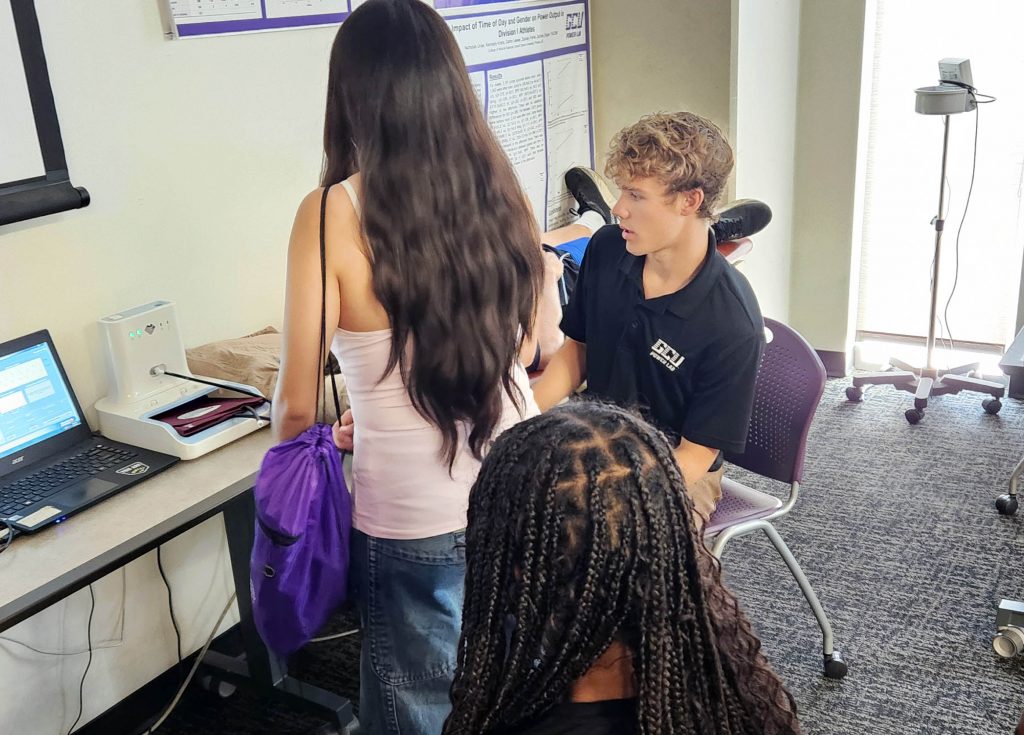
He and a fellow GCU student showed visitors something called PhysioFlow, a cardiac output monitoring system that uses six electrodes to measure electrical impedance changes in the thorax to calculate blood flow changes.
“I’ve always thought this tool, PhysioFlow, is really cool because it’s something you’d see in a movie or traditionally in a lab where you get that real-time monitoring of heart rate. Right now, it wasn’t as exciting only because he was resting,” Reger said of the GCU student volunteer with electrodes fastened to him. “But when we get someone exercising, it’s really cool to watch the adaptations the body starts making to those exercises.”
He also spoke to visiting high school students of his research on chronotypes, a person’s natural, genetically influenced inclination to sleep and be active at specific times. The thought is that aligning your schedule with your chronotype improves the quality of your sleep.
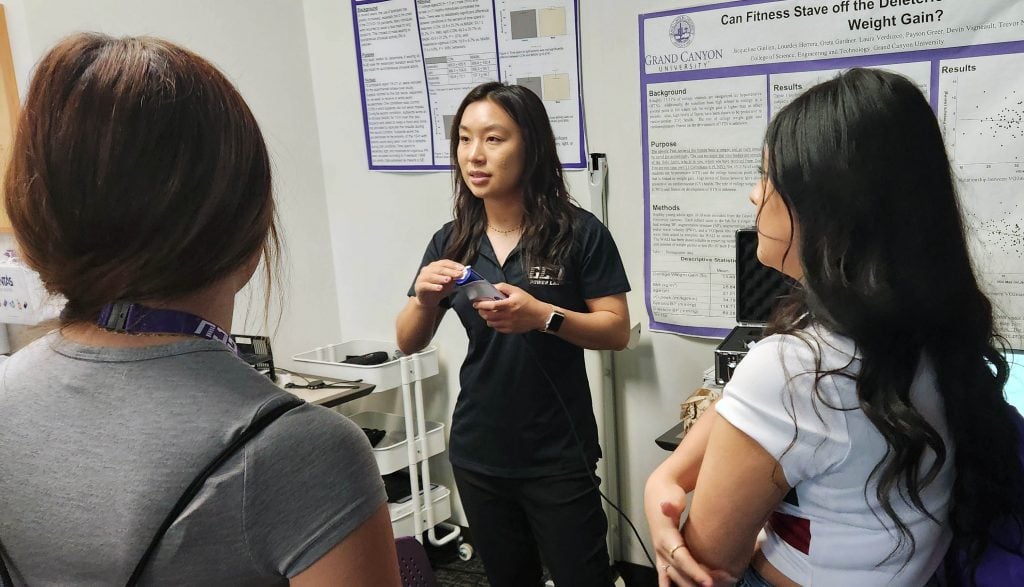
His team is researching “whether night or morning is a better time to exercise,” he said.
Reger said of Exercise Science and Nutrition Day, “It’s just a really cool opportunity to actually demonstrate what you know, because there’s been so much we’ve been taught. It’s really cool to get the experience and actually use that and help other people learn.”
Another GCU student researcher in the POWER Lab spoke of how the university’s sports medicine, athletic training and nutrition students help the university’s club sports teams, for example, by building fitness programs for them.
What was especially meaningful for Michael McKenney about this event was getting the chance to see the results of his work. Several alumni of the GCU athletic training program returned to the university on Exercise and Nutrition Day as educators, such as Chelsey Gonzalez, who teaches sports medicine at Ironwood High School in Glendale, Arizona, and brought 21 students with her.
“I see a lot of familiar faces,” said Gonzalez, who graduated from GCU in 2014. But she said she’s also “astounded by how much the campus has changed.”
“That’s my favorite part,” McKenney said. “Seeing them have the impact now. They’re just carrying it on.”
Manager of Internal Communications Lana Sweeten-Shults can be reached at [email protected] or at (602) 639-7901.